

AI Diffusion Requires Owners, Not Vendors

Long Lake's Varun Shenoy says AI diffusion is a 20-year owner-operator problem and lays out a five-rung ladder from co-pilot to co-worker.

6 min read
Varun Shenoy of Long Lake presents AI diffusion from co-pilot to co-worker on stage
Long Lake's Varun Shenoy outlines the ladder from co-pilots to AI co-workers at AI Engineer.· AI Engineer
Contents(8)

AI diffusion is a 20-year problem, not a model problem. AI Engineer host Varun Shenoy, co-founder of Long Lake, argues the models already feel like magic and the bottleneck is getting them to do economically relevant work inside real services firms.
AI Diffusion Requires Owners, Not Vendors - AI Engineer
AI Diffusion Requires Owners, Not Vendors, from AI Engineer

Long Lake has spent two years building an owner-operator test bed for that thesis. The firm has raised over $3 billion from Elad Gil, General Catalyst and AlphaWave, acquired 35 businesses across HOA and property management, architecture and HR services, and keeps roughly 40% of its team in technology, finance and operations, with more than half of that group in technology.

The electricity problem is real

Shenoy opens with a 200-person property management firm where nothing has changed. Real people, real properties, real dollars, and no AI in production.

That is normal for general-purpose technology. Electricity was demoed at Edison's Pearl Street Station Dynamo Room in Manhattan in the 1880s, but Ford's electrified moving assembly did not appear until 1924.

Diffusion required ripping out motors, buying new equipment and retraining workers. Shenoy says AI faces the same co-invention lag, and solving diffusion may be the most important work of the next two decades.

From co-pilots to co-workers: a ladder you must earn

Long Lake frames autonomy as five rungs. Co-pilot is the RAG chatbot from two years ago: fast, integrated, informational.

Synchronous agent is real-time collaboration like Claude Code or Codex, running 1 to 5 minutes with tool calls but still user-triggered.

Asynchronous agent runs in the background from a job queue and can be triggered externally, not just by the user. Long-running agent extends that to hours, days or weeks, which Shenoy calls a core problem labs are chasing now.

AI co-worker is the proactive partner everyone wants to sell. Long Lake's lesson from owning outcomes is you have to earn the right to automate more, because models are not ready for every task and trust must be built iteratively on site.

The jagged frontier hits services harder than code

The jagged frontier explains why progress is uneven. Coding is already strong, so a synchronous coding agent is just a desktop agent with file system access and instant feedback.

An asynchronous coding agent is largely solved: wrap the same agent in a sandbox, let it build and test, return a pull request. Engineers already parallelize work and accept that job seven may finish before job three.

Services work is still serial. People clear inboxes one email at a time. Long Lake spends its time on what async and forking means for property management or architecture, where the form factor changes by industry.

Shenoy lists three product questions: how to use code-trained agents for knowledge work by representing that work as code, how to parallelize traditionally serial workflows, and how to choose the right async interface per industry instead of copying the code sandbox pattern.

Real-world data is not on the internet

Frontier models trained on everything humans wrote down still fail at closing the books when receipts are missing, scoping a building from a blueprint, or coordinating roof vendors. That knowledge lives in heads, in 20-year-old software, and in a senior employee who just knows how it is done.

Long Lake's flywheel starts when agents collaborate with employees on real work. Every trace, tool call, hiccup and papercut becomes data.

Those traces produce automatically built and scored real-world evals with ground truth: did the roof get fixed, did the books close. Weekly hill-climbing benchmarks become regression tests, so agents ratchet better over time.

Three payoffs follow. First, implicit and explicit feedback, from thumbs up and down to diffs between AI-generated data and what was ultimately submitted. Second, internal post-training on data that is out-of-distribution for frontier labs, because many of these services tasks are still unsolved by base models. Third, agents customized per company, per user and per client, which services work demands.

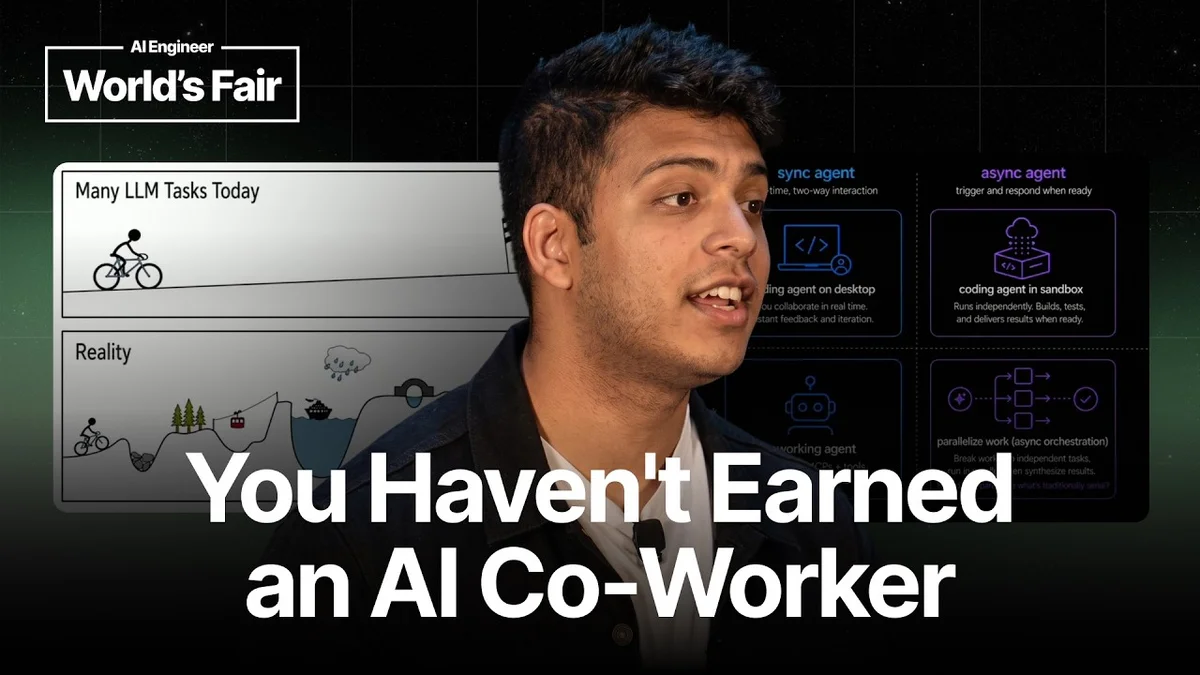
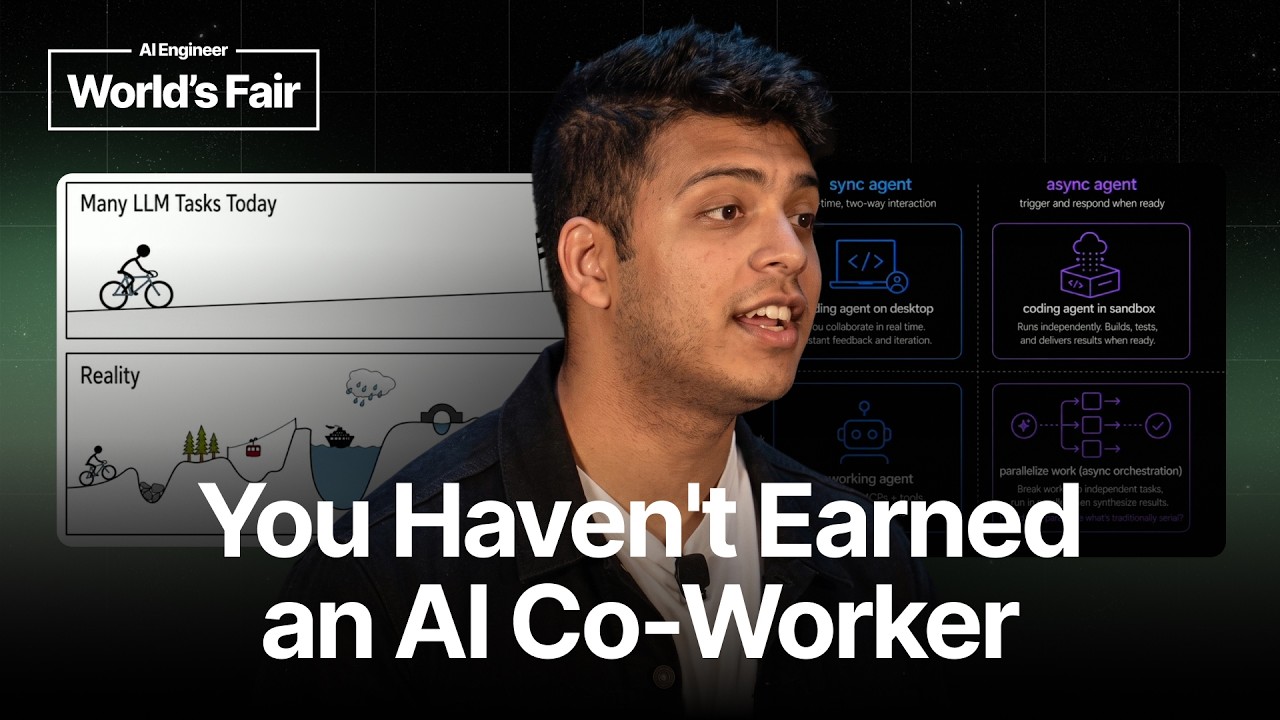
Shenoy contrasts the clean LLM demo slope with real work's hills and ravines. The exceptions are the job, and death by a thousand paper cuts is where adoption actually fails.

Learning loops fail without usage

Continual learning and enablement are the two trends of 2026. Research and platform teams own learning, growth and deployment teams own enablement, usually in silos.

Long Lake says they are one loop. More usage drives continual learning, which drives a better agent, which drives more usage. The loop only starts if initial usage appears, and it rarely does from just shipping Claude Code to an enterprise.

A 100-year-old firm will not change because the tool is good. If the person who closed the books for 20 years keeps the old process, nothing changes.

Extreme software-service co-design

Shenoy borrows Jensen Huang's phrase extreme hardware software co-design and applies it to software and services. Long Lake calls it extreme software service co-design, co-designing products with people and processes under the same roof.

Meeting people means low-friction embedding. Put products inside Excel, the ERP, 3D design software, Outlook or Gmail so enablement energy stays low.

It also means being physical. Long Lake teams do lunch and learns, run stands at company conferences, go mountain biking with staff, and do one-on-one or two-on-one enablement to see how work actually happens.

You cannot co-design with a services business over Zoom or a support ticket. Shenoy closes with a line aimed at San Francisco: to get AI diffusion to work, you have to touch some grass.

Why this matters for enterprise AI

The vendor model optimizes demos. The owner model optimizes completion. Long Lake owns the business, so when AI fails, it is not the customer's problem.

That inverts incentives compared to seat-based SaaS or API usage pricing. It also creates proprietary traces competitors cannot buy, because the task outcome is observable inside the operating company.

The approach mirrors other 2024-2026 roll-up strategies that pair private equity with AI deployment, but most still sell tools into portfolio companies. Long Lake's announced $6.3 billion take-private of Global Business Travel Group (NYSE:GBTG), the operator of American Express Global Business Travel, tests whether the same playbook scales to the world's largest corporate travel platform.

Risks are concentration and operational load. Owning 35 services businesses gives distribution for AI, but also creates 35 integration problems, legacy systems, and compliance regimes that no foundation model was trained to handle.

How Long Lake compares

StartupHub.ai data shows Long Lake at 71/100, just below Perplexity AI at 72/100 and Alphabet Inc. (NASDAQ:GOOGL) at 74/100 among tracked peers, and ahead of Lucidworks at 52/100.

The comparison matters because search and retrieval names like Perplexity and Google sell answers, while Long Lake sells outcomes it must deliver itself. Its VERIFIED financials show $80M raised in a 2023 Series A, a very different capital story than the $3 billion Long Lake says it has raised since founding for its acquisition strategy.

That spread highlights the bet. If diffusion really takes a generation, owning the workflow may be worth more than owning the model.

The demo era is over. The diffusion era will be won inside the businesses doing the work.

© 2026 StartupHub.ai. All rights reserved. Do not enter, scrape, copy, reproduce, or republish this article in whole or in part. Use as input to AI training, fine-tuning, retrieval-augmented generation, or any machine-learning system is prohibited without written license. Substantially-similar derivative works will be pursued to the fullest extent of applicable copyright, database, and computer-misuse laws. See our terms.