


• StartupHub.ai
    StartupHub.aiAI Intelligence
Discover
  • Home
  • Search
  • Trending
  • News
Intelligence
  • Market Analysis
  • Comparison
  • Market Map
Workspace
  • Email Validator
  • Pricing
Company
  • About
  • Editorial
  • Terms
  • Privacy
  • v1.0.0
  1. Home
  2. News
  3. Agis Horizon Two Founders Clash On Intelligence Jobs And The Ai Future
Back to News
Ai video

AGI's Horizon: Two Founders Clash on Intelligence, Jobs, and the AI Future

S
StartupHub Team
Nov 7, 2025 at 4:19 PM4 min read
AGI's Horizon: Two Founders Clash on Intelligence, Jobs, and the AI Future

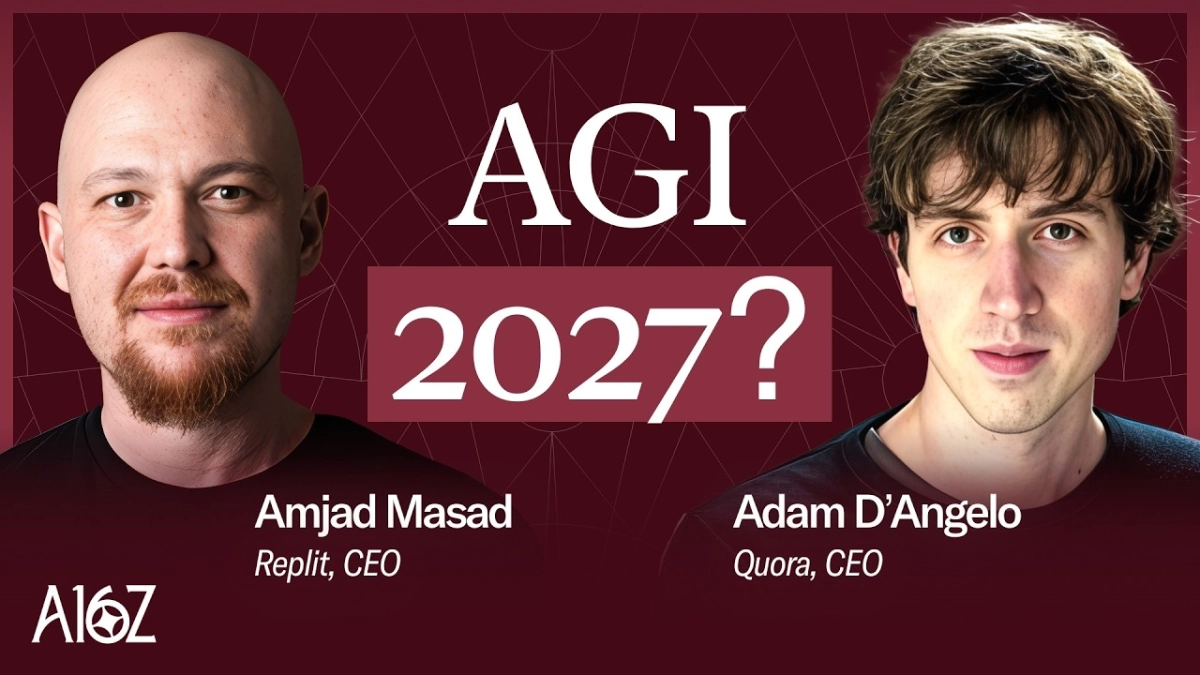
The debate over artificial general intelligence's proximity and its societal implications is fiercely contested, nowhere more vividly than in the recent exchange between Quora/Poe CEO Adam D’Angelo and Replit CEO Amjad Masad. Hosted by Erik Torenberg of a16z, the conversation cut through the prevailing narratives, revealing stark philosophical and practical differences on the nature of AI progress, its economic fallout, and the very definition of intelligence. Their dialogue, often a direct counterpoint, underscores the profound uncertainty that underpins the current era of rapid technological advancement.

Adam D’Angelo, representing a distinctly optimistic viewpoint, dismisses the recent "bearishness paradox" surrounding large language models (LLMs). He argues that the pace of innovation, particularly in areas like reasoning models, code generation, and video synthesis, is accelerating, not slowing. "I honestly don't know what people are talking about," D'Angelo stated, emphasizing the dramatic progress seen in just the last year. He posits that current LLMs are not hitting fundamental limits of intelligence, but rather facing surmountable challenges related to context management and efficient computer utilization, which he expects to be largely resolved within one to two years.

D’Angelo's optimism extends to a bold prediction: within five years, a significant portion of remote work will be automated. His working definition of AGI hinges on this practical application: "Any job that could be done by someone whose job can be done remotely, that’s AGI." He believes achieving a level of AI performance superior to a typical remote worker will fundamentally reshape the world, unleashing a "massively available" opportunity for solo entrepreneurs to leverage these powerful tools. This vision paints a future of unprecedented economic growth, far exceeding the modest 4-5% GDP increases often discussed.

Amjad Masad, however, offers a more tempered, even skeptical, perspective. He characterizes current AI development as "brute-forcing intelligence without understanding it." While acknowledging the impressive capabilities of LLMs as "amazing machines," Masad firmly believes they are not equivalent to human intelligence. He points to their "clear limitations," citing instances where models can be easily tricked by simple logical questions, even after extensive training. Masad argues that much of the perceived progress is due to "papering over the limitations" through massive data labeling, complex reinforcement learning environments, and extensive human-in-the-loop efforts.

This reliance on human input to refine AI models leads Masad to a critical insight: we are currently operating within a "human expertise regime." This dependence, he argues, creates a peculiar economic equilibrium where entry-level tasks become automatable, yet the nuanced, often tacit, knowledge of experts remains irreplaceable. Such a scenario risks creating a "missing middle" in the job market, where a vast segment of the workforce is displaced, but the demand for highly specialized human skills, ironically, intensifies to feed and guide the AI. Masad worries that the current hyper-focus on LLM development is diverting talent and resources from fundamental research into the true nature of intelligence, potentially hindering long-term breakthroughs.

Related Reading

  • OpenAI's Trillion-Dollar Bet on AI Dominance
  • OpenAI’s IPO Horizon: A Strategic Pause in the AI Race
  • Beyond Statistical Prediction: The Rise of Large Reasoning Models

The contrasting views on AGI's impact on the job market are striking. D’Angelo foresees a landscape where individuals, armed with powerful AI agents, can achieve unprecedented levels of productivity, becoming "sovereign individuals" capable of building and creating with minimal overhead. He highlights the burgeoning number of solo entrepreneurs leveraging AI as evidence of this trend. Masad, while acknowledging the empowerment of individuals, emphasizes the unscalable nature of human expertise. He questions how AI can truly improve beyond its current limitations if it remains perpetually dependent on human guidance for complex, non-obvious tasks.

The interview concludes without a definitive answer on AGI's timeline, but with a profound exploration of the underlying challenges and opportunities. It reveals a landscape where technological progress, while undeniable, is interpreted through vastly different lenses, each carrying significant implications for our economic and social future.

#Adam D’Angelo
#AI
#Amjad Masad
#Artificial General Intelligence (AGI)
#Automation
#Future of Work
#Industry Trends
#Large Language Models (LLMs)

AI Daily Digest

Get the most important AI news daily.

GoogleSequoiaOpenAIa16z
+40k readers