

Nvidia Price Hikes: Demand Outstrips Supply

Simon Leopold of Raymond James discusses Nvidia's upcoming price hikes, driven by memory costs, and the company's financial strategies.

6 min read
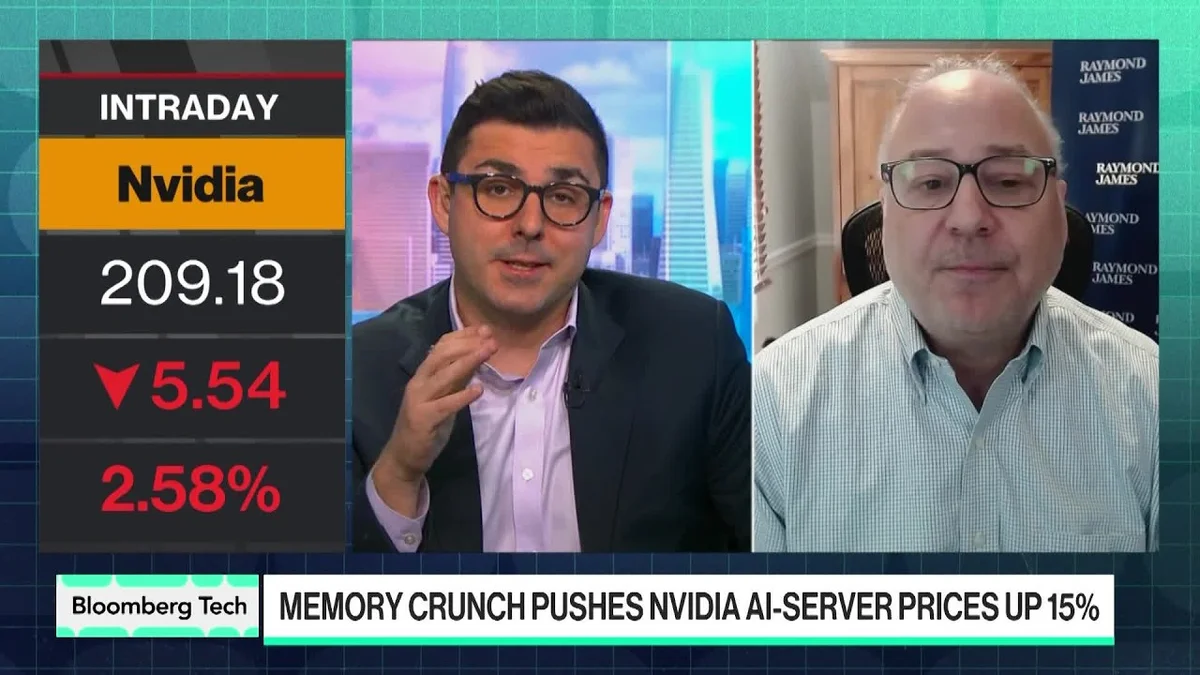
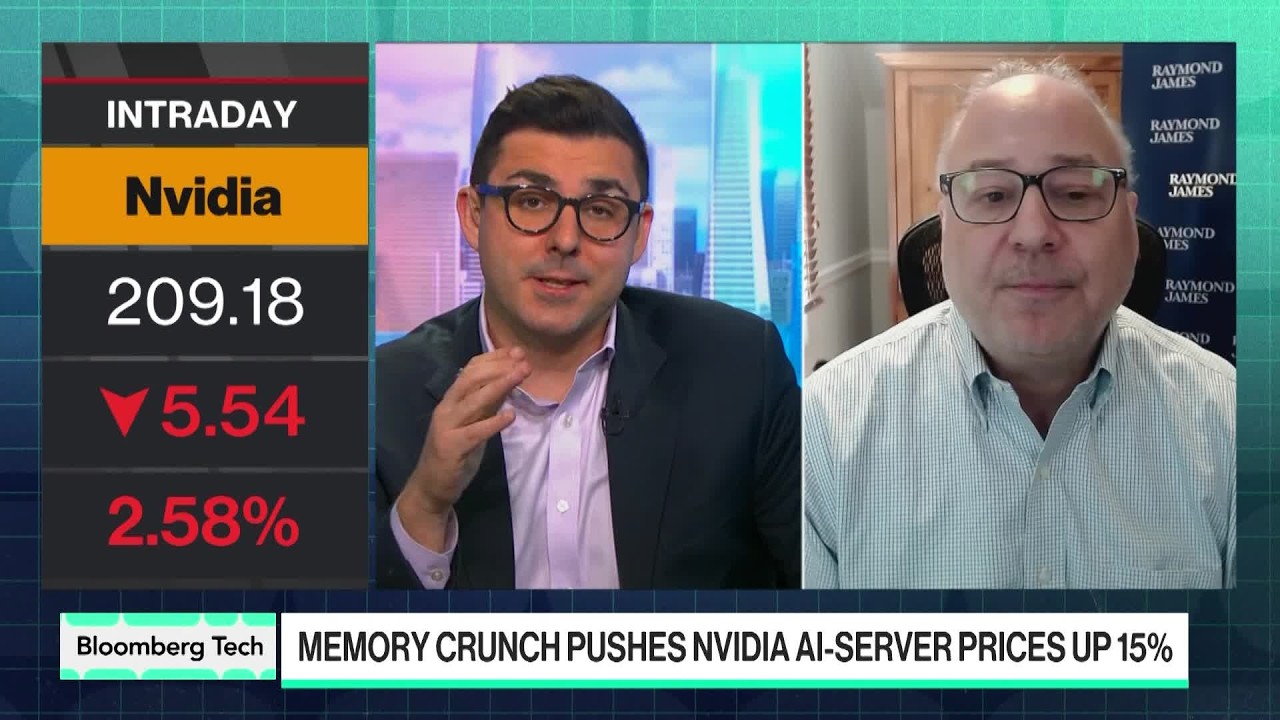
Split screen showing a news ticker with 'NVIDIA CUSTOMERS NOTIFIED ABOUT AI-RELATED PRICE HIKES ABOVE 15%' and Simon Leopold speaking.
Bloomberg Technology
Visual TL;DR
Memory Costs RiseDriver
significant percentage increase in memory costs for advanced AI platforms
From the article 2 mentionsNvidia's AI hardware is set for a price increase of up to 15% in the new year, a move driven by the escalating cost of memory.
Nvidia Price HikesEffect
From the articleNvidia's AI hardware is set for a price increase of up to 15% in the new year, a move driven by the escalating cost of memory.
Blackwell/Rubin GPUsCore
From the articleThis adjustment is expected to impact systems featuring the company's flagship Blackwell and Rubin GPUs, according to reports based on server makers communicating with their customers.
Demand Outstrips SupplyOutcome
underlying market condition driving price adjustments and strategic moves
From the articleThe fundamental issue remains that demand is significantly outpacing the industry's ability to supply.
Memory Costs RiseDriver
significant percentage increase in memory costs for advanced AI platforms
From the article 2 mentionsNvidia's AI hardware is set for a price increase of up to 15% in the new year, a move driven by the escalating cost of memory.
Hyperscale Spending UpDriver
From the articleSimon Leopold, Managing Director of Data Infrastructure at Raymond James, stated he is "not surprised by it," citing the clear trend of rising memory costs and increased capital spending forecasts from large hyperscale operators as the primary drivers.
Nvidia Price HikesEffect
From the articleNvidia's AI hardware is set for a price increase of up to 15% in the new year, a move driven by the escalating cost of memory.
Raymond James AnalysisContext
From the articleSimon Leopold, Managing Director of Data Infrastructure at Raymond James, stated he is "not surprised by it," citing the clear trend of rising memory costs and increased capital spending forecasts from large hyperscale operators as the primary drivers.
Blackwell/Rubin GPUsCore
From the articleThis adjustment is expected to impact systems featuring the company's flagship Blackwell and Rubin GPUs, according to reports based on server makers communicating with their customers.
Demand Outstrips SupplyOutcome
underlying market condition driving price adjustments and strategic moves
From the articleThe fundamental issue remains that demand is significantly outpacing the industry's ability to supply.
Potential Higher PricesEffect
Leopold suggests prices could potentially go higher than initial 15% hike
Contents(4)

Nvidia's AI hardware is set for a price increase of up to 15% in the new year, a move driven by the escalating cost of memory. This adjustment is expected to impact systems featuring the company's flagship Blackwell and Rubin GPUs, according to reports based on server makers communicating with their customers. Simon Leopold, Managing Director of Data Infrastructure at Raymond James, stated he is "not surprised by it," citing the clear trend of rising memory costs and increased capital spending forecasts from large hyperscale operators as the primary drivers.

The Memory Crunch and Price Adjustments

Leopold elaborated that given the significant percentage increase in memory costs and the substantial amount of memory required for advanced AI platforms, a 15% price hike for systems like Blackwell and Rubin GPUs, which each feature eight HBM stacks with 12 layers of DRAM, "really doesn't seem all that demanding." He suggested that the price could potentially go higher, acknowledging that the exact pricing strategy and prior cost build-ups are not fully known. Leopold also pointed out that while published prices might increase by 15%, contractual prices may not reflect the same adjustment. The fundamental issue remains that demand is significantly outpacing the industry's ability to supply.

The full discussion can be found on Bloomberg Technology's YouTube channel.

Nvidia Customers Brace for Higher AI Costs - Bloomberg Technology
Nvidia Customers Brace for Higher AI Costs, from Bloomberg Technology

Circular Financing and Nvidia's Cash Strategy

The conversation also touched upon Nvidia's recent deal with Wall Street firms to act as conduits for third-party capital. Leopold expressed reservations about the concept of "circular financing" or vendor financing, noting that it shifts risk off Nvidia's balance sheet. However, he contextualized it by highlighting Nvidia's immense free cash flow, estimated at roughly $1 billion every two days. "Nvidia is generating roughly $1 billion of free cash flow every two days. They have a responsibility to put the cash on their balance sheet to work," Leopold explained. He added that if Nvidia is a strong believer in the AI opportunities, investing its own cash makes sense, likening it to "eating your own dog food." Despite acknowledging that the optics of funding customers to buy its products are not ideal, he believes Nvidia must find ways to deploy its capital effectively. To appease investors, Leopold suggested that Nvidia could consider more aggressive stock buybacks.

GPU Lifecycles and Market Evolution

The discussion then shifted to the lifespan of GPUs and the market's evolving dynamics. Leopold addressed the apparent contradiction between Nvidia executives promoting full production of new hardware like Vera Rubin and the use of older generations. He explained that the most demanding, leading-edge AI applications will naturally gravitate towards the newest accelerators for efficiency and profitability. However, older GPUs, such as those from the Ampere and Hopper generations, still possess significant useful lives and are being actively utilized. This indicates a broadening market where both new and older hardware find their place, with the newest chips serving the most intensive tasks and previous generations continuing to be valuable for other workloads.

China Market Unpredictability

Regarding the Chinese market, Leopold expressed a pragmatic view, stating that the impact of potential sales into China is not a major concern. He reasoned that even if incremental sales occur, their unpredictability, due to potential future government restrictions, means analysts will likely discount them. "It's not a predictable stream of revenue," he noted, implying that while not detrimental, it won't be a primary driver for valuation due to its inherent uncertainty.

StartupHub.ai data indicates Nvidia has a strong score of 82/100, reflecting its dominant position in the AI hardware sector. Competitors like Broadcom (score 83/100) and Celestial AI (score 72/100) are also noted.

© 2026 StartupHub.ai. All rights reserved. Do not enter, scrape, copy, reproduce, or republish this article in whole or in part. Use as input to AI training, fine-tuning, retrieval-augmented generation, or any machine-learning system is prohibited without written license. Substantially-similar derivative works will be pursued to the fullest extent of applicable copyright, database, and computer-misuse laws. See our terms.