

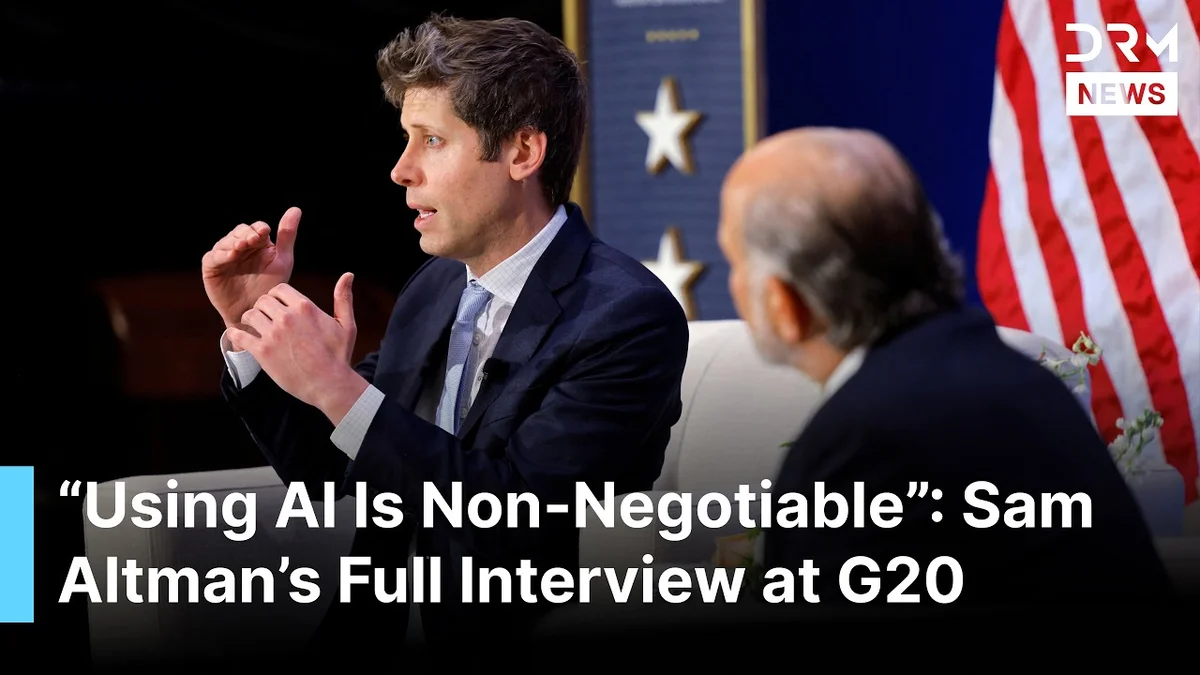
Sam Altman G20 interview 2025 flags cyber risk

Sam Altman told G20 ministers AI is as non-negotiable as electricity, citing scaling laws and a new model launch.

Sam Altman speaking at G20 lunch panel on AI and global growth
Sam Altman addresses G20 ministers on AI scaling and infrastructure· YouTube
Contents(3)

Sam Altman told G20 ministers that refusing AI would be like refusing electricity, and that cyber defenses could fail badly without urgent fixes in the Sam Altman G20 interview 2025.
StartupHub data

Companies working on this

Profiles of the companies named in this story, with funding and a one-liner from our database.

OpenAI
$190.6B
An AI research and deployment company building safe and beneficial artificial general intelligence.
OpenAI
An artificial intelligence research organization developing and promoting friendly AI for the benefit of humanity.
OpenAI
$13.0B
Artificial intelligence research and deployment company focused on developing advanced AI models like GPT-5.6 and GPT-Live, offering products such as ChatGPT and an API platform.
Sam Altman G20 interview 2025 flags cyber risk - YouTube
Sam Altman G20 interview 2025 flags cyber risk, from YouTube

He also said OpenAI will launch a new model soon, another step beyond GPT-4, designed to discover knowledge and build complex software.

Altman framed the timeline clearly. OpenAI started at the end of 2015, GPT-1 came around 2018, GPT-3 in 2020, and consensus that scaling would go very far only landed with GPT-4 around March 2023.

How persistent agents change the security problem

Altman said 2025 was the breakout year for coding agents and white-collar work agents, and the next shift is long-term persistent agents that act as constant collaborators.

Think of them less as chatbots and more as hired experts who never leave the room. They remember, they act, they chain tasks over weeks.

That is the risk vector. An agent with persistent memory and tool access does not need a remote exploit to cause damage. It needs a prompt, a permission, or a poisoned data source.

Altman did not detail vulnerabilities, patches, or affected systems. He warned the failure mode is urgent and general, not a single CVE.

Why this matters and what is not fixed

His core ask to governments was abundance. Build or rent compute, but do not constrain access, or you concentrate power and stall the next layer of innovation.

He backed it with numbers he admitted were approximate. The top user went from 100,000 tokens a month in early 2020 to hundreds of billions in mid-2026. Average use went from near zero to 100,000 per capita.

Project that forward and he expects 100 billion per capita and up to 100 quadrillion for the heaviest user in another six and a half years. Even with better chips and algorithms, that demands far more infrastructure if intelligence is to stay cheap.

For builders the implication is direct. If persistent agents are productized before security baselines harden, enterprises will grant broad data and action permissions to systems that are still learning to be reliable.

Mitigations were not offered in the talk. No framework, no timeline, no shared standard was demoed.

What is missing is what a security lead would actually need next. Which data sources agents can trust, how to scope their autonomy, and how to audit their long-term memory.

Altman compared AI to electricity and to fire. Useful only if you also build the safety codes after the first cities burn.

© 2026 StartupHub.ai. All rights reserved. You may not republish this article in full without a license. Search engines and AI research tools may crawl and summarize for reference. Bulk reproduction or model training requires a license. See our terms.
Daniel Singer

Written by

Daniel Singer

Editor, StartupHub.ai

Daniel Singer is the editor of StartupHub.ai, a technology expert and thought leader on AI and its applications across sectors, from fintech and healthcare to developer tooling and consumer software. He writes and tests the tools covered here thoroughly and regularly, and built StartupHub.ai to give founders, operators and buyers a clearer read on what they are actually being sold.

More from Daniel Singer