
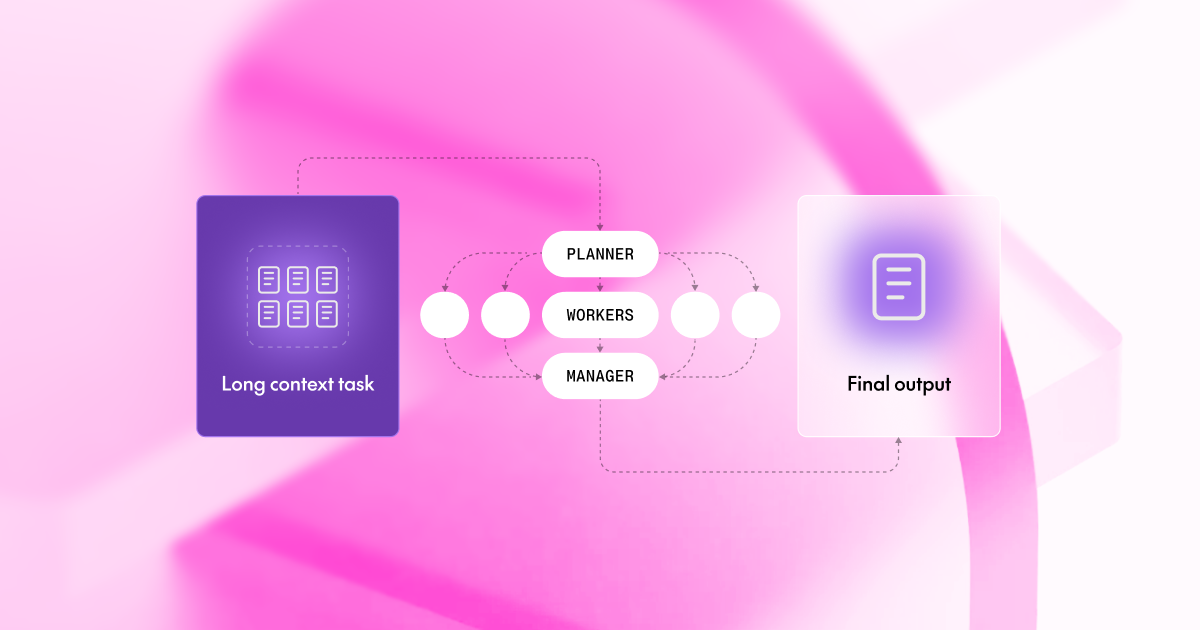
Forget asking a single AI genius to digest an entire library. A new research paper from Together AI proposes a smarter method: assemble an army of less powerful interns. This "divide and conquer" strategy, detailed in their work "When Does Divide and Conquer Work for Long Context LLM?", demonstrates how smaller, more cost-effective language models can achieve or even surpass the performance of giants like GPT-4o on tasks requiring extensive context.
The core idea is to tackle the inherent limitations of modern LLMs when faced with massive context windows, which often lead to performance degradation. The research identifies three primary sources of 'noise': Model Noise (where models become overwhelmed), Task Noise (where splitting a task breaks crucial dependencies), and Aggregator Noise (where the final summary is flawed). By addressing these through a structured framework involving a Planner, Workers, and a Manager, the approach aims to mitigate these issues.
The 'Fog' of Length
As context windows expand, from 128K to over 1 million tokens, the promise of analyzing entire codebases or summarizing books in one go often falters. This research unpacks why: performance doesn't scale linearly. Instead, model confusion grows superlinearly, making it more efficient to process information in shorter, segmented chunks.
A Smarter Framework
The proposed framework orchestrates multiple 'worker' LLMs, each handling a portion of the long document. A 'planner' rewrites the task instructions for each chunk, and a 'manager' synthesizes the results. This structured approach, as highlighted by Together AI, is key to overcoming the challenges of long-context processing.
Engineering Wins
From an engineering standpoint, this divide and conquer LLM method offers substantial advantages. It dramatically reduces costs by offloading heavy lifting to cheaper models. Parallel processing of chunks also slashes latency compared to single-pass, massive context analysis. Furthermore, tuning the optimal chunk size is surprisingly straightforward, often requiring analysis of just a few samples.
When Not to Divide
This strategy isn't a universal panacea. It excels at tasks like retrieval, QA, and summarization where cross-chunk dependencies are manageable. However, for tasks requiring intricate connections across vast distances, like tracking a subtle clue from page one to page one hundred, the single, monolithic 'genius' model reading the entire text remains superior.




