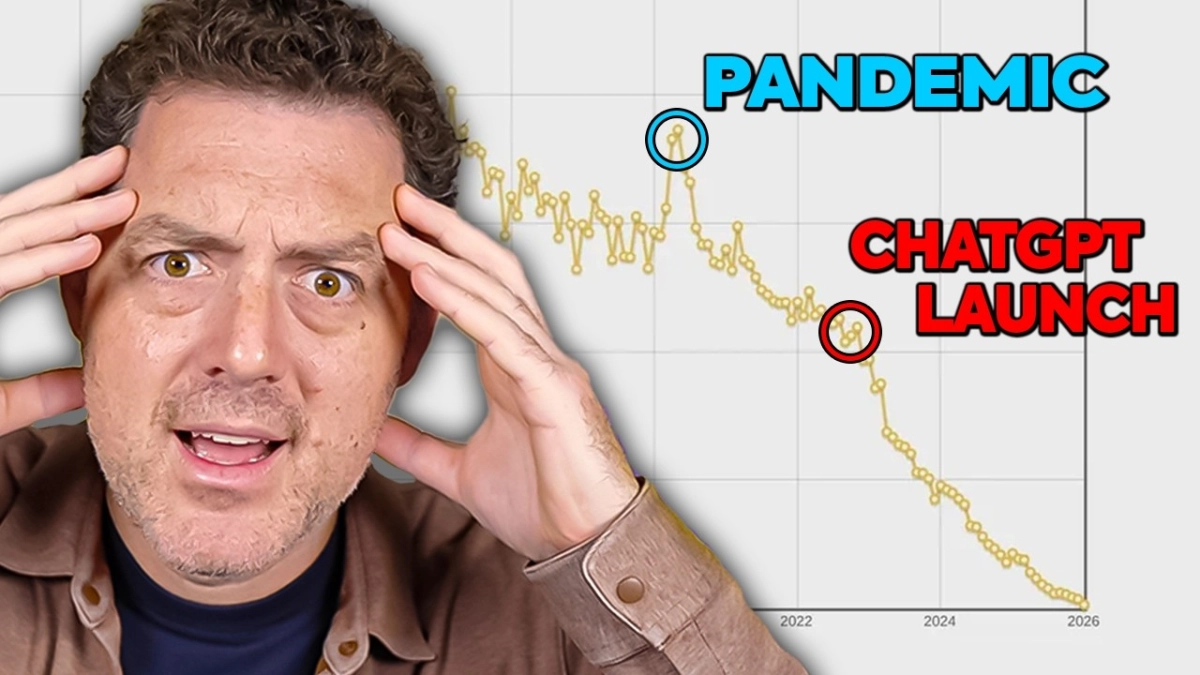
The story of Stack Overflow’s rapid decline is a devastating cautionary tale for any established digital platform reliant on user-generated content. For over a decade, Stack Overflow (SO) was the indispensable digital bedrock for software developers worldwide—the first place to turn when a bug halted progress or a complex framework required clarification. Now, according to market data and sharp commentary from Matthew Berman, the platform is "basically dead." This dramatic shift is not simply a slow migration; it is a rapid, near-fatal blow delivered by generative AI, specifically the models that ironically learned their craft from the community’s own accumulated knowledge.
Berman notes that the platform, launched in 2008, peaked in popularity during the COVID-19 pandemic, hitting maximum monthly questions asked. But the subsequent chart tracking monthly user activity reveals a sheer vertical drop beginning sharply in late 2022, precisely when ChatGPT was launched. For developers, the friction of posting a question, waiting for a response, and wading through occasionally snarky or unhelpful community replies became instantly obsolete when an LLM could provide instantaneous, executable, and debugged code snippets. This shift emphasizes a core insight in the current technological epoch: when a product promises efficiency and speed, a traditional community model, however rich, simply cannot compete.
The central tragedy here is the self-undermining causal loop that Stack Overflow fell victim to. The vast, publicly available corpus of programming questions, answers, and solutions accumulated over fifteen years—a goldmine of highly structured, peer-reviewed, and domain-specific knowledge—was scraped and consumed by large language models during their training phases. "Stack Overflow provided data to LLMs, LLMs replaced Stack Overflow, and now no new Q&A hub exists to provide fresh data," one analyst quoted by Berman observed, characterizing it as a "self-undermining causal loop, like mold growing on food, consuming it, and dying once the food is gone." Stack Overflow’s own public success and open data policies, which built the community in the first place, became the very mechanism of its rapid obsolescence.