

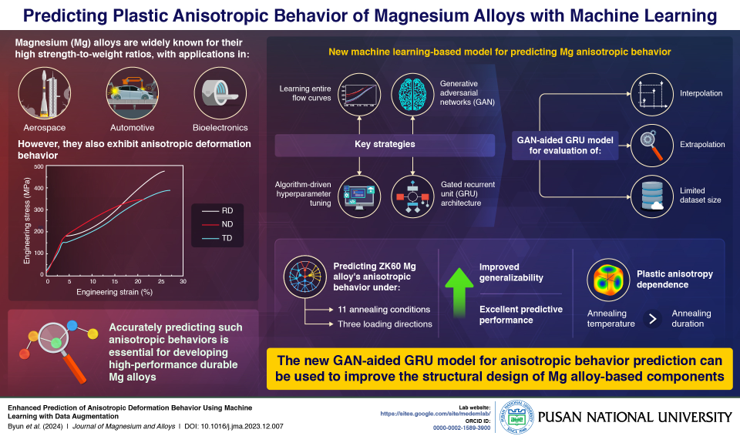
Magnesium (Mg) alloys have a wide range of applications owing to their great strength-to-weight ratio, low density, and biocompatibility. But they often exhibit anisotropic deformation behavior, which can affect their durability. Now, researchers from Pusan National University have developed a machine learning (ML) based model for accurately predicting such deformation behaviors with excellent reliability. The results of this study can assist in the design of magnesium alloy products with complex plastic anisotropy.
Mg alloys have been popularly used for designing aerospace and automotive parts owing to their high strength-to-weight ratio. Their biocompatibility and low density also make these alloys ideal for use in biomedical and electronic equipment. However, Mg alloys are known to exhibit plastic anisotropic behavior. In other words, their mechanical properties vary depending on the direction of the applied load. To ensure that the performance of these Mg alloys is unaffected by this anisotropic behavior, a better understanding of the anisotropic deformations and the development of models for their analysis is needed.
According to Metal Design & Manufacturing (MEDEM) Lab led by Associate Professor Taekyung Lee from Pusan National University, Republic of Korea, ML might hold answers to this prediction problem. In their recent breakthrough, the team proposed a novel approach called "Generative Adversarial Networks (GAN)-aided gated recurrent unit (GRU)." The model holds powerful data analysis abilities to accurately predict the plastic anisotropic properties of wrought Mg alloys. Their work was made available online in the Journal of Magnesium and Alloys on 16 January 2024.
“In terms of the accuracy of ML predictions from the viewpoint of data science, we realized that there was room for improvement. So, unlike the previously reported methods of prediction, we developed an ML model with data augmentation to attain accuracy, as well as generalizability with respect to various loading modes. This eventually opened ways of integration with a finite-element analysis to extract precise stress estimation of products made from metal alloys with significant plastic anisotropy,” says Prof. Lee, describing the core idea behind their novel model.
To build a model with enhanced accuracy, the team combined the entire flow curves, GAN, algorithm-driven hyperparameter tuning, and GRU architecture, which are some of the key strategies used in data science. This new approach facilitates the learning of entire flow-curve data rather than being limited to train on summarized mechanical properties, like many previous models.