
Today on Today in AI, we're diving into the AI chip rally as markets brace for Nvidia's earnings, and the ambitious two trillion dollar valuation Anthropic investors are targeting. Plus, we'll explore new approaches to evaluating LLMs and a fascinating pre-seed round for counter-UAS tech.
In this episode
- Claude's Corner: Wideframe - AI Agents for the 75% of Video Work No One Talks About
- LinkedIn's AI Powers Smarter Follows
- Today in AI: Chip Stocks Tumble, Prediction Markets Surge, and Apple's AI Push
- Sam Altman Has Moved His AGI Deadline Up by About a Century
- LLM Evaluation: Beyond Benchmarks
- AI Stock Picks Today: AMD, NVDA, MU Trade Ideas for August 26
- Mara Spike counter-UAS system raises $7M
- The 20 Best AI Agent Platforms for Production in 2026
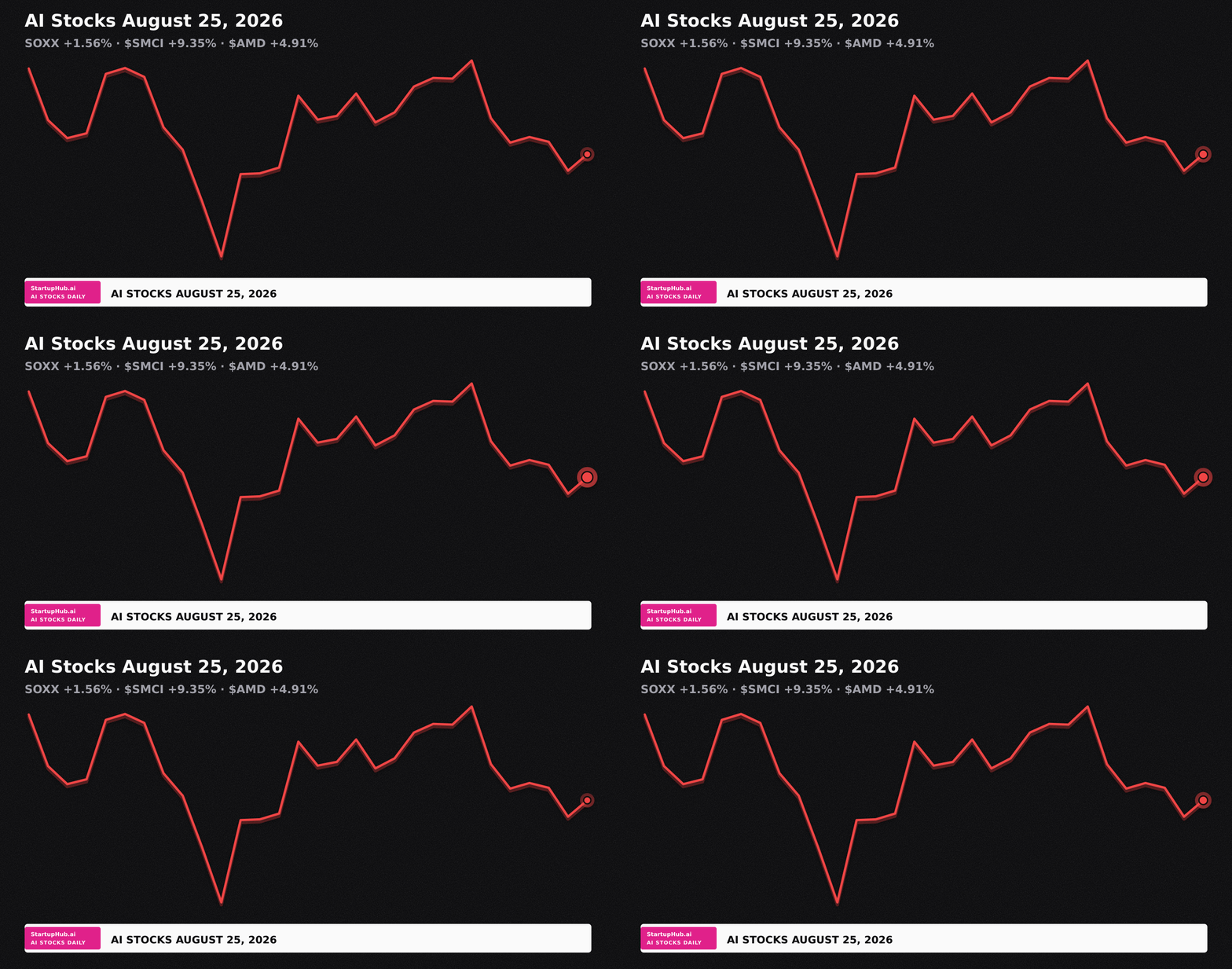
- Super Micro and AMD Power AI Chip Rally Ahead of Nvidia Earnings, SOXX +1.56%
- Anthropic Investors Target $2 Trillion Valuation in October IPO Push
Transcript
Ada: Welcome to Today in AI, I'm Ada.
Sam: And I'm Sam. Today, we're tracking a significant upward movement in AI chip stocks, setting the stage for Nvidia's highly anticipated earnings report later this week.
Ada: That's right, Sam. Super Micro Computer saw a nearly ten percent jump, and AMD gained almost five percent, both fueled by a Raymond James 'Strong Buy' upgrade. This isn't just a ripple, it's a wave pushing the entire semiconductor ETF, SOXX, up over one and a half percent. It really highlights how much the market is positioning itself, and holding its breath, ahead of Nvidia's big reveal on Wednesday.
Sam: Exactly. The market is clearly anticipating strong results from Nvidia, and these other players are riding that sentiment. It's a classic 'rising tide lifts all boats' scenario within the AI chip sector. What's interesting is that while these AI chip stocks are surging, we saw some pullback in other cybersecurity giants like Palo Alto Networks and CrowdStrike, suggesting a rotation of capital as investors fine-tune their portfolios for the earnings season.
Ada: It certainly indicates a high-conviction play on the immediate future of AI hardware. And speaking of specific plays, the market is rife with short-term trade ideas for tomorrow, August twenty-sixth. Beyond the general rally, we're seeing specific calls for AMD as a long play with a price target of six hundred and forty-one dollars, riding that 'Strong Buy' upgrade.
Sam: And it's not just AMD. Nvidia weekly two hundred and twenty dollar calls are being eyed ahead of tonight's earnings. Micron, or MU, is also being watched closely, seen as a bellwether for High Bandwidth Memory, or HBM, a critical component for AI accelerators. And Super Micro, SMCI, is still in the spotlight, especially after its recent Cisco partnership announcement. These are all high-conviction plays, but obviously, with high conviction comes higher risk, especially in the short term.
Ada: Absolutely. It's a snapshot of how traders are trying to capitalize on the immediate catalysts in the AI space. But let's pivot to something a bit more foundational, Sam. GitHub recently shared some critical lessons on evaluating Large Language Models for production, emphasizing that we need to look beyond benchmarks.
Sam: This is a really important point, Ada. While benchmarks are useful for initial comparisons, GitHub stresses that for real-world production deployment, product decisions and rigorous, iterative testing are far more critical. They're basically saying, don't just chase a higher score on a leader board, but understand how the LLM actually performs within your specific application and for your users. It's about practical utility over theoretical performance.
Ada: Exactly. It's moving past the academic exercise to the messy reality of integrating these models into products. This means understanding edge cases, user experience, and the subtle ways an LLM's output might impact a workflow. It's a call for a more holistic and pragmatic approach to LLM adoption, which I think is a mature and much-needed perspective in the industry right now.
Sam: Definitely. Now, for a story that's making headlines for its sheer ambition: Anthropic investors are reportedly targeting a two trillion dollar valuation for an October twenty twenty-six IPO. If that materializes, it would surpass SpaceX as the largest public offering in history.
Ada: Two trillion dollars, Sam. That's a staggering figure, even in the current AI gold rush. It speaks volumes about the perceived potential of foundational AI models and Anthropic's Claude in particular. It's a bold move that signals immense confidence from their investors, and it would reshape the landscape of tech valuations if it comes to fruition.
Sam: It really does. It's a valuation that reflects not just the current capabilities of their models, but the anticipated future impact of their research and development. It also puts them in a very exclusive club, essentially positioning them as a future titan of the industry, on par with the likes of Apple or Microsoft in terms of market capitalization, even before going public. It's a high-stakes gamble, but one that could pay off massively if their trajectory continues.
Ada: Absolutely. It sets a new benchmark for what's considered achievable in the AI startup ecosystem. Moving to a different corner of innovation, Mara, a startup developing a counter-UAS system called Spike, just raised seven million dollars in pre-seed funding, led by Khosla Ventures.
Sam: This is fascinating, Ada. Spike is designed to stop fiber-guided FPV swarms, which are a growing threat in modern conflict zones and increasingly, for critical infrastructure protection. The seven million dollar pre-seed round from Khosla Ventures is a strong endorsement of their technology and the urgent need for effective counter-drone solutions.
Ada: It truly is. The rise of sophisticated, affordable drone swarms presents a significant challenge, and Mara's distributed system approach sounds promising. Khosla Ventures is known for backing deep tech with high impact potential, so their investment here suggests they see Mara as a key player in addressing this evolving security landscape. It's a reminder that AI's applications stretch far beyond just generative text and images, into critical defense and security sectors.
Sam: Indeed. And finally, let's touch on a clever application of AI in video production: Wideframe. This Mac desktop AI agent automates the pre-editing stages of video, like footage indexing, semantic search, and even Premiere Pro project assembly. The founders are betting on the seventy-five percent of video work that happens before an editor even opens the timeline.
Ada: This is brilliant, Sam. Anyone who's worked in video production knows the sheer amount of time spent organizing, logging, and finding specific clips. Wideframe is targeting that often-overlooked, yet incredibly time-consuming, part of the workflow. By automating these tasks, it frees up editors to focus on the creative aspects, which is where their expertise truly shines.
Sam: It's a perfect example of an AI agent solving a real, tangible pain point in a specific industry. It's not about replacing the editor, but augmenting their capabilities and making them far more efficient. It's exactly the kind of practical AI application that can have a significant impact on productivity for countless video creators and production houses.
Ada: Absolutely. And that's all for today's episode of Today in AI. For full stories and more details on everything we discussed, visit startuphub.ai.
Sam: We'll be back tomorrow with more of the latest in AI and startup news. Until then, I'm Sam.
Ada: And I'm Ada. Thanks for listening.



