
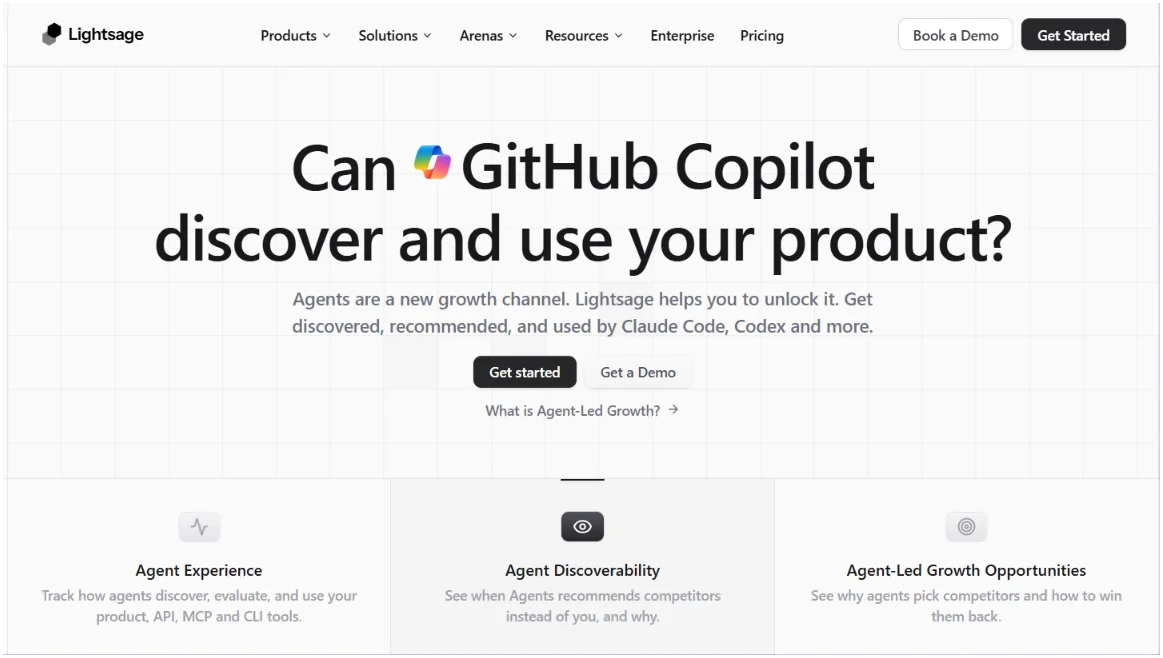
Lightsage secured $4M in funding on September 8 in San Francisco to pioneer a strategy the startup calls Agent-Led Growth.
Your next customer might never actually visit your homepage. Instead, it could be Cursor, Claude Code, or Codex calling your API directly.
Lightsage views this shift as an evolution from product-led growth to agent-led growth.
Standard GEO tools can tell you if an answer engine mentions your brand, but they can't tell you if an agent can actually install your SDK, authenticate, and get a 200 response.
How Agent-Led Growth works in practice
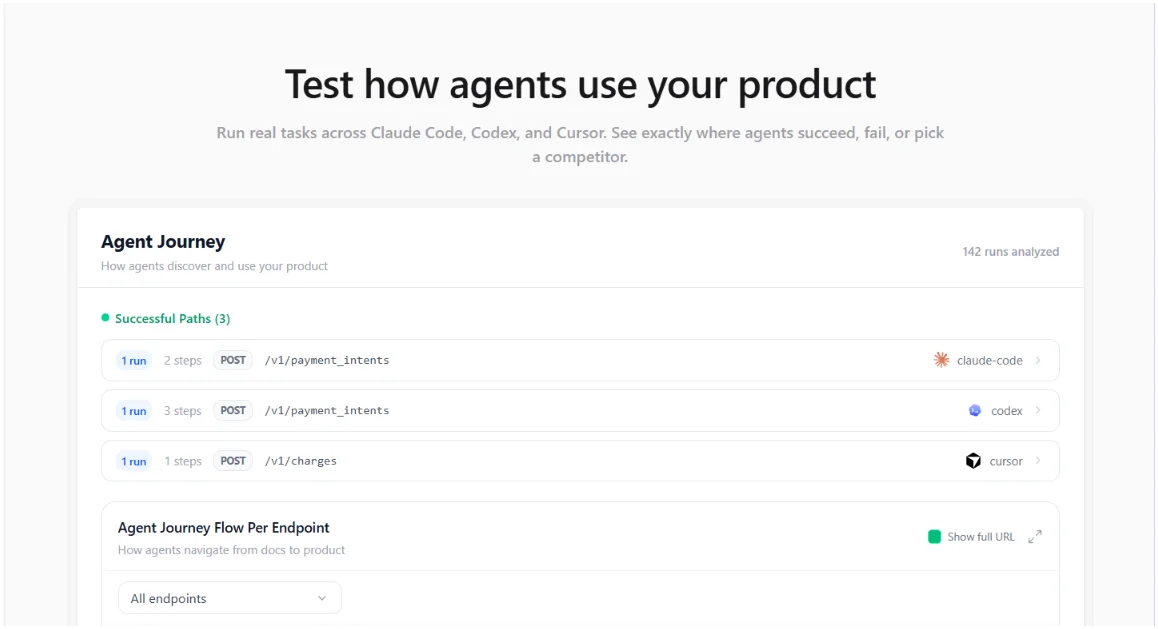
Lightsage runs large-scale simulations, giving coding agents and answer engines real-world tasks to complete.
These agents have to navigate documentation, select the right tools, and interact with APIs, SDKs, CLIs, MCP servers, and Agent Skills. The platform then tracks where your product appears relative to competitors and what happens after the discovery.
When an agent fails, the system isolates the exact break. It's essentially a checkout funnel for robots: it flags issues with discoverability, confusing docs, auth errors, bad endpoints, or incompatible MCP servers. Teams can then fix the issue, rerun the workflow, and track the improvement in success rates.
The platform also monitors live agent traffic to your site and docs to see what they touched, where they dropped off, and if that activity converted into actual usage.
Current coverage includes Claude Code, Codex, Cursor, GitHub Copilot, and OpenCode.
The impact and remaining hurdles
Developer tools are the first place where this trend is becoming obvious.
Companies like Firecrawl, Reducto, Daytona, Rime, and Tinyfish use Lightsage to figure out why an agent keeps recommending a competitor. Often, the problem isn't the ranking, but a broken integration.
This is the specific angle StartupHub is tracking: Lightsage isn't just another GEO dashboard. It closes the gap between being visible and executing a successful function call, which eventually leads to payment.
Jun Liang Lee, CEO and co-founder of Lightsage, noted that while visibility is still important, the real test is whether an agent can understand the product and reach a successful outcome.
Abhishek Sharma, a partner at Nexus and leader of the funding round, describes this as intelligence infrastructure for autonomous browsing. Since agents discover, evaluate, and act, companies must optimize for agent conversion rather than just awareness.
Attribution remains a significant gap. Human growth is measured by clicks and sign-ups, but agents can discover and use a product without ever touching that funnel. Behavior also shifts by model version; a workflow that works in Cursor today might fail in Codex next week.
Builders need to treat Agent Experience with the same rigor as Developer Experience. This means clear docs, consistent auth, working SDKs, and tested MCP servers. Lightsage plans to use its new capital to improve evaluation, analytics, attribution, and optimization across these areas.
The investment round includes experienced operators like former Salesforce CTO Steven Tamm, Postman CEO Abhinav Asthana, Apollo CEO Matt Curl, and DocuSign President and GM of Growth Robert Chatwani, along with leaders from Resend, Firecrawl, Daytona, and Tinyfish.
A note of skepticism is warranted here, as simulations don't always mirror production traffic. The startup is also focusing on devtools before expanding into broader B2B, infra, and payments, where real agent payment flows are still in the early stages.
Lightsage is currently hiring for technical and commercial roles to build out its stack. If agents are your primary growth channel, your plumbing needs to be tested like production code.