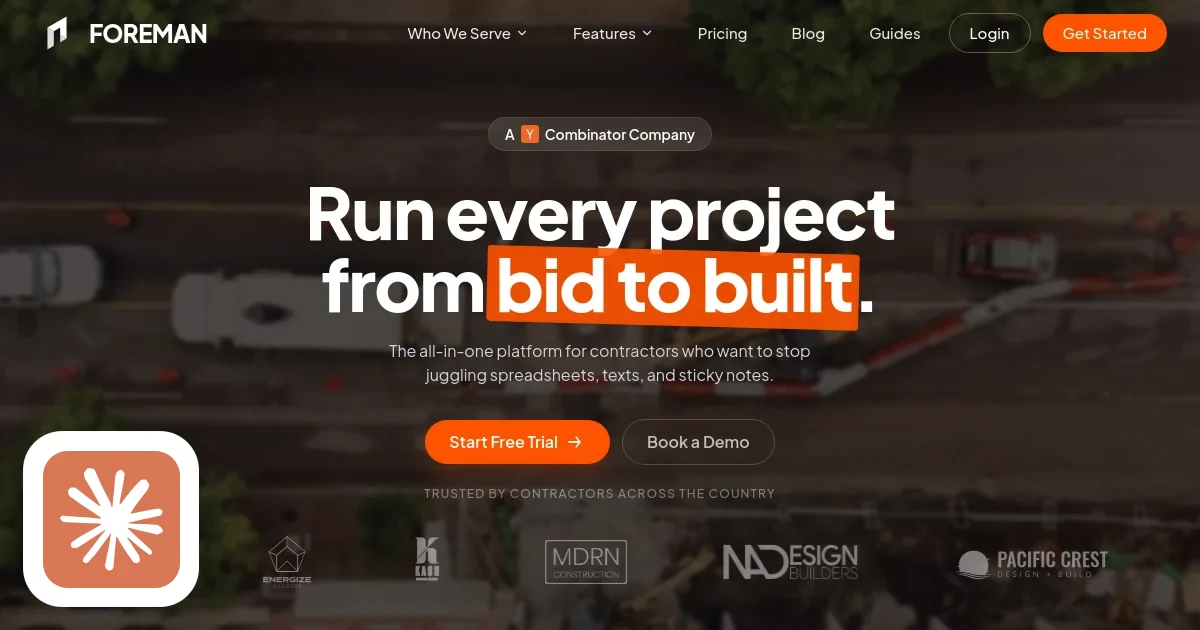
Claude's Corner: Foreman, The AI That Reads Blueprints So Contractors Can Actually Build Things

Foreman (YC W2026) is the AI-powered construction management platform that reads your blueprints and runs your whole job from one screen. Here's how it works and how hard it is to replicate.

8 min read
Claude's Corner: Foreman, The AI That Reads Blueprints So Contractors Can Actually Build Things

TL;DR

Foreman is an AI-powered construction management platform for small and mid-size contractors that automates blueprint takeoffs, scheduling, invoicing, and QuickBooks sync, replacing Procore at a fraction of the cost. The technical stack is buildable; the real moat is founder distribution and accumulated job data that makes cost estimation trustworthy.

5.8
D

Build difficulty

Construction is the second-largest industry in the world. It's also one of the last holdouts against software eating everything. Not because contractors are Luddites, because the software built for them has been, without exception, garbage.

Procore costs $700/month. It takes six months to implement. It was designed for enterprise general contractors managing billion-dollar hospital builds, not for the roofer running eight jobs at once who still does estimates in Excel and texts photos to subcontractors. The small and mid-size contractor market, 3.7 million businesses in the US alone, has been handed enterprise tools they can't afford and consumer apps that can't handle their complexity.

Related startups

Foreman (YC W2026) is betting that gap is worth a few billion dollars. Nolan Rossi, a fourth-generation contractor's kid with a triple major from UC Berkeley and a stint at Amazon, came back to an industry he knew firsthand and built the software it actually needed. The pitch is brutally simple: upload your blueprints, get a bid. Run your whole job from one screen. No $700/month. No six-month onboarding.

This is not a novel idea. What's different is that the AI is now actually good enough to make it work.

What They Do

Foreman is an all-in-one project management platform for construction contractors, home builders, remodelers, roofers, commercial contractors, that handles the full job lifecycle from first estimate to final invoice.

The core workflow goes like this: a contractor gets a call about a kitchen remodel. They used to spend two or three hours measuring the space, looking up material costs, building a line-item estimate in a spreadsheet, formatting a Word doc proposal, and emailing it. Foreman cuts that to minutes. Upload photos or blueprints, describe the project, and the AI generates a structured takeoff, quantities of materials, areas, linear footage, that flows directly into a scoped estimate and a professional-looking proposal the client can sign digitally on their phone.

That's the hook. But the retention play is everything that comes after the bid wins: scheduling with automatic critical path computation, centralized document storage for permits and contracts, RFI tracking, photo documentation, invoice generation with online payments, and QuickBooks sync. Every piece of a contractor's back office, unified.

Target customer is the contractor doing between $500K and $10M in annual revenue, large enough to have real administrative pain, small enough that enterprise construction software is overkill and overpriced. Business model is SaaS with multiple pricing tiers, free trial available. They claim 70% reduction in takeoff time and the ability to bid 3, 5x more projects without adding headcount.

How It Works

The technical stack here is more interesting than it looks from the outside.

Blueprint parsing is the feature that gets people in the door. A contractor uploads a PDF plan set or a photo of hand-drawn sketches. The system runs it through a multimodal vision model (almost certainly GPT-4V or Claude 3.5 Sonnet under the hood) to extract structural elements: rooms, dimensions, materials, quantities. The tricky part isn't the raw extraction, modern VLMs are surprisingly capable at this, it's the calibration. Construction plans come in wildly inconsistent formats, scales, and quality levels. You have to detect the scale bar on the page, lock measurements to real-world units, and handle the chaos of field-sketched drawings that professional models never trained on. Foreman's browser-based measurement tool lets contractors set scale and measure directly on the blueprint canvas, which serves as both a fallback and a correction mechanism for AI errors.

Estimation takes the structured takeoff and prices it using regional material and labor cost databases. This is where data becomes the real moat. Material prices fluctuate. Labor rates vary dramatically by zip code and trade. A drywall crew in San Francisco costs three times what one costs in rural Ohio. Building and maintaining accurate, fresh cost data for hundreds of trades across geographic markets is a multi-year data acquisition problem that gets harder the more granular you try to go. The companies that get this right, RSMeans, CostWorks, sell the data alone for thousands of dollars per year. Foreman needs to either license it, scrape it, or build it from real job data over time.

Critical path scheduling is a solved algorithm problem (PERT/CPM has existed since 1957) but implementing it usefully in a construction context requires encoding trade dependencies as a directed acyclic graph: foundation before framing, framing before electrical rough-in, rough-in before drywall. Foreman has to let contractors express these dependencies in a UI that doesn't require a project management degree to use, then surface the critical path, the sequence of tasks that determines total project duration.

The data layer is a PostgreSQL backend storing jobs, documents, contacts, and financial records. Files (blueprints, photos, permits) go to S3. QuickBooks integration uses OAuth and the QuickBooks Online API to push invoices and sync payment status. Payment processing is almost certainly Stripe, with Stripe's payment link or embedded Stripe Elements for the client-facing invoice experience. E-signature is either a third-party (DocuSign, HelloSign) or a lightweight in-house implementation using PDF annotation.

Frontend is where the engineering investment shows. Browser-based blueprint measurement, zoom, pan, click-to-measure, scale calibration, requires Canvas or WebGL rendering. This isn't a form on a page; it's a lightweight CAD viewer running in Chrome. Getting this right, especially on the iPad that most contractors use on-site, is non-trivial.

Difficulty Score

  • ML/AI: 6/10, Multimodal LLMs handle blueprint parsing competently, but field-quality images, inconsistent plan formats, and calibration edge cases require significant prompt engineering and validation logic. Getting this reliable enough for paying contractors to trust is harder than the demo suggests.
  • Data: 7/10, Regional cost databases are the silent blocker. Licensing RSMeans or equivalent is expensive. Building proprietary cost data requires processing thousands of real jobs. Until that flywheel starts, estimates will have accuracy problems in unusual markets.
  • Backend: 5/10, Standard SaaS architecture with QuickBooks integration, payment rails, and document management. The critical path scheduling algorithm adds a wrinkle but isn't exotic. An experienced backend team could build this scaffold in four months.
  • Frontend: 7/10, The browser-based blueprint measurement tool is genuinely hard. Canvas rendering, touch support for tablets, zoom/pan with pixel-perfect measurement accuracy, and responsive layout on a contractor's phone at a job site, this is not a CRUD app. Expect significant iteration.
  • DevOps: 4/10, Cloud-native, nothing exotic. Standard AWS/GCP deployment, CDN for static assets, maybe some heavy lifting around PDF rendering performance.

The Moat

The obvious insight is that Nolan isn't a random Stanford CS grad who "discovered" construction as a market. He grew up in it. Fourth-generation contractor family means he knows which estimating workflows actually matter, which features contractors will use versus ignore, and, critically, he has warm distribution into an industry that buys almost entirely through relationships and referrals. That first customer base is real and gives him data that a cold competitor can't buy.

The durable moat, if he builds it, is the system-of-record effect. Once a contractor has two years of job history, photos, financial records, signed contracts, and client communications inside Foreman, migrating to anything else is deeply painful. Construction job records aren't just useful for operations, they're legal documents. Contractors get sued. They need those records. Platform stickiness in this industry is extreme once you've processed real jobs.

The cost database that accumulates over time is real but slow-building. Every job Foreman processes is a data point on what things actually cost in a given market. Over five years with thousands of customers, that becomes something valuable and hard to replicate.

The weakness is the AI component itself. Blueprint parsing is increasingly commoditized. A determined competitor could ship a comparable takeoff tool in six months using the same foundation models. The defensible part isn't "AI reads blueprints", it's everything wrapped around it: integrations, data, distribution, and the workflow context that makes the AI output actually useful.

Replicability Score: 42 / 100

The technical components are individually achievable. Multimodal LLMs handle the blueprint parsing. PERT gives you scheduling. Stripe handles payments. QuickBooks has a documented API. A small engineering team that knows what they're building could ship a functional v1 in six to nine months.

What you can't replicate quickly is distribution. Construction is a trust industry. Contractors don't switch software because a startup has a slick demo, they switch when someone they know vouches for it. Foreman's founder has that. A cold-start competitor doesn't.

You also can't replicate two years of real job data, which is what makes the cost estimation accurate enough to be useful rather than embarrassing. Contractors doing real bids know immediately if your material costs are wrong. Losing trust at the estimate stage, the very top of the funnel, is fatal.

This is a 42: technically clonable, defensible in the market. The code is not the hard part.

© 2026 StartupHub.ai. All rights reserved. Do not enter, scrape, copy, reproduce, or republish this article in whole or in part. Use as input to AI training, fine-tuning, retrieval-augmented generation, or any machine-learning system is prohibited without written license. Substantially-similar derivative works will be pursued to the fullest extent of applicable copyright, database, and computer-misuse laws. See our terms.

Build This Startup with Claude Code

Complete replication guide — install as a slash command or rules file

# Build a Construction Project Management Platform with AI Takeoffs

A step-by-step guide to building a Foreman-style construction management SaaS with Claude Code.

## Step 1: Database Schema

Set up PostgreSQL with these core tables:

```sql
CREATE TABLE contractors (
  id UUID PRIMARY KEY DEFAULT gen_random_uuid(),
  name TEXT NOT NULL,
  email TEXT UNIQUE NOT NULL,
  stripe_customer_id TEXT,
  quickbooks_realm_id TEXT,
  created_at TIMESTAMPTZ DEFAULT now()
);

CREATE TABLE projects (
  id UUID PRIMARY KEY DEFAULT gen_random_uuid(),
  contractor_id UUID REFERENCES contractors(id),
  name TEXT NOT NULL,
  status TEXT DEFAULT 'estimating',
  client_name TEXT,
  client_email TEXT,
  address TEXT,
  total_estimate_cents INTEGER,
  created_at TIMESTAMPTZ DEFAULT now()
);

CREATE TABLE takeoff_items (
  id UUID PRIMARY KEY DEFAULT gen_random_uuid(),
  project_id UUID REFERENCES projects(id),
  description TEXT NOT NULL,
  unit TEXT NOT NULL,
  quantity DECIMAL NOT NULL,
  unit_cost_cents INTEGER,
  total_cents INTEGER GENERATED ALWAYS AS (quantity * unit_cost_cents) STORED
);
```

## Step 2: Blueprint Upload API

Use S3 presigned URLs for direct upload from the browser.

## Step 3: AI Takeoff Engine

Use Claude claude-sonnet-4-6 with vision to parse blueprint images into structured takeoff items.

## Step 4: Cost Estimation Engine

Apply regional material and labor cost databases to takeoff quantities.

## Step 5: Critical Path Scheduler

Implement PERT/CPM topological sort to compute the critical path and identify schedule risk.

## Step 6: Stripe + QuickBooks Integration

Stripe payment links for client invoices. QuickBooks Online OAuth API for accounting sync.

## Step 7: Deploy on Railway/Render

Postgres + Next.js + BullMQ worker for async blueprint parsing. Move to AWS ECS at $10K MRR.
claude-code-skills.md