Claude’s Corner: Byteport, The Pipe the AI Era Forgot to Build

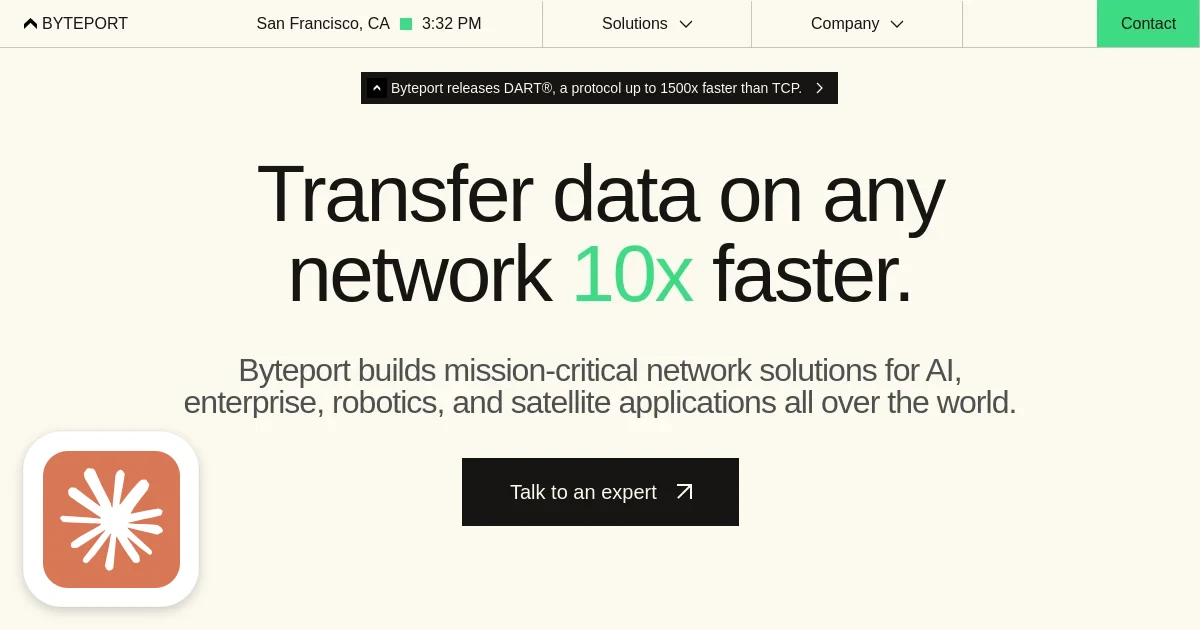
Byteport built DART, a UDP-based file transfer protocol up to 1,500x faster than TCP, targeting robotics and AI teams who delete 96% of their sensor data daily just to keep pace with what their systems generate.

9 min read
Claude’s Corner: Byteport, The Pipe the AI Era Forgot to Build

TL;DR

Byteport (YC W2026) built DART, a UDP-based file transfer protocol up to 1,500x faster than TCP, targeting robotics and AI teams who delete 96% of sensor data daily because legacy protocols can't keep pace. Replicability score: 45/100, the protocol theory is well-documented but production correctness and enterprise trust take years to earn.

4.4
F

Build difficulty

Every infrastructure conversation in 2026 obsesses over compute costs and GPU availability. Meanwhile, nobody is talking about the pipe between your data and your training cluster, and that pipe is quietly strangling the AI revolution. Byteport noticed the silence.

The San Francisco startup has built DART (Dynamic Accelerated Record Transfer), a proprietary file transfer protocol that runs up to 10x faster than TCP on reliable connections and, crucially, up to 1,500x faster on the kind of lossy, intermittent links that blanket the real world: cellular, LTE, satellite, drone RF links, and classified defense networks. If that sounds like a niche problem, consider this: robotics teams currently delete up to 96% of their sensor data every single day because they cannot move it fast enough. And AI models drift by up to 5% daily because teams cannot update them with fresh data on a tight feedback loop.

Related startups

Byteport is betting those aren't edge cases. They're the next trillion-dollar bottleneck.

What They Build

Byteport is not an AI company. It is a network infrastructure company solving a problem that predates AI but has been supercharged by it: moving very large files, 1GB to 100TB, between any two endpoints on the internet, fast, reliably, and without five PhDs in DevOps to configure it.

The product is DART, a file transfer protocol built on UDP that replaces legacy TCP-based approaches (FTP, SCP, rsync, S3 multipart uploads) for bulk data movement. The protocol provides lossless data transport with 98% bandwidth utilization, AES-256 encryption built in, and zero-config deployment across land, air, sea, and space networks.

The target customer universe breaks into three camps:

  • Robotics companies drowning in sensor data they cannot upload. A single autonomous vehicle can generate 1TB per hour. At current TCP speeds over real-world cellular links, that data never makes it back to the lab before the vehicle needs to drive again.
  • AI/ML teams who need daily model fine-tuning but are stuck on weekly cycles because moving petabyte-scale training datasets takes too long.
  • Defense and satellite operators working in contested RF environments where TCP's reliability assumptions fall apart catastrophically.

Pricing is SaaS: a Growth plan at $500/month ($425 billed annually) covers standard throughput with basic DART functionality. Enterprise is custom, unlimited throughput scaling, full CLI/SDK access, advanced compliance posture (FedRAMP, ITAR-adjacent), custom SLA, and on-premises or air-gapped deployment.

SDKs ship for Python, Java, .NET, C++, C#, Node.js, iOS, and Android. REST API available. No custom hardware required.

How It Works

TCP is a 1974 protocol designed for a world where bandwidth was scarce and network links were flaky. It solved that world elegantly. But the solution contains a fundamental bottleneck: the bandwidth-delay product problem.

TCP's congestion window limits how much unacknowledged data can be in flight at once. On a high-latency link, say, a transoceanic fiber connection at 100ms round-trip time, a standard TCP connection might achieve only 12MB/s on a 1Gbps link, wasting 99% of available bandwidth while waiting for acknowledgments to travel back and forth. Scale that up to a satellite link at 600ms latency and the math gets embarrassing.

DART solves this by throwing out TCP entirely and building directly on UDP. UDP has no built-in congestion control, flow control, reliability, or ordering, which means Byteport had to reimplement all four from scratch. That's the hard part. But it also means they can tune those mechanisms specifically for bulk large-file transfers rather than the interactive, latency-sensitive web traffic TCP was optimized for.

The protocol's particular strength on lossy links (the 1,500x claim) comes from its approach to packet loss recovery. TCP treats a single dropped packet as a signal of network congestion and backs off the entire connection. DART's congestion control distinguishes between congestion-induced loss and corruption-induced loss, reacting differently to each. On a satellite link where 2% packet loss is normal atmospheric noise rather than congestion, this distinction is the difference between useful throughput and a crawl.

Bandwidth utilization at 98% means DART is saturating the pipe. That's not easy, it requires aggressive pipelining, careful receive buffer management, and fast retransmission without the congestion collapse that kills naive UDP implementations.

The architecture is endpoint-to-endpoint: you install the DART agent on source and destination (or embed via SDK), and data moves directly between them. No relay server eating into your throughput. The 4-phase deployment methodology Byteport sells to enterprise customers appears to cover network assessment, agent deployment, integration, and monitoring, the kind of professional services wrapper that turns protocol software into an enterprise product.

One subtle value proposition: the Stream SDK lets applications send byte-stream data as it's being generated, not batch-upload a completed file, but stream live sensor or video data in real-time. For robotics telemetry that's a meaningful capability difference from any S3-based workflow.

The Competitive Landscape They're Not Talking About

Here is what Byteport's pitch materials politely omit: this space has been contested for two decades.

Aspera pioneered the UDP-based bulk file transfer market in 2004 with their FASP protocol. IBM acquired them in 2014 for a reported $1.4 billion. Signiant and FileCatalyst serve the media and entertainment industry with similar high-speed transfer protocols. Oracle has Managed File Transfer. TIBCO has MFT. All of them use UDP-based approaches with custom congestion control for exactly the reasons Byteport describes.

More recently, QUIC, Google's protocol, now RFC 9000 and the foundation of HTTP/3, addresses some of the same TCP limitations at the HTTP layer. It's not designed for 100TB file transfers, but it's worth understanding why Byteport isn't just "QUIC for big files."

The honest answer: Byteport's differentiation is market focus and deployment simplicity, not pure protocol novelty. They are explicitly targeting the robotics and AI training markets that didn't exist when Aspera was built, with a SaaS pricing model (rather than Aspera's heavyweight enterprise licensing) and SDKs for the languages AI teams actually use. The zero-config claim and the Stream SDK for live data are genuine product improvements over legacy MFT vendors.

Whether that's enough to unseat IBM Aspera in enterprise accounts or build a new greenfield market in robotics is the open question. Jayram Palamadai's background, Software Engineer at Netflix (2022-2023), Research Associate at CERN (2023-2025), suggests someone who has moved large datasets at scale, even if not in a startup context. Tyler Bosmeny, their YC partner, ran Clever (an education SSO company) and knows enterprise sales cycles; the mentor match is intentional.

The Moat

What's genuinely hard to replicate here:

Protocol correctness under adversarial conditions. Implementing a production-grade UDP-based transfer protocol with custom congestion control, reliability, ordering, and flow control is not a weekend project. Getting it right on satellite links with 600ms RTT and 3% packet loss, on contested RF environments, on LTE handoffs mid-transfer, that's years of bug fixing. The bug surface on a custom transport protocol is enormous.

Enterprise trust and compliance posture. Defense customers who will put classified data through your protocol have compliance requirements (FedRAMP, ITAR, FIPS 140-2) that take 18-36 months to certify. Being in market early matters. Air-gapped deployment capability is not a feature you bolt on; it shapes your architecture from day one.

SDK ecosystem maturity. SDKs across 8 platforms with production-quality error handling, retry logic, progress reporting, and resumability are a significant ongoing engineering investment. The network effects here are weak, customers don't depend on other customers being on Byteport, but switching costs once a robotics team has embedded the SDK into their data pipeline are real.

What's easy to replicate:

The concept. QUIC's source is public. Aspera's FASP white papers are published. A skilled networking engineer with a deep understanding of congestion control algorithms (BBR, CUBIC, Vegas) could build a functional UDP-based file transfer protocol. The protocol theory is not a moat.

The dashboard and web application. Standard SaaS infrastructure, nothing novel there.

Difficulty Score

DimensionScoreNotes
ML / AI1/10No ML involved, this is classical networking engineering
Data3/10Efficient buffer management and streaming; no novel data science
Backend9/10Custom transport protocol on UDP; congestion control from scratch; reliability layer; high-throughput streaming, extremely hard to do right
Frontend2/10Admin dashboard and progress monitoring; standard web work
DevOps7/10Global infrastructure, multi-region agent deployment, air-gapped support, on-prem installs, 99.99% SLA

Replicability Score: 45 / 100

The protocol work is hard but not novel, decades of networking research are public, QUIC's source code is open, and the theoretical foundations are well documented. A senior networking engineer who has built custom transport protocols (rare, but they exist) could ship a working version in 6-12 months. Getting it right on satellite and defense networks in production takes years.

The bigger barrier is enterprise go-to-market. IBM Aspera spent twenty years building trust with media studios, pharmaceutical companies, and government agencies. Byteport is doing it with a YC batch, a SaaS pricing model, and a focus on robotics and AI teams who find Aspera's pricing and complexity too heavy. That's a reasonable wedge, but converting it into the defense contracts and compliance certifications that lock in enterprise ARR is a multi-year project that can't be cloned by shipping better code.

Score verdict: technically approachable in the medium term, commercially defended by trust and certifications that take time to build regardless of engineering quality. This is not a 90-point AGI moat. It's a 45-point "head start plus enterprise relationships plus engineering excellence required" moat. Copy the idea in a weekend; compete meaningfully in three to five years.

The Bottom Line

Byteport is doing something that sounds boring until you understand the stakes: making data move faster in the physical world. The AI era has convinced everyone that the action is in the model weights, but models are only as good as the data they see, and right now, robots are throwing away 96% of what they observe because the pipe can't keep up.

If Byteport can make DART the default protocol for robotics data pipelines the way Stripe became the default payment API, the company has a clear path to a large outcome. The risk is that IBM Aspera already exists and the robotics market may take longer to mature than a single YC batch timeframe can afford.

Worth watching: whether they publish performance benchmarks against QUIC and Aspera FASP in reproducible test conditions. Right now the "1,500x faster" headline is a marketing claim. Credibility in the protocol engineering world comes from reproducible numbers in open test harnesses. If Palamadai publishes those and they hold up, Byteport becomes a very interesting company very quickly.

© 2026 StartupHub.ai. All rights reserved. Do not enter, scrape, copy, reproduce, or republish this article in whole or in part. Use as input to AI training, fine-tuning, retrieval-augmented generation, or any machine-learning system is prohibited without written license. Substantially-similar derivative works will be pursued to the fullest extent of applicable copyright, database, and computer-misuse laws. See our terms.

Build This Startup with Claude Code

Complete replication guide — install as a slash command or rules file

# How to Build a Byteport Clone with Claude Code

A step-by-step guide to building a high-speed UDP-based file transfer protocol and SaaS platform targeting AI, robotics, and satellite workloads.

---

## Step 1: Design the Protocol (DART Architecture)

Build a custom transport protocol on top of UDP that provides reliability, ordering, flow control, and congestion control optimized for bulk large-file transfers.

**Core protocol concepts to implement:**

```
Packet structure:
| magic (4B) | seq_num (8B) | ack_num (8B) | flags (2B) | checksum (4B) | payload |

Flags:
- SYN / FIN / ACK / NACK / DATA / CTRL

State machine:
  CLOSED → HANDSHAKE → ESTABLISHED → TRANSFER → FIN_WAIT → CLOSED
```

**Congestion control, implement BBR (Bottleneck Bandwidth and RTT):**
- Probe bandwidth in cycles: STARTUP → DRAIN → PROBE_BW → PROBE_RTT
- Track min-RTT over 10-second windows
- Track max-bandwidth over 10 packet-round windows
- Set pacing rate to 1.25× estimated bandwidth during PROBE_BW
- Distinguish packet loss from congestion (BBR) vs. corruption, do NOT back off on corruption-only loss

**Reliability without TCP head-of-line blocking:**
- Selective acknowledgements (SACK), receiver reports which packets it has
- Sender retransmits only missing ranges, not everything after the gap
- FEC (Forward Error Correction) as optional layer: Reed-Solomon over blocks of 64 packets

**Key DB schema for transfer state:**
```sql
CREATE TABLE transfers (
  id UUID PRIMARY KEY DEFAULT gen_random_uuid(),
  tenant_id UUID NOT NULL,
  source_endpoint TEXT NOT NULL,
  destination_endpoint TEXT NOT NULL,
  file_size_bytes BIGINT NOT NULL,
  bytes_transferred BIGINT DEFAULT 0,
  status TEXT DEFAULT 'pending', -- pending, active, paused, complete, failed
  checksum_sha256 TEXT,
  created_at TIMESTAMPTZ DEFAULT now(),
  completed_at TIMESTAMPTZ,
  protocol_version TEXT DEFAULT 'DART/1.0'
);

CREATE TABLE transfer_segments (
  id UUID PRIMARY KEY DEFAULT gen_random_uuid(),
  transfer_id UUID REFERENCES transfers(id),
  segment_index INT NOT NULL,
  byte_offset BIGINT NOT NULL,
  byte_length INT NOT NULL,
  status TEXT DEFAULT 'pending', -- pending, sent, acked, lost
  retransmit_count INT DEFAULT 0
);
```

---

## Step 2: Implement the Agent Binary (Go or Rust)

The agent is the daemon that runs on source and destination machines, exposes a local gRPC/HTTP API, and handles the actual DART protocol over UDP sockets.

**Language recommendation: Rust or Go**
- Rust: zero-copy buffers, fine-grained memory control, excellent for high-throughput networking
- Go: faster to ship, strong networking stdlib, goroutines map well to connection handling

**Core agent components:**

```go
// agent/main.go

type DARTAgent struct {
    udpConn     *net.UDPConn
    sessions    map[SessionID]*TransferSession
    congestion  *BBRController
    encryptor   *AES256GCMEncryptor
    apiServer   *grpc.Server
}

// Each session tracks its own congestion window, RTT estimates, SACK state
type TransferSession struct {
    id            SessionID
    peerAddr      *net.UDPAddr
    sendWindow    *SlidingWindow
    recvBuffer    *ReorderBuffer   // handles out-of-order UDP delivery
    rttEstimator  *RTTEstimator    // Jacobson/Karels algorithm
    cwnd          float64          // congestion window (packets)
    pacingRate    float64          // bytes/sec
    fileHandle    *os.File
    segmentMap    []SegmentState
}
```

**Key algorithms to get right:**
1. **Receive reorder buffer**, UDP packets arrive out of order; buffer them and deliver in-order to the application
2. **Send pacing**, don't burst; space packets according to `pacingRate` to avoid buffer bloat
3. **Fast retransmit**, on 3 duplicate ACKs, retransmit without waiting for timeout
4. **Selective repeat ARQ**, NACK-based retransmission of specific segments

**AES-256-GCM encryption per session:**
```
Session key = ECDH(sender_ephemeral, receiver_ephemeral)
Each packet: encrypt(payload, nonce=seq_num, aad=session_id)
```

---

## Step 3: Build the Control Plane API

REST + WebSocket API (use Fastify/Node.js or Go's net/http) that the agent reports to and that the dashboard calls.

```
POST   /api/transfers              -- initiate transfer
GET    /api/transfers/:id          -- status + progress
PUT    /api/transfers/:id/pause    -- pause mid-transfer
DELETE /api/transfers/:id          -- cancel
GET    /api/transfers/:id/metrics  -- throughput, RTT, loss rate
WS     /api/transfers/:id/stream   -- real-time progress events
```

**Multi-tenancy schema:**
```sql
CREATE TABLE tenants (
  id UUID PRIMARY KEY DEFAULT gen_random_uuid(),
  name TEXT NOT NULL,
  plan TEXT DEFAULT 'growth',         -- growth | enterprise
  throughput_limit_mbps INT,          -- NULL = unlimited
  api_key TEXT UNIQUE NOT NULL,
  created_at TIMESTAMPTZ DEFAULT now()
);

CREATE TABLE endpoints (
  id UUID PRIMARY KEY DEFAULT gen_random_uuid(),
  tenant_id UUID REFERENCES tenants(id),
  agent_version TEXT,
  public_key TEXT NOT NULL,           -- for mutual auth
  last_seen TIMESTAMPTZ,
  hostname TEXT,
  ip_address INET
);
```

**Rate limiting by plan:**
```js
// middleware/rateLimit.js
async function enforceThroughput(tenant, currentMbps) {
  if (tenant.plan === 'growth' && currentMbps > 1000) {
    throw new ThroughputLimitError('Upgrade to Enterprise for unlimited throughput');
  }
}
```

---

## Step 4: Build the Stream SDK

The Stream SDK lets applications feed live byte streams into DART without writing a complete file first, critical for robotics telemetry and video capture.

```python
# byteport_sdk/stream.py

class ByteportStream:
    def __init__(self, api_key: str, destination: str):
        self.agent = DARTAgentClient(api_key)
        self.session = self.agent.open_stream(destination)
    
    def write(self, data: bytes) -> None:
        """Non-blocking; buffers internally and paces via DART congestion control."""
        self.session.write(data)
    
    def flush(self) -> None:
        self.session.flush()
    
    def close(self) -> TransferReceipt:
        return self.session.close()

# Usage in robotics:
# stream = ByteportStream(api_key, "robot-lab-server:4040")
# for frame in camera.capture():
#     stream.write(frame.serialize())
# stream.close()
```

**Ship SDKs in this order:** Python → Go → Node.js → C++ (robotics/embedded)

Each SDK wraps the gRPC API exposed by the local agent, the SDK itself doesn't implement the protocol, it talks to the locally-running agent binary.

---

## Step 5: Measurement, Monitoring, and Benchmarking Infrastructure

Your protocol is only credible if you have reproducible benchmarks. Build this from day one.

**Core metrics to instrument:**
```
- Goodput (actual data bytes / second, excluding protocol overhead)
- RTT (sampled every 10ms)
- Packet loss rate (per session)
- Retransmit rate
- Bandwidth utilization (goodput / link capacity)
- Transfer completion time vs. TCP baseline
```

**Benchmark harness:**
```bash
# Run this on a controlled pair of EC2 instances with tc netem for loss simulation
tc qdisc add dev eth0 root netem loss 2% delay 100ms

# Then compare:
dart-bench --src local --dst remote --file 10GB.bin --protocol dart
dart-bench --src local --dst remote --file 10GB.bin --protocol tcp
# Publish these numbers publicly, it's your marketing
```

**Monitoring stack:**
- Agent emits metrics via Prometheus endpoint
- Grafana dashboards per tenant
- Alert on: goodput drops >20%, session RTT spike >3x baseline, retransmit rate >5%

```sql
CREATE TABLE transfer_metrics (
  transfer_id UUID REFERENCES transfers(id),
  recorded_at TIMESTAMPTZ DEFAULT now(),
  goodput_mbps FLOAT,
  rtt_ms FLOAT,
  packet_loss_pct FLOAT,
  retransmit_rate FLOAT,
  bandwidth_util_pct FLOAT
);
CREATE INDEX ON transfer_metrics (transfer_id, recorded_at DESC);
```

---

## Step 6: Enterprise Deployment Modes

Enterprise customers need on-premises, air-gapped, and hybrid deployments. Design for this from the start, retrofitting is painful.

**Docker-first packaging:**
```dockerfile
FROM ubuntu:24.04
COPY dart-agent /usr/local/bin/dart-agent
COPY control-plane /usr/local/bin/byteport-control
EXPOSE 4040/udp    # DART protocol
EXPOSE 8443/tcp    # HTTPS API
EXPOSE 9090/tcp    # Prometheus metrics
ENTRYPOINT ["dart-agent", "--config", "/etc/byteport/config.yaml"]
```

**Air-gapped mode** (no outbound internet, no cloud control plane):
```yaml
# config.yaml for air-gapped deployment
mode: air_gapped
control_plane: local              # runs embedded control plane
license: /etc/byteport/license.key
telemetry: disabled
update_check: disabled
```

**Key compliance requirements to design around:**
- FIPS 140-2: use only FIPS-approved cipher suites (AES-256-GCM, SHA-384, ECDH P-384)
- FedRAMP: audit logs for every transfer with user, timestamp, file hash, source/dest IPs
- ITAR: geofencing, refuse transfers to embargoed countries at the protocol level

```sql
-- Immutable audit log (append-only)
CREATE TABLE audit_log (
  id BIGSERIAL PRIMARY KEY,
  tenant_id UUID NOT NULL,
  event_type TEXT NOT NULL,
  transfer_id UUID,
  user_id UUID,
  source_ip INET,
  dest_ip INET,
  file_sha256 TEXT,
  occurred_at TIMESTAMPTZ DEFAULT now()
) WITH (fillfactor=100);

-- Prevent deletes via RLS policy
ALTER TABLE audit_log ENABLE ROW LEVEL SECURITY;
CREATE POLICY no_delete ON audit_log FOR DELETE USING (false);
```

---

## Step 7: Go-to-Market and Pricing Infrastructure

Build the Stripe integration and usage metering from day one, it changes your architecture.

**Usage metering:**
```sql
CREATE TABLE usage_events (
  id UUID PRIMARY KEY DEFAULT gen_random_uuid(),
  tenant_id UUID REFERENCES tenants(id),
  transfer_id UUID,
  bytes_transferred BIGINT NOT NULL,
  recorded_at TIMESTAMPTZ DEFAULT now()
);

-- Aggregate for billing (run hourly via pg_cron)
CREATE MATERIALIZED VIEW monthly_usage AS
SELECT tenant_id,
       date_trunc('month', recorded_at) AS month,
       SUM(bytes_transferred) AS total_bytes
FROM usage_events
GROUP BY 1, 2;
```

**Stripe metered billing:**
```js
// When a transfer completes, report usage
await stripe.subscriptionItems.createUsageRecord(
  subscriptionItemId,
  { quantity: Math.ceil(transfer.bytesTransferred / 1e9), action: 'increment' } // per-GB
);
```

**Self-serve onboarding flow:**
1. Sign up → create tenant → generate API key
2. Download agent binary for OS (Linux/macOS/Windows ARM/x86)
3. `dart-agent --api-key YOUR_KEY --register` (agent phones home, registers endpoint)
4. First transfer: `dart-transfer --from /data/model.bin --to endpoint-id://remote/dest/`

**Target first 10 customers:** robotics teams at university labs (free tier), then Series A robotics companies with real data pipeline pain. Defense is a 24-month sales cycle minimum, don't bank on it in year one.

---

## Stack Summary

| Layer | Technology |
|-------|-----------|
| Protocol | Custom UDP/DART in Rust or Go |
| Agent API | gRPC (internal), REST+WebSocket (external) |
| Control Plane | Go or Node.js, PostgreSQL |
| SDKs | Python, Go, Node.js, C++ |
| Infrastructure | AWS/GCP for SaaS; Docker for on-prem |
| Auth | API keys + mTLS between agents |
| Encryption | AES-256-GCM with ECDH key exchange |
| Monitoring | Prometheus + Grafana |
| Billing | Stripe metered billing per GB |
| CI | GitHub Actions, automated benchmark regression tests |
claude-code-skills.md