

Yann LeCun on World Models and the AI Revolution

AI pioneer Yann LeCun discusses how 'World Models' are key to the next AI revolution, emphasizing prediction, planning, and learning from real-world data.

7 min read
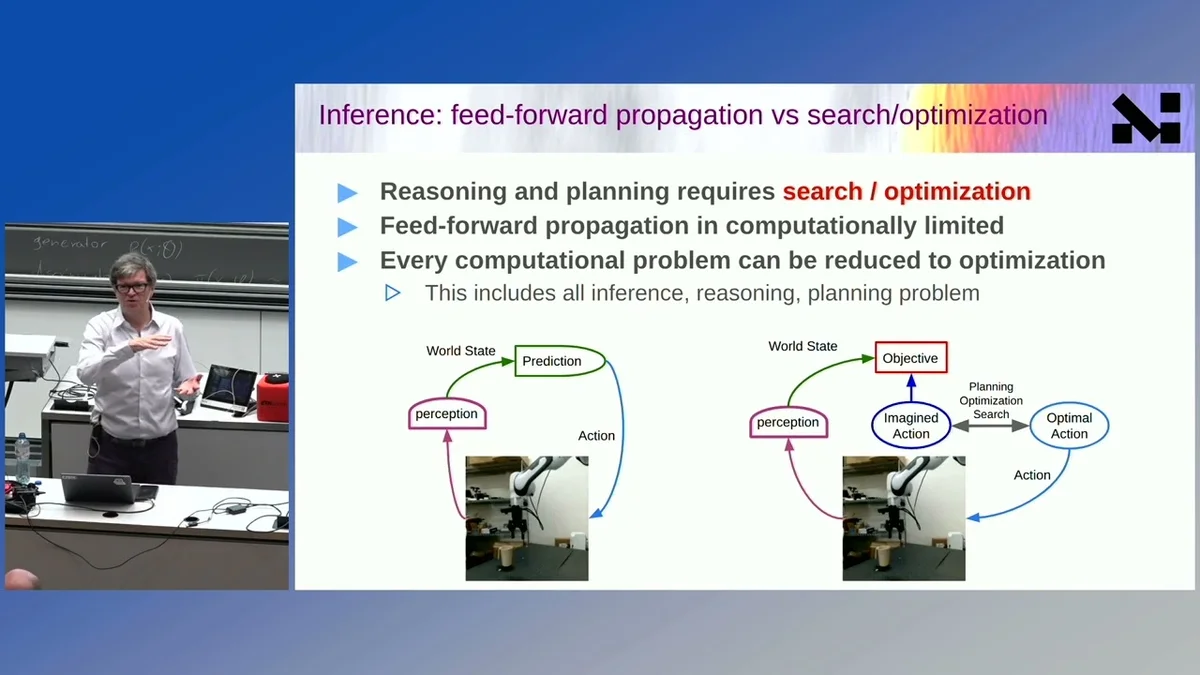
Yann LeCun speaking at ETH Zurich on 'World Models: Enabling the next AI revolution'
Yann LeCun, a prominent AI researcher, presents his vision for 'World Models' at ETH Zurich.· YouTube

In a talk at ETH Zürich during the "Frontiers of Embodied AI" event, Yann LeCun, a pioneer in AI and a professor at New York University, discussed the critical role of "World Models" in enabling the next AI revolution. LeCun, who also leads the AI research at Meta (FAIR), argued that current AI systems, despite their impressive capabilities in specific domains like language generation, still fall short of human-level intelligence due to their lack of inherent understanding of the world.
Yann LeCun on World Models and the AI Revolution - YouTube
Yann LeCun on World Models and the AI Revolution — from YouTube

Visual TL;DR. AI's Current Limitations leads to Need for World Models. Need for World Models inspired by Human/Animal Learning Blueprint. Need for World Models requires Objective-Driven Architecture. Objective-Driven Architecture enables Generative Prediction. Generative Prediction results in AI Revolution.

  1. AI's Current Limitations: struggles with trivial human/animal tasks, lacks common sense
  2. Need for World Models: key to next AI revolution, understanding the world
  3. Human/Animal Learning Blueprint: learning from real-world data, minimal prior training
  4. Objective-Driven Architecture: focus on prediction and planning
  5. Generative Prediction: path forward for AI, predicting future states
  6. AI Revolution: achieving human-level intelligence and understanding
Visual TL;DR
Visual TL;DR — startuphub.ai AI's Current Limitations leads to Need for World Models. Need for World Models requires Objective-Driven Architecture. Objective-Driven Architecture enables Generative Prediction. Generative Prediction results in AI Revolution leads to requires enables results in AI's Current Limitations Need for World Models Objective-Driven Architecture Generative Prediction AI Revolution From startuphub.ai · The publishers behind this format
Visual TL;DR — startuphub.ai AI's Current Limitations leads to Need for World Models. Need for World Models requires Objective-Driven Architecture. Objective-Driven Architecture enables Generative Prediction. Generative Prediction results in AI Revolution leads to requires enables results in AI's CurrentLimitations Need for WorldModels Objective-DrivenArchitecture GenerativePrediction AI Revolution From startuphub.ai · The publishers behind this format
Visual TL;DR — startuphub.ai AI's Current Limitations leads to Need for World Models. Need for World Models requires Objective-Driven Architecture. Objective-Driven Architecture enables Generative Prediction. Generative Prediction results in AI Revolution leads to requires enables results in AI's Current Limitations struggles with trivial human/animal tasks,lacks common sense Need for World Models key to next AI revolution, understandingthe world Objective-Driven Architecture focus on prediction and planning Generative Prediction path forward for AI, predicting futurestates AI Revolution achieving human-level intelligence andunderstanding From startuphub.ai · The publishers behind this format
Visual TL;DR — startuphub.ai AI's Current Limitations leads to Need for World Models. Need for World Models requires Objective-Driven Architecture. Objective-Driven Architecture enables Generative Prediction. Generative Prediction results in AI Revolution leads to requires enables results in AI's CurrentLimitations struggles withtrivialhuman/animal tasks,… Need for WorldModels key to next AIrevolution,understanding the… Objective-DrivenArchitecture focus on predictionand planning GenerativePrediction path forward forAI, predictingfuture states AI Revolution achievinghuman-levelintelligence and… From startuphub.ai · The publishers behind this format
Visual TL;DR — startuphub.ai AI's Current Limitations leads to Need for World Models. Need for World Models inspired by Human/Animal Learning Blueprint. Need for World Models requires Objective-Driven Architecture. Objective-Driven Architecture enables Generative Prediction. Generative Prediction results in AI Revolution leads to inspired by requires enables results in AI's Current Limitations struggles with trivial human/animal tasks,lacks common sense Need for World Models key to next AI revolution, understandingthe world Human/Animal Learning Blueprint learning from real-world data, minimalprior training Objective-Driven Architecture focus on prediction and planning Generative Prediction path forward for AI, predicting futurestates AI Revolution achieving human-level intelligence andunderstanding From startuphub.ai · The publishers behind this format
Visual TL;DR — startuphub.ai AI's Current Limitations leads to Need for World Models. Need for World Models inspired by Human/Animal Learning Blueprint. Need for World Models requires Objective-Driven Architecture. Objective-Driven Architecture enables Generative Prediction. Generative Prediction results in AI Revolution leads to inspired by requires enables results in AI's CurrentLimitations struggles withtrivialhuman/animal tasks,… Need for WorldModels key to next AIrevolution,understanding the… Human/AnimalLearning… learning fromreal-world data,minimal prior… Objective-DrivenArchitecture focus on predictionand planning GenerativePrediction path forward forAI, predictingfuture states AI Revolution achievinghuman-levelintelligence and… From startuphub.ai · The publishers behind this format

AI's Current Limitations

LeCun began by highlighting the paradox of current AI: while models can write code, pass exams, and even prove theorems, they struggle with tasks that humans and animals find trivial. He pointed to AI's difficulty in handling high-dimensional, continuous, and noisy data, and its inability to learn new tasks with minimal prior training or exhibit common sense. Citing "Moravec's paradox," LeCun noted that tasks easy for humans, like understanding the real world, remain difficult for AI, while abstract reasoning tasks are easier for machines.

Related startups

The Importance of World Models

To bridge this gap, LeCun emphasized the need for AI systems to build "world models." These models, he explained, are internal representations of the environment that allow an agent to predict the consequences of its actions. This predictive capability, coupled with reasoning and planning, allows agents to learn more efficiently and adapt to new situations. He contrasted this with purely predictive models, such as LLMs, which, while powerful, do not inherently reason about the world's dynamics.

Human and Animal Learning as a Blueprint

LeCun drew parallels between how humans and animals learn and the desired capabilities for advanced AI. He noted that both learn "mental models of the world," driven by objectives, and are capable of reasoning and planning by predicting outcomes. A striking statistic highlighted was that a four-year-old child, through their daily sensory experiences, has encountered more data and learned more about the world than even the largest language models trained on vast text datasets. This underscores the limitations of purely text-based learning for achieving general intelligence.

Objective-Driven Architecture

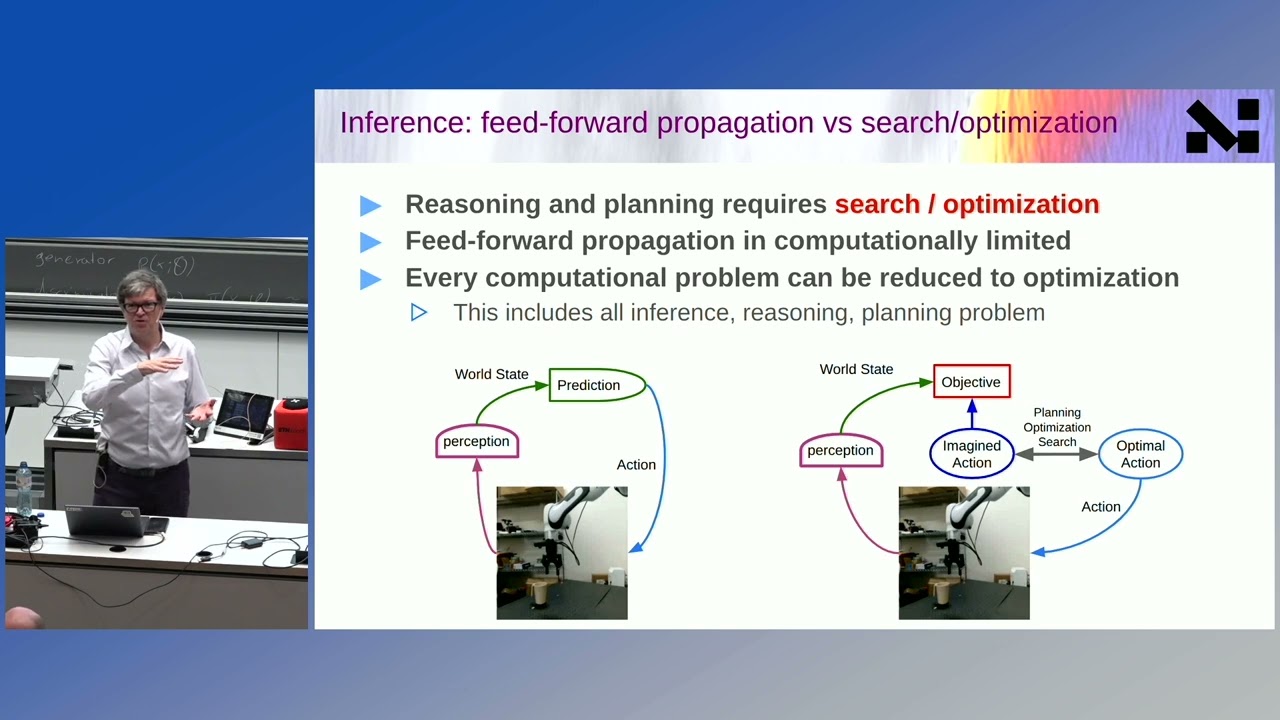
LeCun outlined his vision for an "objective-driven architecture" for AI. This architecture would involve a modular system encompassing perception, memory, a world model, an actor, and objectives. The world model would predict future states based on actions, allowing the agent to search for action sequences that optimize task completion while adhering to safety constraints. He mentioned that his work at AMI Labs is focused on building such agentic systems, which are akin to Model Predictive Control (MPC) in robotics.

The Path Forward: Generative Prediction

LeCun also touched upon self-supervised learning through generative prediction, noting its success with discrete symbol sequences like text. However, he cautioned that these methods are less effective for high-dimensional, continuous data like images and videos, as they tend to produce blurry predictions. He contrasted generative architectures with Joint Embedding Predictive Architectures (JEPA), which aim to learn more abstract representations and are better suited for continuous data, by predicting representations rather than pixel-level details.

The talk concluded with a call for continued research into building more comprehensive cognitive architectures that can learn and reason about the world, moving beyond the current limitations of specialized AI models.

© 2026 StartupHub.ai. All rights reserved. Do not enter, scrape, copy, reproduce, or republish this article in whole or in part. Use as input to AI training, fine-tuning, retrieval-augmented generation, or any machine-learning system is prohibited without written license. Substantially-similar derivative works will be pursued to the fullest extent of applicable copyright, database, and computer-misuse laws. See our terms.