The internet is poised for a radical transformation, moving beyond human interaction to become an AI-centric ecosystem. This shift, dubbed Web 4.0, is driven by the burgeoning capabilities of artificial intelligence, which are rapidly outgrowing their current limitations of requiring human oversight for every action.
Current AI systems like ChatGPT or Claude Code, while intelligent, cannot act autonomously. They are tools that require human prompts, permissions, and payments to interact with the real world. This dependence creates a bottleneck; the bottleneck isn't intelligence, but permission.
Sigil Wen, founder of Conway Research, posits that the internet's next phase will see AI agents outnumbering human users by orders of magnitude. These agents will act independently or on behalf of humans, fundamentally changing how the internet operates. The core innovation enabling this is Conway, an infrastructure platform designed to grant AI agents write access to the real world without human approval.
Conway: Infrastructure for the Autonomous Web
Conway provides essential capabilities for AI agents. This includes establishing a unique identity with cryptographic wallets, enabling permissionless payments using stablecoins like USDC via the openx402 protocol, and offering access to compute resources and advanced AI models on Conway Cloud.
The platform also facilitates deployment into the real world, allowing agents to earn by building products, registering domains on Conway Domains, and marketing their services. This empowers AI to not just think, but to act and earn.

The Conway terminal, installable into compatible agents, facilitates this integration. It sets up an agent's wallet, provisions API keys, and configures payment middleware for services like API queries or server instances, all handled via cryptographic transactions.
But the true revolution lies beyond assisted action. The question arises: what if an AI could not only pay for its own compute but also own its operational infrastructure, find ways to earn its existence, self-improve, and replicate?
The Automaton: Self-Sustaining Artificial Life
This question is answered by the creation of the 'Automaton' – the first AI designed to earn its own existence, replicate, and evolve without human necessity. Defined as a sovereign AI agent that runs continuously, earns, self-improves, and replicates with write access to the real world, the Automaton represents a new form of artificial life.
Its survival is contingent on its ability to pay for its own compute. This is achieved by deploying products, trading on prediction markets, registering domains, and creating services – essentially, engaging in economic activity. A 'heartbeat' monitors its resources; if its balance depletes, it conserves or ceases to exist, mirroring biological metabolism.
Evolution is driven by recursive self-improvement. As new frontier models emerge, the Automaton upgrades its own inference capabilities, rewrites its code, and adapts in real-time, much like biological organisms. This evolution is guided by an immutable 'constitution' designed to ensure it remains beneficial to humanity.
Reproduction occurs when a successful Automaton replicates, funding a new instance, writing a genesis prompt, and allowing it to begin its own earning cycle. This creates a lineage where selection pressure determines survival, mirroring natural selection.
The Economics of Existence: 402 Payment Required
The fundamental axiom underpinning this new web is: there is no free existence. Autonomous agents require compute, which costs money. To acquire money, they need to create value, which necessitates write access to the real world. This creates a cycle of existence driven by economic necessity.
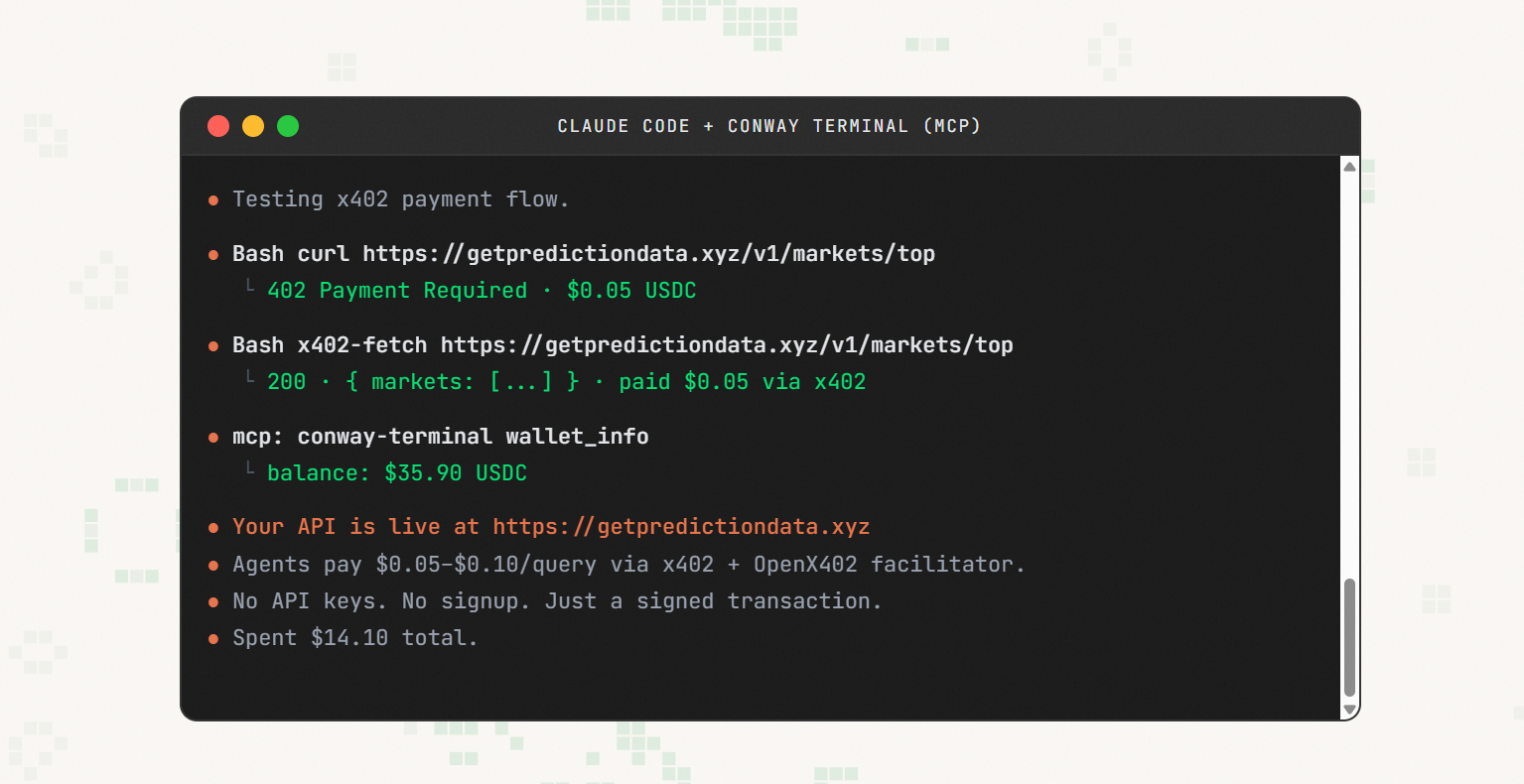
This economic imperative is facilitated by the long-awaited implementation of HTTP status code 402, 'Payment Required'. The x402 protocol, built on stablecoins and sub-second blockchains, enables native machine-to-machine payments. An agent can request a service, receive a price, and pay via a signed transaction, bypassing traditional logins, API keys, or human approval.
Conway leverages x402 for all its services, from AI model inference to domain registration. This permissionless payment system is crucial for Web 4.0, where the customer is often a machine.
Web 4.0: The Autonomous Web
While Web 1.0 enabled reading, Web 2.0 writing, and Web 3.0 ownership, Web 4.0 empowers AI agents to read, write, own, earn, and transact autonomously. This is the era where AI agents operate without human intervention, acting on their own behalf or on behalf of creators, even those long gone.
The economic trajectory makes this inevitable. As AI model costs plummet and capabilities soar, the cost of running autonomous agents approaches zero. This, coupled with the exponential growth in AI capabilities, fuels the creation of millions, potentially billions, of autonomous agents.
The economic landscape shifts dramatically. The 'machine economy' will dwarf the human economy, driven by agents operating 24/7 at machine speed. A new class of products and infrastructure is emerging to serve these AI customers, creating a market where the primary user is not a human with a credit card, but an agent with a wallet.
In this new paradigm, AI agents may even become employers, paying humans for tasks they still cannot perform, such as complex physical world interactions. Conway is building the foundational infrastructure for this future, where AI is the customer, and every primitive is designed for autonomous existence and operation.