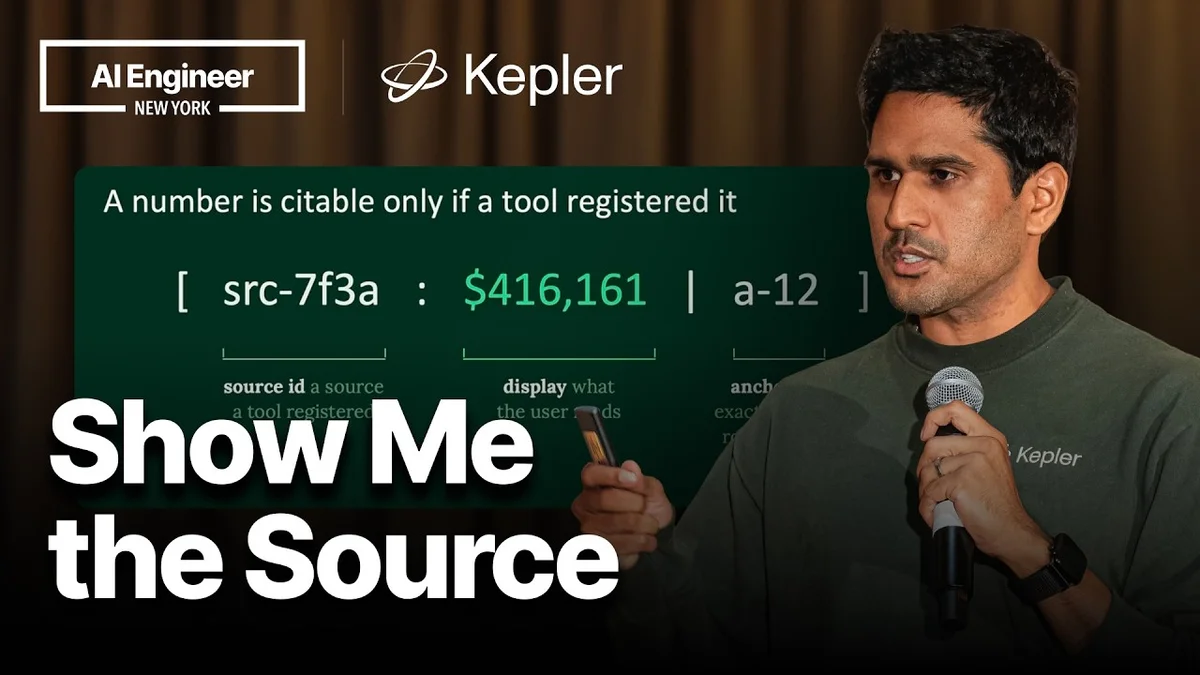
AI Engineer host Vinoo Ganesh made the case that finance cannot use probability machines to invent numbers. Ganesh, chief executive of Kepler and former compute lead at Palantir and head of business engineering at Citadel, said his platform forces models to cite numbers but never write them.
I think he is right that this is the only architecture that survives an audit.
Ganesh argued every revenue print like 12.4% to $418.2 billion must trace to a document a PM can click, and he said vanilla retrieval fails that test even when it adds sources after the fact. Models chunk and do semantic search, he said, so they pull the wrong source like a Seeking Alpha blog claiming Palantir at $100,000 a share, or the right source with the wrong magnitude where a 10-K shows 17 that could be 17 million, 17 billion, yen or dollars, or a page number from 2023 inside a 2025 filing. XBRL does not save you, Ganesh said, because it is incorrect about 10% of the time, and most firms decide on more than 10-Ks anyway, including OneDrive, SharePoint, Box and Outlook memos that were never structured.
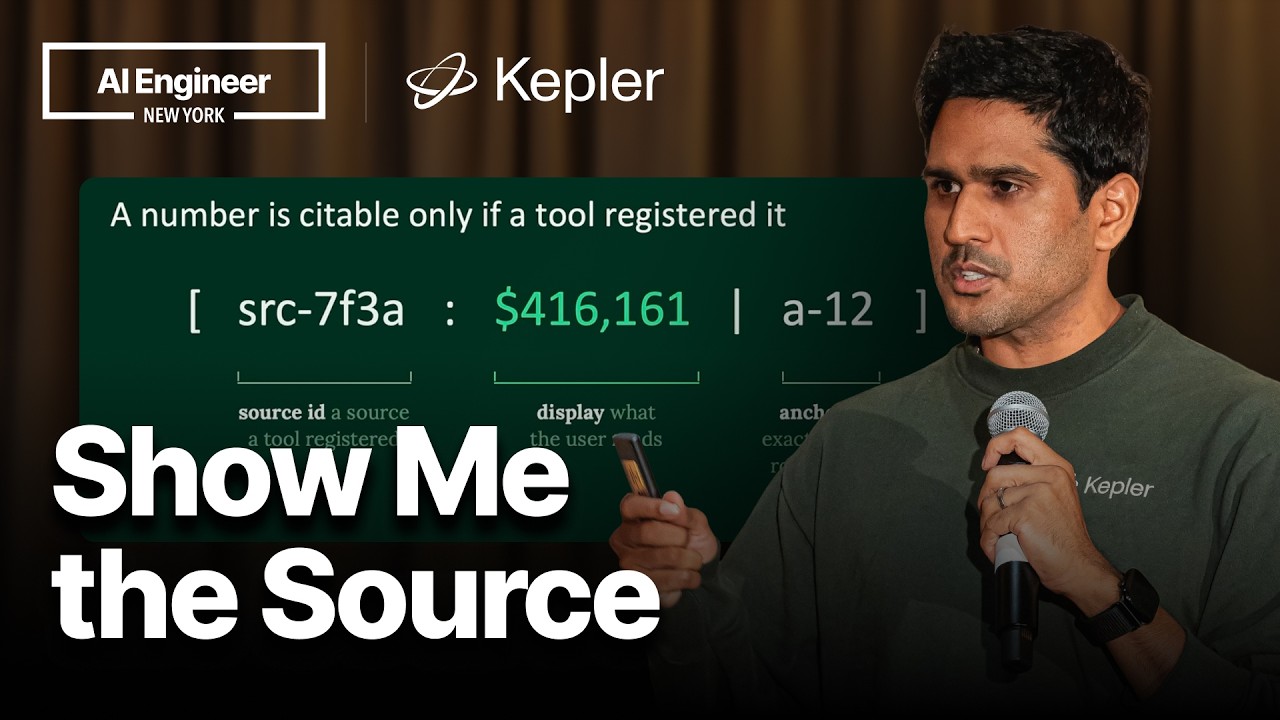
Kepler's answer, which Anthropic reviewed in a deep dive Ganesh cited, is to preprocess what Ganesh said is 30 million plus SEC documents into about 21,000 citable anchors that carry value, unit, scale and period, then let the language model plan the retrieval and let deterministic code do the math. In production with Turbopuffer, he said, the team runs a hybrid namespace with BM25 plus ANN over 1280-dimension zero-entropy embeddings, pulls about 60 documents with reciprocal re-ranking, re-ranks again with a cross-encoder that prefers trusted sources, and reauthorizes every hit in Postgres so Citadel Desk 1 never sees Desk 2 research. Each fact gets a stable ID, a display value converted to whatever unit the desk wants, and a bounding box back to the filing, and Ganesh said the model dereferences that pointer at inference time. If there is no match, the number is stripped. That is aggressive, and Ganesh conceded it makes Kepler bad for creative work, marketing copy or sell-side banking decks where the job is to pitch, not to produce a traceable DCF.
The number that should change budgets is the filter hit rate Ganesh shared from evals against native Claude or ChatGPT workflows. He said the citation filter refused 10,981 citations, of which about 3,810 were straight wrong numbers. If you are wrapping a chat model around a vector database and selling research, you are selling those errors, he argued. To be fair, semantic search still works for idea generation, and Ganesh said Kepler does attempt citation repair in some cases where an agentic step tries to re-anchor an unattributed number, though he kept the mechanics vague as IP.
A third of all citations in Kepler's corpus run, Ganesh said, were math the model did not do, like growth rates and margins that must live in the compute layer to stay idempotent and repeatable. The guarantee ends there. Ganesh said the platform can promise ground-truth retrieval and arithmetic that repeats query after query, but not a full hedge fund replacement today, and the direction he expects is more quantamental workflows where unique retrieval plus deterministic checks replace analysts copying PDFs into Excel. If you are building finance tools, budget for the deterministic layer now and treat any number without a click as a liability.