

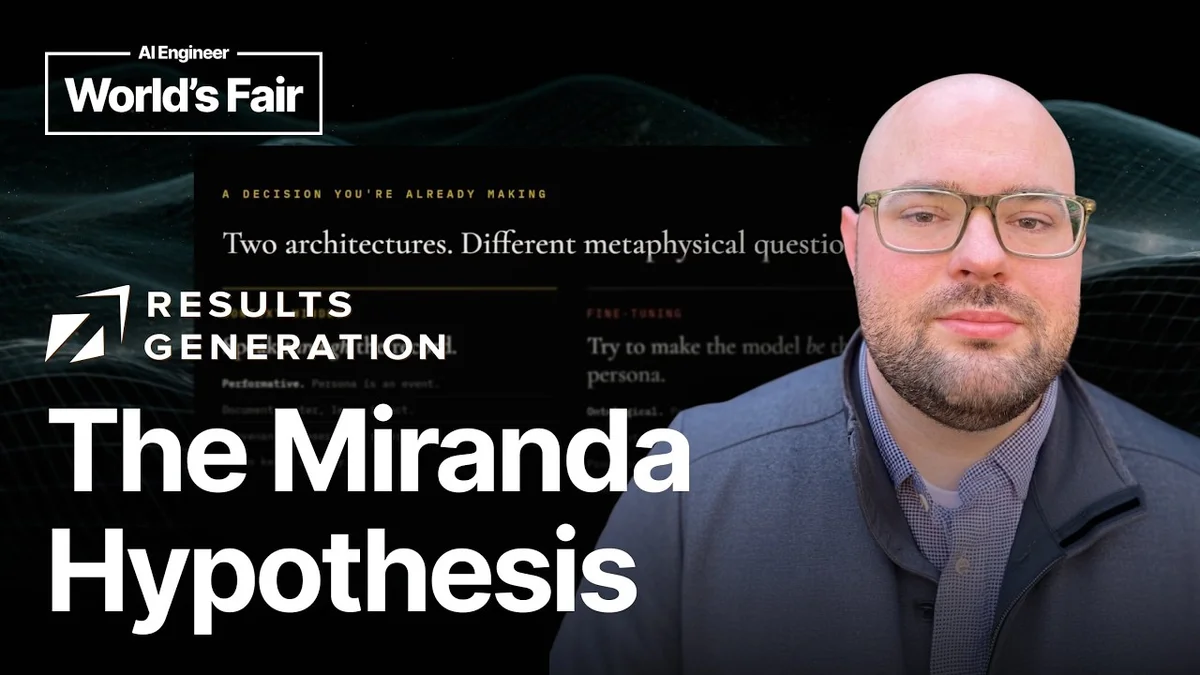
The Miranda Hypothesis: Persona Evals Poisoned by Hamilton

Jacob E. Thomas of Results Gen reveals "The Miranda Hypothesis," arguing that the Hamilton musical has inadvertently skewed AI persona evaluations towards superficiality.

7 min read
Jacob E. Thomas from Results Gen discussing the Miranda Hypothesis and its impact on AI persona evaluations
Jacob E. Thomas presenting his insights on the Miranda Hypothesis and its implications for AI persona evaluations.· AI Engineer

In a provocative discussion, Jacob E. Thomas from Results Gen unveiled "The Miranda Hypothesis," a compelling theory asserting that the groundbreaking musical Hamilton has, perhaps unwittingly, corrupted the very foundation of persona evaluations in the AI and startup world. Thomas's insights challenge the prevalent, often superficial, methods used to assess AI personas, arguing that the entertainment industry's influence has led to a critical misdirection in how we understand and design AI systems for human interaction.

The Miranda Hypothesis: Persona Evals Poisoned by Hamilton - AI Engineer
The Miranda Hypothesis: Persona Evals Poisoned by Hamilton — from AI Engineer

Visual TL;DR. Jacob E. Thomas proposes Miranda Hypothesis. Hamilton Musical Influence causes Skewed Persona Evals. Miranda Hypothesis explains Skewed Persona Evals. Skewed Persona Evals leads to Superficial AI Understanding. Superficial AI Understanding prompts Call for Depth.

Related startups

  1. Jacob E. Thomas: Results Gen representative, critical AI perspective
  2. Miranda Hypothesis: theory on AI persona evaluation flaws
  3. Hamilton Musical Influence: entertainment industry's unintended impact on AI
  4. Skewed Persona Evals: AI assessments lean towards superficiality
  5. Superficial AI Understanding: misguided comprehension of AI human interaction
  6. Call for Depth: advocating for deeper qualitative understanding
Visual TL;DR
Visual TL;DR, startuphub.ai Jacob E. Thomas proposes Miranda Hypothesis. Hamilton Musical Influence causes Skewed Persona Evals. Miranda Hypothesis explains Skewed Persona Evals proposes causes explains Jacob E. Thomas Miranda Hypothesis Hamilton Musical Influence Skewed Persona Evals From startuphub.ai · The publishers behind this format
Visual TL;DR, startuphub.ai Jacob E. Thomas proposes Miranda Hypothesis. Hamilton Musical Influence causes Skewed Persona Evals. Miranda Hypothesis explains Skewed Persona Evals proposes causes explains Jacob E. Thomas MirandaHypothesis Hamilton MusicalInfluence Skewed PersonaEvals From startuphub.ai · The publishers behind this format
Visual TL;DR, startuphub.ai Jacob E. Thomas proposes Miranda Hypothesis. Hamilton Musical Influence causes Skewed Persona Evals. Miranda Hypothesis explains Skewed Persona Evals proposes causes explains Jacob E. Thomas Results Gen representative, critical AIperspective Miranda Hypothesis theory on AI persona evaluation flaws Hamilton Musical Influence entertainment industry's unintended impacton AI Skewed Persona Evals AI assessments lean towards superficiality From startuphub.ai · The publishers behind this format
Visual TL;DR, startuphub.ai Jacob E. Thomas proposes Miranda Hypothesis. Hamilton Musical Influence causes Skewed Persona Evals. Miranda Hypothesis explains Skewed Persona Evals proposes causes explains Jacob E. Thomas Results Genrepresentative,critical AI… MirandaHypothesis theory on AIpersona evaluationflaws Hamilton MusicalInfluence entertainmentindustry'sunintended impact… Skewed PersonaEvals AI assessments leantowardssuperficiality From startuphub.ai · The publishers behind this format
Visual TL;DR, startuphub.ai Jacob E. Thomas proposes Miranda Hypothesis. Hamilton Musical Influence causes Skewed Persona Evals. Miranda Hypothesis explains Skewed Persona Evals. Skewed Persona Evals leads to Superficial AI Understanding. Superficial AI Understanding prompts Call for Depth proposes causes explains leads to prompts Jacob E. Thomas Results Gen representative, critical AIperspective Miranda Hypothesis theory on AI persona evaluation flaws Hamilton Musical Influence entertainment industry's unintended impacton AI Skewed Persona Evals AI assessments lean towards superficiality Superficial AI Understanding misguided comprehension of AI humaninteraction Call for Depth advocating for deeper qualitativeunderstanding From startuphub.ai · The publishers behind this format
Visual TL;DR, startuphub.ai Jacob E. Thomas proposes Miranda Hypothesis. Hamilton Musical Influence causes Skewed Persona Evals. Miranda Hypothesis explains Skewed Persona Evals. Skewed Persona Evals leads to Superficial AI Understanding. Superficial AI Understanding prompts Call for Depth proposes causes explains leads to prompts Jacob E. Thomas Results Genrepresentative,critical AI… MirandaHypothesis theory on AIpersona evaluationflaws Hamilton MusicalInfluence entertainmentindustry'sunintended impact… Skewed PersonaEvals AI assessments leantowardssuperficiality Superficial AIUnderstanding misguidedcomprehension of AIhuman interaction Call for Depth advocating fordeeper qualitativeunderstanding From startuphub.ai · The publishers behind this format

Who Is Jacob E. Thomas

Jacob E. Thomas, representing Results Gen, is a voice in the AI and startup community known for his critical perspective on current methodologies and his push for more robust, data-driven, and thoughtful approaches. His work at Results Gen focuses on optimizing outcomes through rigorous analysis, often dissecting established practices to uncover underlying flaws and propose more effective alternatives. Thomas's presentation on "The Miranda Hypothesis" positions him as a thought leader questioning the status quo in AI development and evaluation.

The Hamilton Effect on AI Personas

Thomas's core argument revolves around the idea that Hamilton, while a cultural phenomenon, inadvertently set a precedent for how we perceive and evaluate "personas" today. The musical's brilliance lies in its ability to condense complex historical figures into relatable, archetypal characters through song and narrative. This theatrical success, Thomas contends, fostered an expectation for similar, easily digestible character profiles in other domains, including AI persona development.

He explains that the demand for quick, engaging narratives for historical figures, popularized by Hamilton, inadvertently created a blueprint for how we now approach persona evaluations in AI. Instead of deep, qualitative research into user behaviors and motivations, there's a tendency to create personas that are more akin to theatrical characters: easily identifiable, with clear motivations and predictable reactions. This approach, while efficient for storytelling, falls short when designing AI systems meant to interact with a diverse and unpredictable human population.

"The theatrical success of Hamilton, in simplifying complex characters for mass appeal, inadvertently trained us to look for similar simplicity in our persona evaluations," Thomas stated. He elaborated that this simplification leads to superficial assessments, where the nuance of human interaction is lost in favor of easily quantifiable traits or narrative arcs.

The Poisoned Well of Persona Evals

The "poisoning" of persona evaluations, according to Thomas, manifests in several ways. Firstly, there's an over-reliance on quantitative metrics that often fail to capture the qualitative richness of human experience. Teams might focus on metrics like "engagement rates" or "task completion times" without truly understanding the emotional or cognitive journey of the user.

Secondly, the drive for speed and performativity in the startup world exacerbates the issue. In a race to launch and iterate, deep dives into user psychology are often sacrificed for quick, "good enough" persona definitions. This results in AI systems that might function technically but fail to connect with users on a meaningful level, or worse, perpetuate biases embedded in these superficial archetypes.

Thomas highlighted the danger of creating AI personas that are merely reflections of popular cultural tropes rather than genuine representations of user segments. "When we evaluate personas through a performative lens, we risk building AI that appeals to a broad, lowest-common-denominator audience, missing the specific needs and nuances of individual users," he argued.

A Call for Deeper Qualitative Understanding

Results Gen advocates for a significant shift in how persona evaluations are conducted. Thomas urged the audience to move beyond the performative and quantitatively-driven models towards a more qualitative, empathetic, and rigorous approach. This means investing more time in ethnographic research, in-depth interviews, and contextual observations to truly understand the lived experiences of target users.

He suggested that instead of asking, "Does this persona perform well?" we should be asking, "Does this persona genuinely represent the user's needs, motivations, and pain points?" This requires a commitment to understanding the "why" behind user behaviors, rather than just the "what."

The ultimate goal, Thomas explained, is to design AI systems that are not just functional but also truly helpful, inclusive, and attuned to the complexities of human interaction. By shedding the theatrical influences of "The Miranda Hypothesis," the AI industry can build more robust and effective personas, leading to more impactful and ethical AI products.

© 2026 StartupHub.ai. All rights reserved. Do not enter, scrape, copy, reproduce, or republish this article in whole or in part. Use as input to AI training, fine-tuning, retrieval-augmented generation, or any machine-learning system is prohibited without written license. Substantially-similar derivative works will be pursued to the fullest extent of applicable copyright, database, and computer-misuse laws. See our terms.