
The Wall Street Journal took cameras inside the Space Force’s electromagnetic warfare compound to show the ground-based jammers the service says it flew into operations in Iran and Venezuela.
These are not orbit weapons.
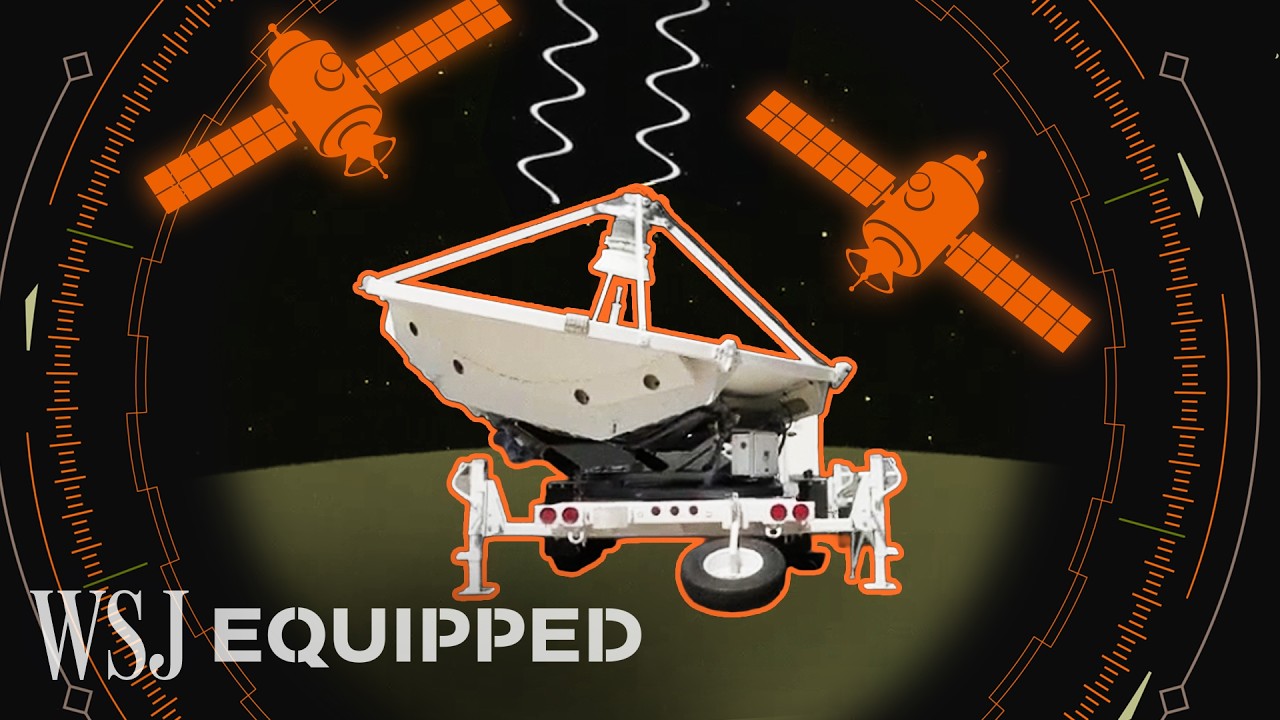
Shelby, reporting for the outlet from the compound, opened on two systems sitting side by side. Lt. Gen. Gregory Gagnon, who leads the Space Force’s Combat Forces Command, introduced one as a ground-based jammer built to deploy worldwide. Shelby identified it as Meadowlands, an offensive system designed to jam enemy satellites and block their communications.
Gagnon argued the point is spectrum dominance. He said guardians now operate on-orbit weapons that can defend the joint force against space-enabled attacks, but the ground game is about keeping US satellites, ships and planes connected while disrupting an adversary’s ability to do the same. Shelby framed that as the invisible part of warfare, carried on electromagnetic waves that link submarines, drones, radars and ground stations, the same physics behind X-rays and cell towers.
Meadowlands works by surging radio frequency energy at a target satellite, overwhelming it with noise so it cannot talk to its ground station. Shelby described the effect as non-kinetic, meaning the satellite can return to normal once the jamming stops. That matters for escalation and for recovery. It also means the effect is temporary by design, and an adversary can resume operations if the jammer moves or pauses.
The second system, Bounty Hunter, is defensive. Shelby said it scans the electromagnetic spectrum to detect and geolocate signals that could jam or compromise American satellites, the inverse of what Meadowlands does to others. Gagnon and Shelby described them operating as spotter and shooter. Bounty Hunter listens and pinpoints, then a commander could order an offensive action or a kinetic strike against the source. The outlet noted satellites underpin missile launch detection, weapons guidance and overhead imagery, which is why Iran repeatedly targeted US satellite communications terminals to degrade that advantage, according to Shelby.
A third system barely appears. The Space Force recently expedited a more nimble jammer called the remote modular terminal, Shelby said, shown only in a still photo of a containerized unit. Filming was not allowed. Gagnon said the terminals are used in combat and are placed globally. Shelby asked if enemies know where they are. Gagnon said no. Shelby asked if that is intentional. Gagnon said yes.
The people who pack and run the gear fill the rest of the piece. Technical Sergeant Joshua Lomax, a guardian in Mission Delta 3 at Peterson Space Force Base in Colorado, said his team had 72 hours to pack, inspect and load the equipment for airlift, then 96 hours after wheels down to set up and execute. Shelby said Lomax had just helped jam satellites to create a protective bubble around US forces during the capture of Venezuelan leader Nicolás Maduro when he was told to redeploy to the Middle East for the war against Iran. Lomax said the threat was real and described a heads-on-a-swivel environment where guardians, airmen, soldiers and marines looked out for each other. He did not reveal his exact location and Shelby said he was among the first guardians to come under enemy fire.
Captain Sophia Parlock, also deployed with an electromagnetic warfare system in support of operations against Iran, described her job as watching for changes on the spectrum and passing that information to the tasking authority. Shelby asked if that means scanning for potential threats. Parlock said yes.
Col. Angelo Fernandez, who commands Mission Delta 3 and is responsible for space electromagnetic warfare, tied the deployments together. He cited Operation Midnight Hammer, Operation Absolute Resolve and Operation Epic Fury and said guardians deployed forward and operated with distinction. Shelby asked if this was the first time guardians had deployed for major combat operations as Space Force guardians. Fernandez said it was a very intense year that demanded a lot out of the formations and called Epic Fury one of the most highly contested environments in the unit’s history, both on spectrum and under direct fire.
What the reporting leaves open is how success is measured when the weapon’s effect is reversible by definition, what frequencies and constellations Meadowlands can actually hold at risk, and where the containerized terminals sit now. The outlet was not shown the remote modular terminal in operation and no performance data, timelines for Iran and Venezuela beyond Lomax’s 72 and 96 hour windows, or adversary attribution details were provided. The Wall Street Journal’s report circulated widely after publication, with The Jerusalem Post noting on Wednesday that it had highlighted the role of the electromagnetic weapons in the Venezuela and Iran operations.
No one in the piece answered how the Space Force deconflicts persistent jamming with its own reliance on the same spectrum, or what happens when both sides jam at once.


