

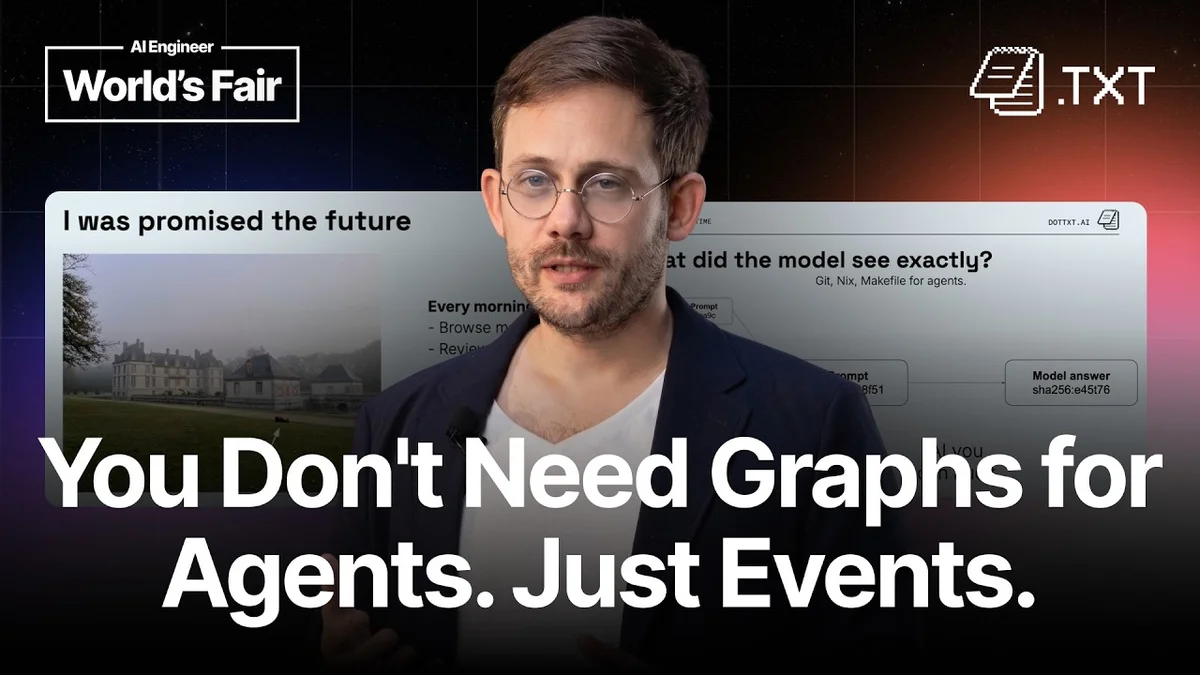
Rémi Louf: Agent Frameworks Are "Harmful"

Rémi Louf, CEO of .txt, argues that current AI agent frameworks are "harmful" due to their reliance on manual intervention, advocating for event-driven systems and robust logging.

Rémi Louf speaking at a podium with a slide titled 'Agents frameworks considered harmful'
AI Engineer
Visual TL;DR
Current Agent FrameworksDriver
rely on manual intervention, falling short of truly autonomous agents
From the article 4 mentionsRémi Louf, CEO of .txt, presented a compelling case against current agent frameworks at the AI Engineer World's Fair.
Ideal Autonomous VisionContext
From the articleLouf began by illustrating his ideal vision of an autonomous morning routine: a "morning briefing with my coffee." This would involve agents automatically browsing market news, reviewing his CRM and Jira, and processing long voice notes recorded during his walks.
Frustration with ToolsDriver
From the articleHowever, he found that current AI tools, while capable of coding and other tasks, often require continuous user input, likening it to "having a robot mower that you still have to stay on." He critiqued the transitional nature of current solutions, such as apps that feel like "SSH with vibes," where users are still actively managing the agent.
Better Building PrimitivesContext
personal journey to identify improved ways to construct agent infrastructure
From the articleHe shared his personal journey over two weeks in January, spurred by significant improvements in AI agents, to understand their capabilities and identify better building primitives.
Louf: Frameworks "Harmful"Core
CEO of .txt argues against prevailing frameworks at AI Engineer World's Fair
From the article 3 mentionsLouf, whose company builds infrastructure for reliable agents, argued that the prevailing frameworks are "harmful" because they often fall short of delivering truly autonomous agents.
Advocates Event-DrivenEffect
proposes event-driven systems and robust logging for reliable agents
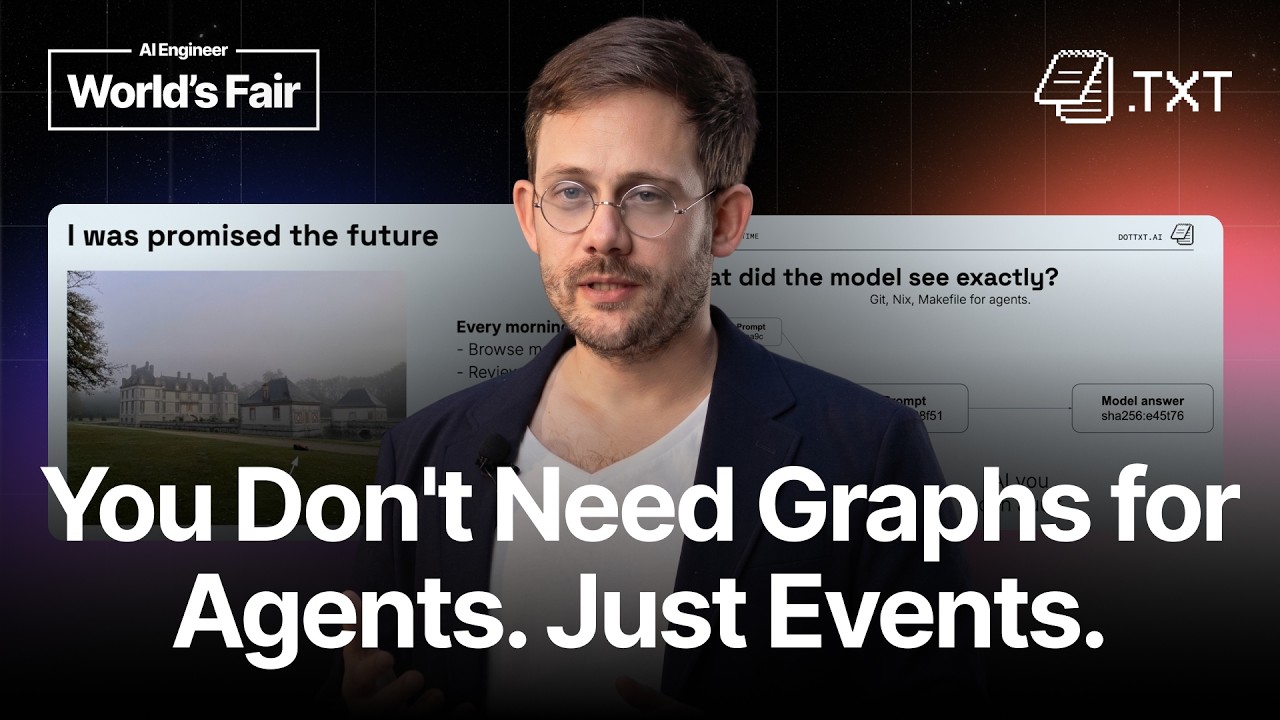
From the articleLouf emphasized the importance of an event-driven architecture, contrasting it with graph-based approaches.
Reliable Agent InfrastructureOutcome
company .txt builds systems for truly autonomous and dependable agents
From the article 2 mentionsLouf, whose company builds infrastructure for reliable agents, argued that the prevailing frameworks are "harmful" because they often fall short of delivering truly autonomous agents.
Contents(5)

Rémi Louf, CEO of .txt, presented a compelling case against current agent frameworks at the AI Engineer World's Fair. Louf, whose company builds infrastructure for reliable agents, argued that the prevailing frameworks are "harmful" because they often fall short of delivering truly autonomous agents. He shared his personal journey over two weeks in January, spurred by significant improvements in AI agents, to understand their capabilities and identify better building primitives.

Rémi Louf: Agent Frameworks Are "Harmful" - AI Engineer
Rémi Louf: Agent Frameworks Are "Harmful", AI Engineer

The Promise of Autonomous Agents

Louf began by illustrating his ideal vision of an autonomous morning routine: a "morning briefing with my coffee." This would involve agents automatically browsing market news, reviewing his CRM and Jira, and processing long voice notes recorded during his walks. However, he found that current AI tools, while capable of coding and other tasks, often require continuous user input, likening it to "having a robot mower that you still have to stay on." He critiqued the transitional nature of current solutions, such as apps that feel like "SSH with vibes," where users are still actively managing the agent.

From Frustration to Building

Frustrated by the limitations, Louf decided to build his own solution, starting with the "simplest thing that could possibly work." He found that while coding frameworks exist, the real challenge lay in prompt editing. He discovered that using YAML frontmatter, as opposed to pure code, made implementing agents easier, allowing for versioning, diffing, and PR reviews. The system also leverages cron jobs for scheduling and emits events for new data like voice notes or emails, enabling agents to react dynamically.

Events Over Graphs

Louf emphasized the importance of an event-driven architecture, contrasting it with graph-based approaches. "No edges to maintain, agents subscribe to events," he stated. This event-centric model allows for fan-in and fan-out capabilities and simplifies agent creation, requiring only a file drop and no complex coding. He demonstrated this with a voice note processing agent that accepts a voice note, transcribes it, and emits a new "voice_note.processed" event, which in turn triggers a daily brief agent.

The Runtime Solution

Louf detailed the failures he encountered, such as duplicate Slack messages and vanished voice notes, which led to the development of a robust runtime. Key components include an immutable log for traceability, a proper queue system, and a content-addressed system (akin to Git) for managing prompts and artifacts. This system allows for precise tracking of what went into the model, ensuring auditability and making compaction easier. He also highlighted the ability to perform diffs between runs and replay requests with different models or parameters.

Key Takeaways for Agent Development

Louf concluded with several key lessons for building effective AI agents:

  • Well-executed background agents are "magical," automating tasks and processing information seamlessly.
  • The difficulties encountered are primarily "good old engineering problems" related to orchestration.
  • Open-source models are readily available and "good enough" for many applications, even running locally.
  • The infrastructure category for agents is "unsettled," and Louf advises building before buying to understand specific needs and limitations.
  • Developers building agent frameworks should "eat your own dog food."
  • The field is moving rapidly, necessitating active engagement and experimentation.

Louf stressed the importance of immersing oneself in the technology, as his two-week experiment fundamentally shifted the trajectory of his company. He encouraged others to "steal this code" from his GitHub repository, emphasizing that it's not a product they intend to sell.

© 2026 StartupHub.ai. All rights reserved. You may not republish this article in full without a license. Search engines and AI research tools may crawl and summarize for reference. Bulk reproduction or model training requires a license. See our terms.
Daniel Singer

Written by

Daniel Singer

Editor, StartupHub.ai

Daniel Singer is the editor of StartupHub.ai, a technology expert and thought leader on AI and its applications across sectors, from fintech and healthcare to developer tooling and consumer software. He writes and tests the tools covered here thoroughly and regularly, and built StartupHub.ai to give founders, operators and buyers a clearer read on what they are actually being sold.