


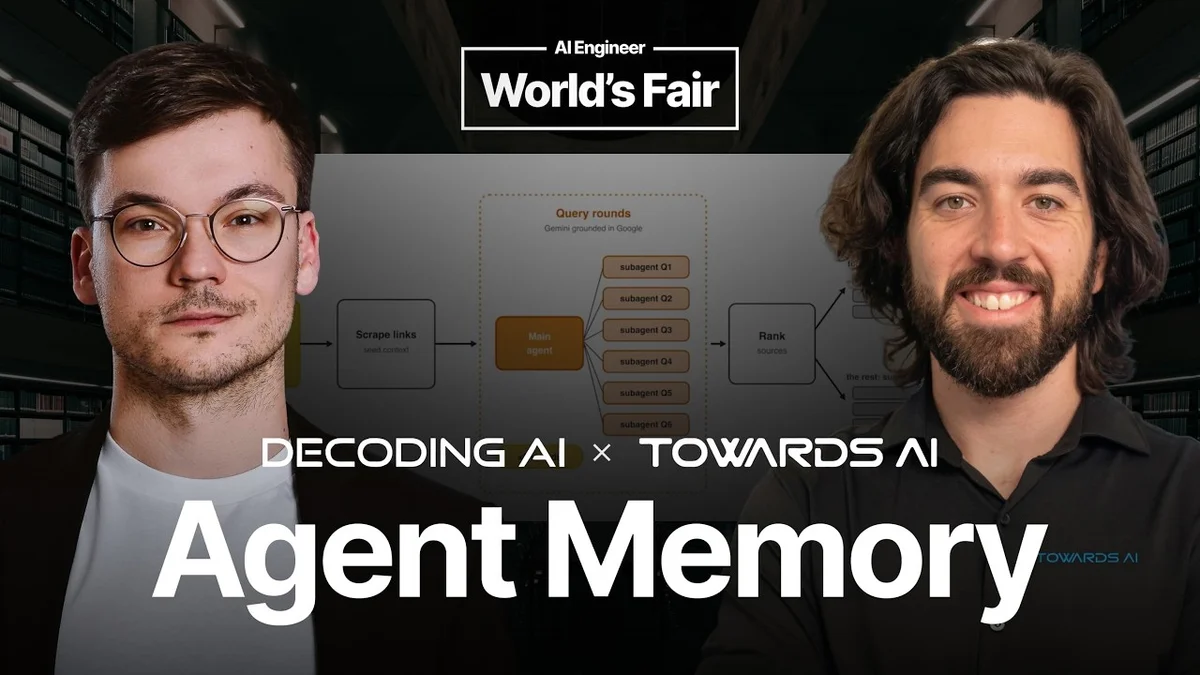
Paul Iusztin and Louis-François Bouchard on Turning Notes Into Memory

Paul Iusztin of Decoding AI and Louis-François Bouchard of Towards AI discuss effective strategies for transforming thousands of notes into lasting memory.

4 min read
Paul Iusztin and Louis-François Bouchard discussing memory techniques and AI for learning
AI Engineer

In an insightful conversation for anyone grappling with information overload, Paul Iusztin of Decoding AI and Louis-François Bouchard of Towards AI recently shared their strategies for converting thousands of notes into lasting memory. The discussion, titled "Turn 10,994 Notes Into Memory," delves into practical methodologies and potential AI-driven tools that can transform how individuals learn and retain knowledge from vast personal archives. This exchange is particularly relevant in an age where digital note-taking is ubiquitous, but effective recall often remains a challenge.
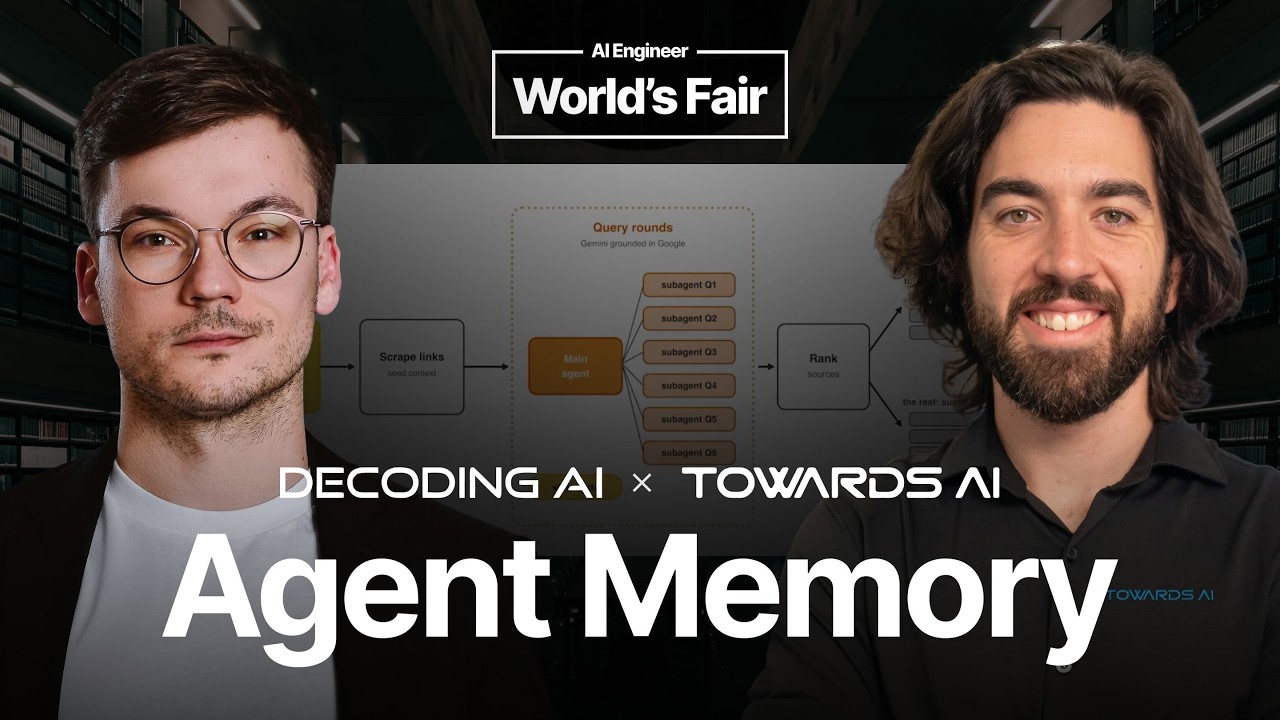
Paul Iusztin and Louis-François Bouchard on Turning Notes Into Memory - AI Engineer
Paul Iusztin and Louis-François Bouchard on Turning Notes Into Memory — from AI Engineer

Who Are Paul Iusztin and Louis-François Bouchard

Paul Iusztin is known for his work with Decoding AI, a platform focused on making complex AI concepts accessible and understandable. His background likely involves a deep understanding of machine learning and its practical applications, including how AI can augment human cognition and learning. His perspective in this discussion would naturally lean towards leveraging intelligent systems for knowledge management.

Related startups

Louis-François Bouchard is a prominent figure at Towards AI, a leading media platform for artificial intelligence and data science. As a co-founder and CEO, he has a broad view of the AI landscape and its implications across various domains. His contributions often highlight the intersection of AI research, practical implementation, and community building, making him well-versed in discussions about learning and knowledge dissemination.

The Challenge of Information Overload

The core premise of the discussion revolves around a common modern dilemma: the accumulation of vast amounts of digital notes without a clear, effective system for internalizing that information. Many individuals, especially in fast-paced fields like technology and AI, find themselves taking thousands of notes from articles, books, lectures, and meetings. The sheer volume can be overwhelming, leading to a sense that valuable insights are being lost or forgotten.

Iusztin and Bouchard address this directly, acknowledging that simply having notes is not enough. The crucial step is transforming these passive records into active, retrievable memories. This transformation requires deliberate strategies beyond simple storage.

Strategies for Knowledge Retention

While the specifics of their individual methods are detailed in the video, the conversation broadly explores several key strategies. These likely include techniques rooted in cognitive science, such as active recall and spaced repetition. Active recall involves retrieving information from memory rather than passively rereading it, which significantly strengthens neural pathways. Spaced repetition schedules review sessions at increasing intervals, optimizing retention over time.

The discussion also touches upon the importance of organizing notes in a way that facilitates retrieval and connection. This could involve hierarchical structures, tagging systems, or graph databases that map relationships between different pieces of information. A well-organized note system acts as a second brain, but only if the information within it is regularly engaged with and consolidated into long-term memory.

Leveraging AI for Memory Enhancement

Given the backgrounds of both speakers, a significant portion of the conversation likely explores how artificial intelligence can aid in this process. AI tools can analyze notes, identify key concepts, and even generate questions for active recall. For example, natural language processing (NLP) could be used to summarize lengthy texts or extract critical data points, making notes more digestible.

Furthermore, AI algorithms could personalize learning paths, suggesting which notes to review and when, based on an individual's past performance and learning patterns. This could take the form of intelligent flashcard systems or personalized quizzing tools that adapt to the user's progress. The goal is to move beyond static note-taking to a dynamic, AI-powered memory system that actively supports learning.

Practical Advice for Note-Takers

The discussion offers practical advice for anyone looking to improve their note-taking and memory retention. This includes tips on how to structure notes for better recall, methods for integrating new information with existing knowledge, and routines for consistent review. They emphasize that building a robust memory system is an ongoing process that requires discipline and the right tools.

For instance, they might recommend specific digital tools or applications that facilitate these strategies. The conversation likely highlights the importance of not just collecting information, but actively processing, synthesizing, and applying it. This active engagement is what ultimately turns a collection of notes into a well-integrated knowledge base within one's mind.

The Future of Learning and AI

Ultimately, the conversation between Paul Iusztin and Louis-François Bouchard underscores a broader trend: the increasing integration of AI into personal learning and productivity workflows. As AI capabilities grow, its potential to enhance human cognitive functions, including memory and learning, becomes more pronounced. This discussion serves as a valuable guide for individuals seeking to harness these advancements to better manage and leverage their intellectual capital.

© 2026 StartupHub.ai. All rights reserved. Do not enter, scrape, copy, reproduce, or republish this article in whole or in part. Use as input to AI training, fine-tuning, retrieval-augmented generation, or any machine-learning system is prohibited without written license. Substantially-similar derivative works will be pursued to the fullest extent of applicable copyright, database, and computer-misuse laws. See our terms.