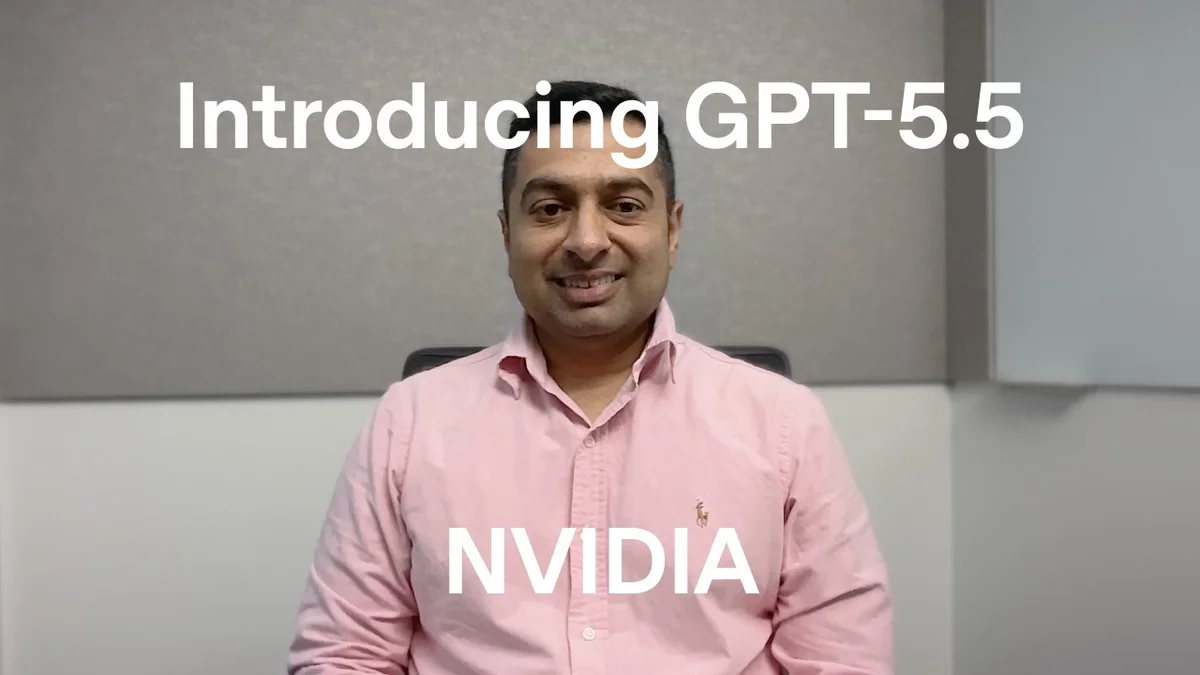
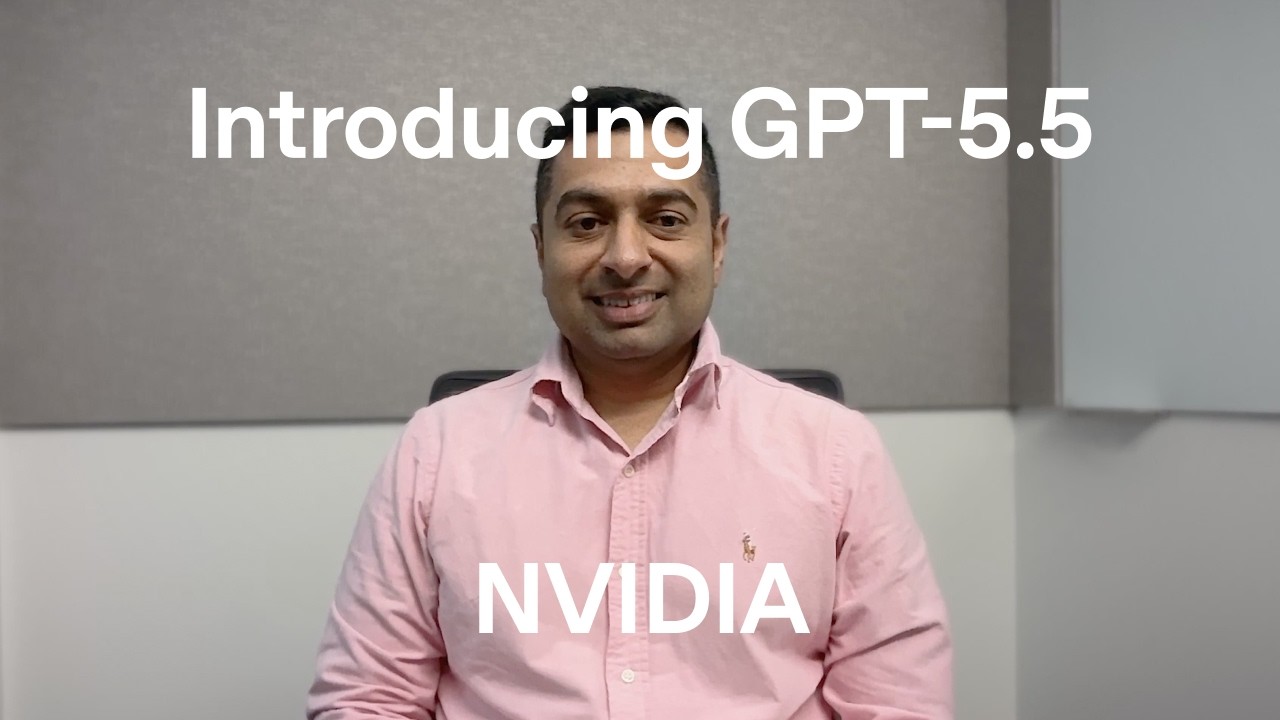
Shaunak Joshi, an AI Researcher at NVIDIA, shares his excitement about GPT-5.5, a new iteration of OpenAI's language model. In a brief but impactful presentation, Joshi highlights the significant advancements in both the model's creative capabilities and its efficiency in accelerating AI research workflows. His insights suggest a leap forward in how AI can assist researchers in discovery and development.
Joshi's background at NVIDIA, a company at the forefront of AI hardware and software development, lends significant weight to his observations. His role as an AI researcher positions him to understand the practical implications of new model advancements for the broader AI community.
The full discussion can be found on OpenAI Youtube's YouTube channel.
Introducing GPT-5.5: A Leap in Creativity and Efficiency
Joshi describes a key moment of realization with GPT-5.5: "I think the magic moment was just the fact that it had enough intelligence to come back to me with a solution, based on this very abstract question that I asked it." This indicates a level of sophisticated reasoning and problem-solving ability that surpasses previous models. The AI's capacity to return with a refined solution, rather than just a direct answer, points to a more nuanced and insightful interaction.
He further elaborates on the model's creative potential, stating, "it seems to be a lot more creative than some of the competitors." This suggests that GPT-5.5 is not merely generating plausible text but is capable of novel and imaginative output, a crucial factor for tasks requiring original thought and exploration.
Accelerating AI Research with GPT-5.5
A significant aspect of Joshi's discussion revolves around the practical impact of GPT-5.5 on the AI research process. He notes that the model's capabilities extend to streamlining complex workflows. "I will talk to it or prompt it, and it'll come back to me with an even more brilliant idea," he explains. This highlights a collaborative dynamic where the AI acts as a creative partner, suggesting novel avenues for research.
The most striking claim from Joshi is the dramatic improvement in experimental speed. He quantifies this advancement: "It's been a 10X speed improvement in terms of running experiments because it's able to handle the end-to-end workflow." This 10x speedup is a substantial gain for AI researchers, who often spend considerable time on experimental design, implementation, and execution. The ability of GPT-5.5 to manage the entire experimental cycle, from identifying research ideas to training models, promises to significantly accelerate the pace of discovery in the field.
Joshi details this end-to-end capability: "like find research ideas and then write the scripts on machine learning infrastructure to go ahead and train models." This comprehensive functionality means researchers can leverage GPT-5.5 to automate much of the manual labor involved in experimentation. The model can not only propose innovative research directions but also translate those ideas into executable code and manage the subsequent training processes, a remarkable feat that could democratize advanced AI research.
The Trace Explorer Tool
The video also showcases a tool called 'Trace Explorer,' which appears to be a visualization platform designed to help researchers understand complex AI models and their relationships. Joshi uses this tool to demonstrate how GPT-5.5 can help map out research areas and connections between different algorithms. The visual representation in Trace Explorer, with its interconnected nodes, suggests a method for navigating and comprehending vast amounts of research data.
He explains the utility of such a tool in conjunction with GPT-5.5: "I build a knowledge graph and help you visualize all the ideas within the files that you've dumped and pointed me towards." This implies that researchers can feed their research papers, code, or datasets into the system, and GPT-5.5, aided by Trace Explorer, can synthesize this information into a structured and visual knowledge base. This capability can be invaluable for identifying gaps in research, understanding the lineage of ideas, and discovering novel connections that might otherwise be missed.