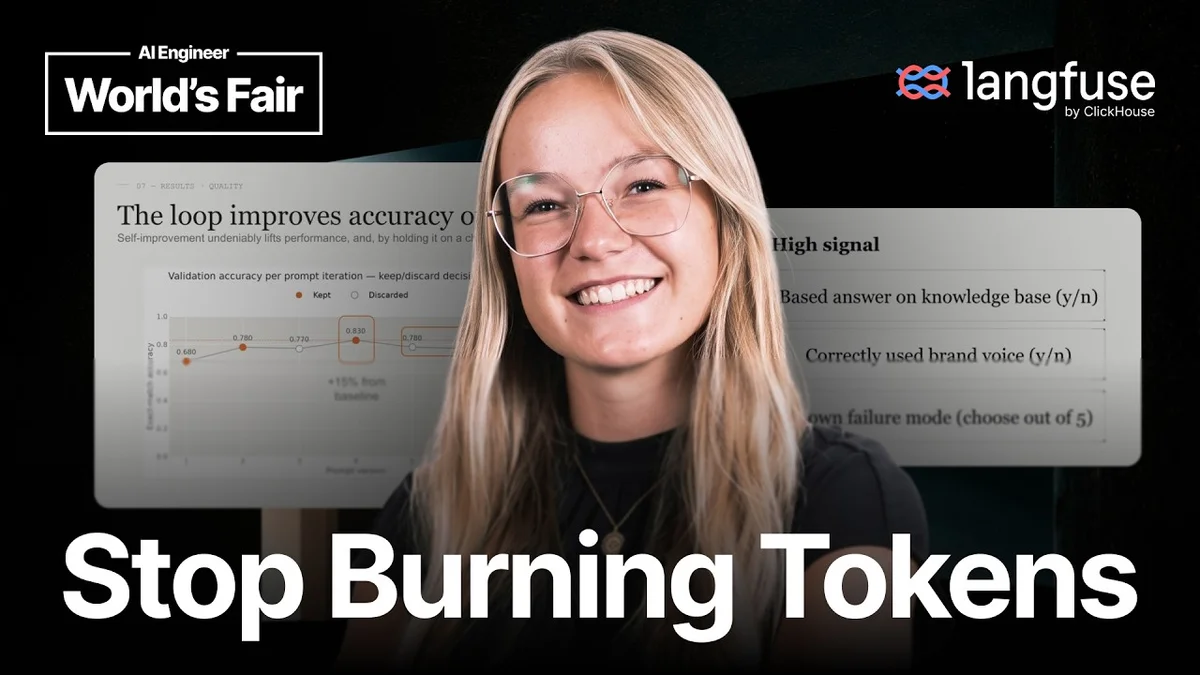
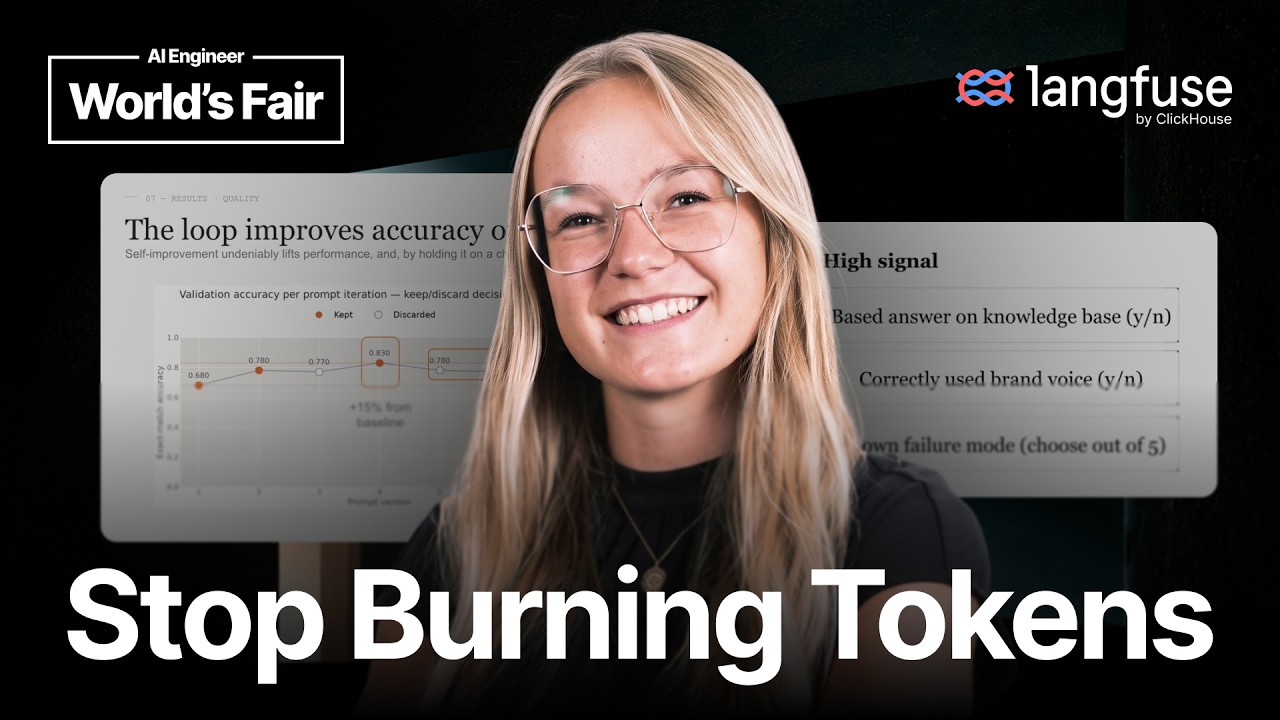
Langfuse: Domain Expertise Crucial for AI Self-Improvement

Langfuse's Annabelle Schäfer explains why domain expertise is crucial for AI self-improvement, advocating for high-signal target functions and expert-driven data.

Presentation slide showing 'Stop burning tokens: Self-improvement needs domain expertise first' with Langfuse logo.
AI Engineer
Visual TL;DR
AI Self-ImprovementContext
industry buzz about 'loops' and 'auto-optimization' for AI agents
From the articleSchäfer outlined a three-step approach to building effective self-improvement systems:
Ambiguous TargetsDriver
relying solely on prompt engineering leads to poorly defined AI goals
From the article 7 mentionsA key challenge, Schäfer explained, lies in defining clear target functions, especially for AI applications in specialized domains like healthcare or legal compliance.
Domain ExpertiseCore
Annabelle Schäfer advocates for deep understanding of specific AI operating domains
From the article 4 mentionsBy focusing on domain expertise and high-signal feedback, developers can build more reliable and performant AI applications.
High-Signal FeedbackEffect
meticulously defining goals and ensuring clear, quantifiable feedback mechanisms
From the article 4 mentionsSchäfer then addressed the challenge of translating this "right/wrong" high-signal feedback to other, less deterministic AI applications.
Langfuse PlatformCore
open-source observability and evaluation platform for AI systems
From the article 3 mentionsTheir platform supports a workflow that includes tracing, monitoring, building datasets, experimenting, and evaluating AI outputs.
Expert-Driven DataEffect
crucial for translating high-signal feedback to diverse AI applications
From the article 2 mentionsShe stressed that great target functions require sufficient data volume and high-signal evaluators, often developed through collaboration with domain experts.
Successful AI LoopsOutcome
achieving robust, self-improving AI systems through clear objectives
From the article 4 mentionsSchäfer began by referencing prominent figures in the AI space, such as Boris Journy and Peter Steinberger, who advocate for designing "loops" rather than relying solely on prompt engineering for AI agents.
Contents(6)

In the rapidly evolving AI landscape, the drive towards self-improving systems is paramount. However, achieving this requires more than just sophisticated algorithms; it demands a deep understanding of the specific domain in which the AI operates. Annabelle Schäfer, Growth Engineer at Langfuse, a leading open-source observability and evaluation platform for AI systems, recently highlighted this critical point in a presentation titled "Stop Burning Tokens: Why self-improvement needs domain expertise first." Schäfer emphasized that while the industry buzz is all about "loops" and "auto-optimization," the success of these systems hinges on meticulously defining their goals and ensuring high-signal feedback mechanisms.

Companies working on this

StartupHub profiles of the companies this article names, with funding and a one-liner from our database.

Langfuse
$3M
Open-source LLM engineering platform for debugging, monitoring, and improving production-grade LLM applications.
Databricks
$190.0B
A unified data analytics and AI platform built on the lakehouse architecture.
New Relic
$6.5B
A data observability company that helps enterprises monitor, debug, and optimize their software stack.
Langfuse: Domain Expertise Crucial for AI Self-Improvement - AI Engineer
Langfuse: Domain Expertise Crucial for AI Self-Improvement, from AI Engineer

The Challenge of Ambiguous Targets

Schäfer began by referencing prominent figures in the AI space, such as Boris Journy and Peter Steinberger, who advocate for designing "loops" rather than relying solely on prompt engineering for AI agents. She noted that the recent surge in interest around auto-research and auto-improvement topics, while promising, often stems from a developer-centric perspective.

A key challenge, Schäfer explained, lies in defining clear target functions, especially for AI applications in specialized domains like healthcare or legal compliance. Unlike coding, where a clear binary outcome like "does it compile" serves as a straightforward target, many AI applications deal with far more nuanced and subjective goals. She illustrated this with a diagram showing a winding path from a "start" point to an "optimal destination," often obscured by challenges like storms and rough terrain. This visual metaphor underscores that the initial targets given to AI agents are inherently incomplete, and discovering the true optimal path requires iterative refinement and a deep understanding of the problem space.

Langfuse's Approach to Improvement Loops

Langfuse, Schäfer explained, is building the infrastructure to facilitate these improvement loops, not just for humans but also for AI agents themselves. Their platform supports a workflow that includes tracing, monitoring, building datasets, experimenting, and evaluating AI outputs. The core idea is to move from "know what's going on" to "find what's interesting/wrong," then to "capture what you want to work," "test hypothesis," and finally "check if it worked." This iterative process, when done correctly, allows teams to continuously upgrade and improve their applications, shipping with confidence.

The Power of Clear, Quantifiable Feedback

Schäfer detailed an experiment conducted by Langfuse to identify the clearest possible target function for an AI agent and to learn from optimizing it. They settled on a single-label classification task, which offers a definitive "yes/no" outcome. For instance, categorizing an item with a true label and a set of available labels allows for a direct comparison: "Is the true label equal to the predicted label?" This provides a clear signal for accuracy calculation.

The experiment involved classifying papers from arXiv. The setup included a dataset split into 200 items for fitting, 100 for validation, and 300 for testing to prevent overfitting. The agent was a simple prompt-based classifier using GPT-5-4-nano, chosen for its cost-effectiveness. The optimization process utilized Claude Opus 4.8, which proposed prompt updates based on the GPT-5-4 prompting guide and a task markdown file describing the loop.

The results were encouraging. The baseline accuracy started at 68%, and after several iterations, it reached 83%, eventually plateauing around 80%. Notably, the first iteration alone yielded a 10% increase in accuracy. The system learned to add general classification approaches, refine decision-making between similar classes, and incorporate examples of frequently confused labels. This demonstrated that even a simple model, when guided by a clear target function and a structured improvement loop, can achieve significant performance gains.

Translating High-Signal Feedback to Diverse Applications

Schäfer then addressed the challenge of translating this "right/wrong" high-signal feedback to other, less deterministic AI applications. She argued that while metrics like correctness, helpfulness, or hallucination are common, they often represent "low signal" feedback, especially when based on scales (e.g., 0 to 1, 1 to 5). For these metrics to be effective for auto-improvement, each point on the scale needs to be meticulously defined with specific criteria, which is often not the case.

Instead, Schäfer advocated for developing "high signal" target functions that translate quality criteria into clear yes/no answers. Examples include:

  • "Is the answer based on the knowledge base?" (Yes/No)
  • "Is the brand voice correctly used?" (Yes/No)
  • "Did we ensure our brand name was written correctly?" (Yes/No)
  • "Were any known failure modes triggered?" (Categorize out of 5)

She stressed that great target functions require sufficient data volume and high-signal evaluators, often developed through collaboration with domain experts. These experts can provide concrete examples, identify nuanced failure modes, and define what "good" truly means in a specific context.

The Path Forward: Expertise, Data, and Generalization

Schäfer outlined a three-step approach to building effective self-improvement systems:

  1. Work with your experts: Use them to create examples, analyze sample runs, identify failure modes, and define what "good" means.
  2. Review production data as a human: It's impossible to capture the full scope initially. Scale your dataset with production traces and behaviors to identify typical failure modes.
  3. Design a system that generalizes: Incorporate validation sets, provide clear instructions for generalization, and include escape hatches to prevent token burning when the system hits a wall.

Ultimately, Schäfer concluded, the goal is to create systems where humans and AI agents collaborate on continuous improvement, rather than simply burning tokens on inefficient processes. By focusing on domain expertise and high-signal feedback, developers can build more reliable and performant AI applications.

© 2026 StartupHub.ai. All rights reserved. You may not republish this article in full without a license. Search engines and AI research tools may crawl and summarize for reference. Bulk reproduction or model training requires a license. See our terms.
Daniel Singer

Written by

Daniel Singer

Editor, StartupHub.ai

Daniel Singer is the editor of StartupHub.ai, a technology expert and thought leader on AI and its applications across sectors, from fintech and healthcare to developer tooling and consumer software. He writes and tests the tools covered here thoroughly and regularly, and built StartupHub.ai to give founders, operators and buyers a clearer read on what they are actually being sold.

More from Daniel Singer