

Is the Log the Agent? Omnara CEO Challenges AI Convention

Omnara CEO Ishaan Sehgal argues that the 'log' is the true agent, not the model or tools, enabling reliability and portability.

4 min read
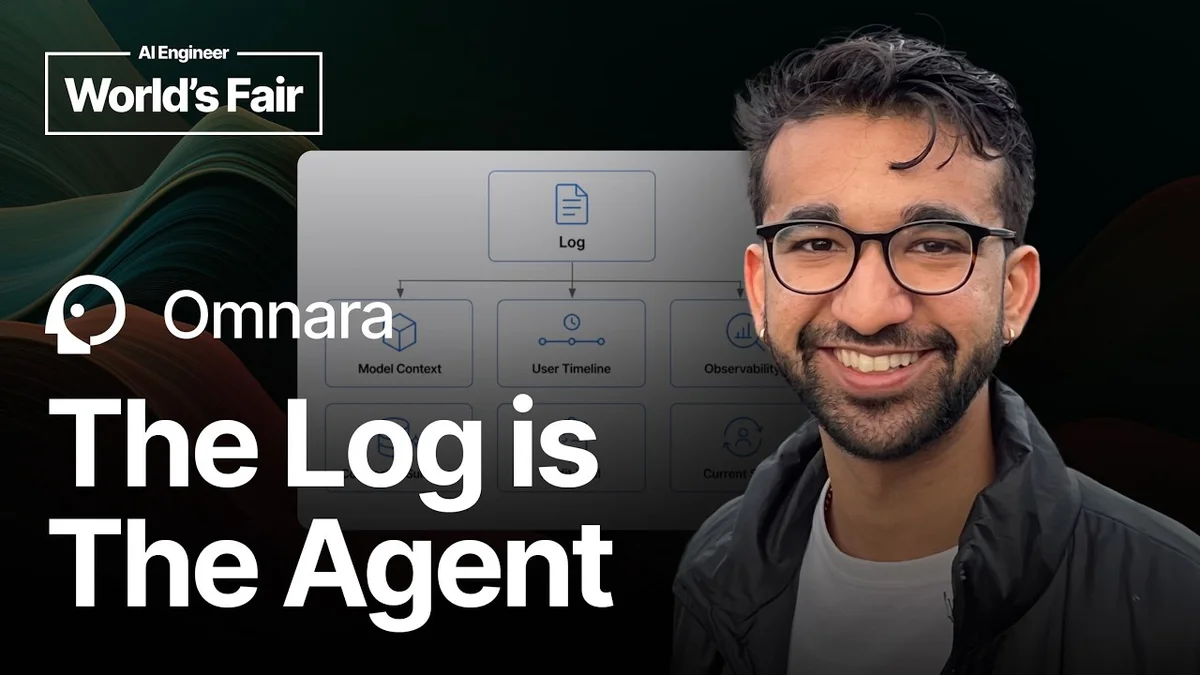
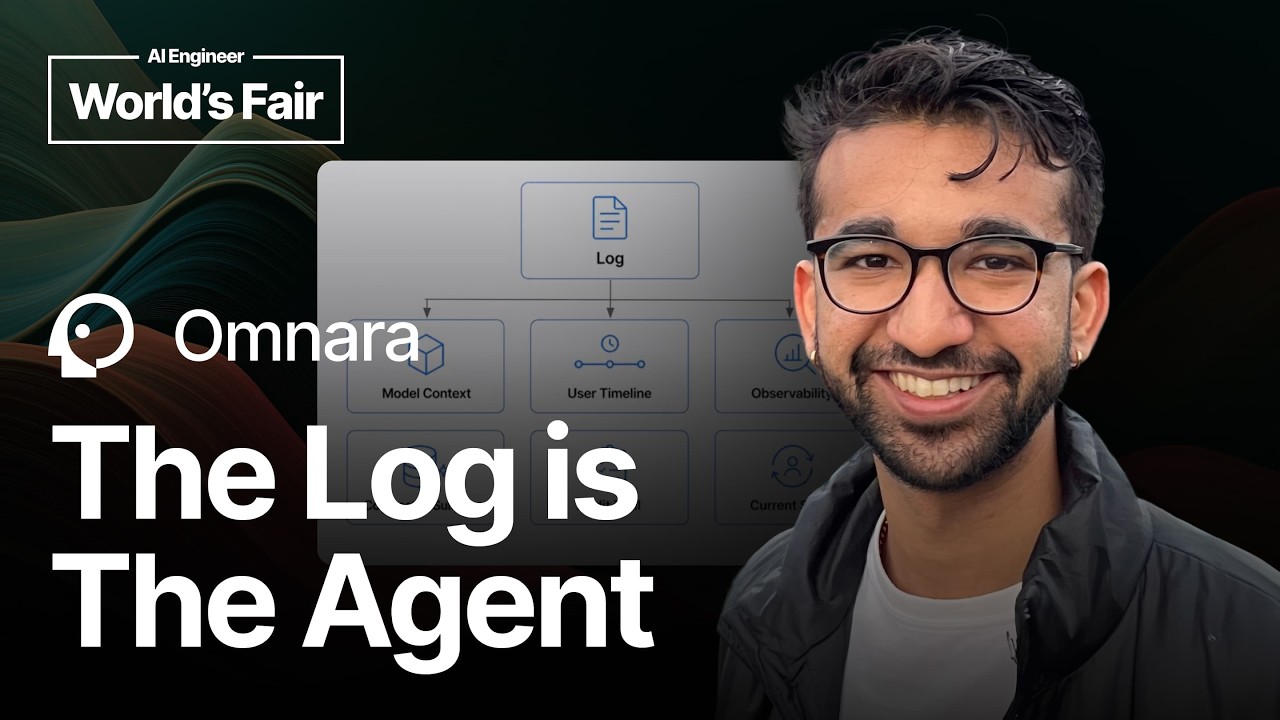
Slide titled 'The Log Is The Agent' with speaker Ishaan Sehgal in a small video window.
AI Engineer

In a compelling presentation, Ishaan Sehgal, CEO of Omnara, shared a provocative thesis: "The Log Is The Agent." Sehgal argues that the conventional understanding of AI agents, often focusing solely on the model or execution environment, misses a crucial element. He posits that the true agent is its persistent log of interactions, which captures its state, history, and identity.
Is the Log the Agent? Omnara CEO Challenges AI Convention - AI Engineer
Is the Log the Agent? Omnara CEO Challenges AI Convention — from AI Engineer

Sehgal contends that most current approaches to building AI agents are fundamentally flawed because they treat the log as a secondary concern, an afterthought rather than the core of the agent's existence. This leads to several critical problems, including a lack of reliability, difficulties in scaling, and problematic vendor lock-in.

Related startups

Rethinking Agent Identity

Sehgal uses the analogy of a video game character to illustrate his point. He asks the audience to consider what defines a character they've spent hours playing, like in Skyrim. Is it the game engine, the console, or the controller? He argues that these are merely the tools or environment. The true essence of the character, its progression, skills, and history, is captured in the save file. Similarly, Sehgal suggests, an AI agent's identity is its log, the append-only history of its interactions, decisions, and outcomes.

He elaborates that when a game crashes or a console is replaced, the save file allows the player to resume exactly where they left off. This is because the save file encapsulates the agent's state. Sehgal believes AI agents need this same durability and continuity. He criticizes the common practice of treating models, tools, and runtimes as the agent, pointing out that these components can be swapped or fail without consequence if the agent's true state, its log, is preserved.

The Log as the Primitive

Sehgal defines the log as an append-only event history. This includes user input, model input/output, tool calls, permission requests, human approvals, and tool results. He presents a simplified loop where a worker reconstructs the agent's state from the log, gets the next response from the model, and appends the outcome back to the log. This continuous read-and-append cycle is the fundamental operation of an agent.

He draws a parallel to databases, which long ago learned the importance of logs for durability and consistency. Sehgal notes that while databases have evolved to use logs as the primary source for generating tables, indices, and caches, AI agents are still largely treating logs as a side effect. This leads to a brittle architecture where components like models, tools, and sandboxes are tightly coupled, making them difficult to swap or upgrade without data loss.

Addressing Objections: Compaction and State

Sehgal anticipates objections, primarily concerning the potential for logs to grow infinitely and become unmanageable. He addresses this by distinguishing between the log and its projections, such as compacted summaries or materialized views. He argues that while compaction is necessary for efficiency, it should not replace the log itself. Losing the raw log means losing the agent's true history and the ability to reconstruct its state perfectly.

He also highlights the problem of "log lock-in," where the format or provider of the log dictates the choice of models and tools. If a provider owns the log, they effectively own the agent. This is why a durable, portable, and queryable log is crucial for agent development.

Properties Derived from the Log

Sehgal outlines several properties that emerge when the log is treated as the primary component of an agent:

  • Reliability: If a worker or machine fails, a new one can read the log and resume the agent's state and task without interruption.
  • Scalability: One process can manage thousands of agents, each independently advancing its state based on its log.
  • Forking: The log allows for easy branching, enabling agents to explore different strategies or models concurrently from the same history.
  • Multiplayer: Multiple users or agents can share access to a log, allowing for collaborative work or observation without losing continuity.
  • Migration/Model Portability: An agent's identity is tied to its log, not its specific model, making it easier to swap out models or providers without losing the agent's state.

Sehgal concludes by emphasizing that the current practice of treating logs as side effects is a significant architectural weakness. By embracing the log as the agent's core, developers can build more robust, scalable, and flexible AI systems.

© 2026 StartupHub.ai. All rights reserved. Do not enter, scrape, copy, reproduce, or republish this article in whole or in part. Use as input to AI training, fine-tuning, retrieval-augmented generation, or any machine-learning system is prohibited without written license. Substantially-similar derivative works will be pursued to the fullest extent of applicable copyright, database, and computer-misuse laws. See our terms.