

IBM's Martin Keen on AI Human-in-the-Loop Spectrum

IBM's Martin Keen explains the human-in-the-loop spectrum for AI, detailing how human involvement is crucial in training, tuning, and inference stages.

4 min read
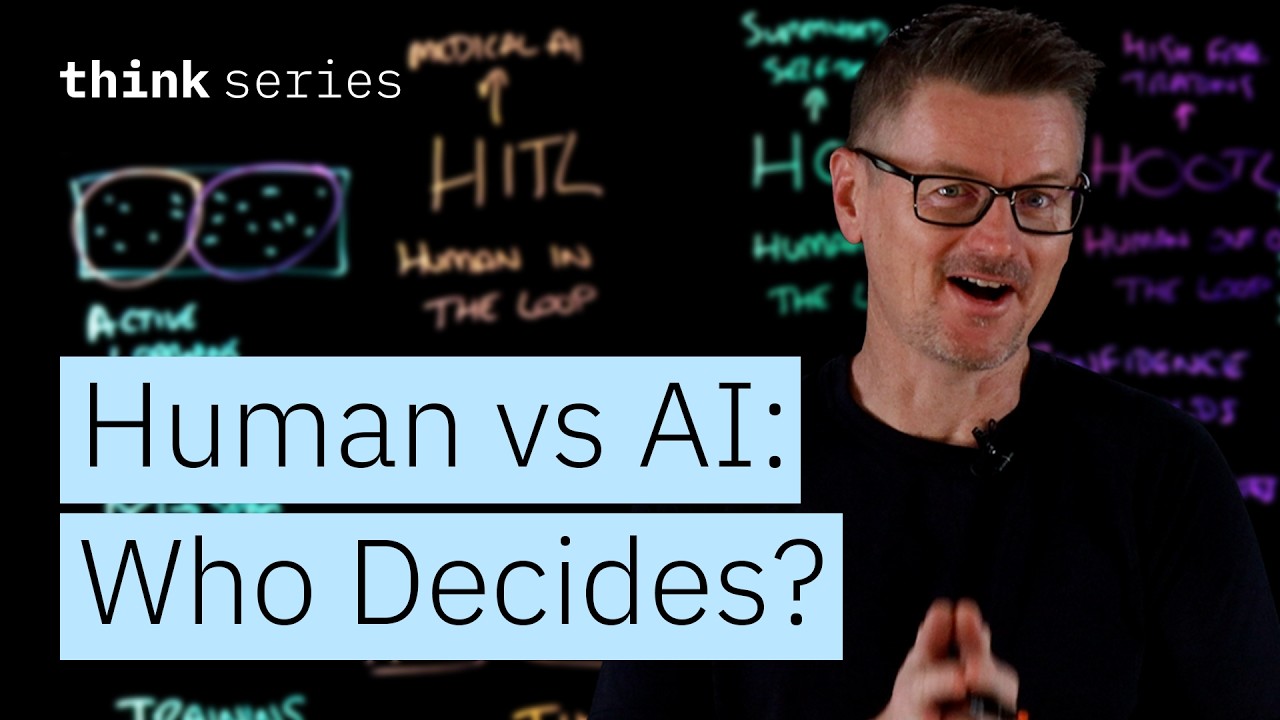
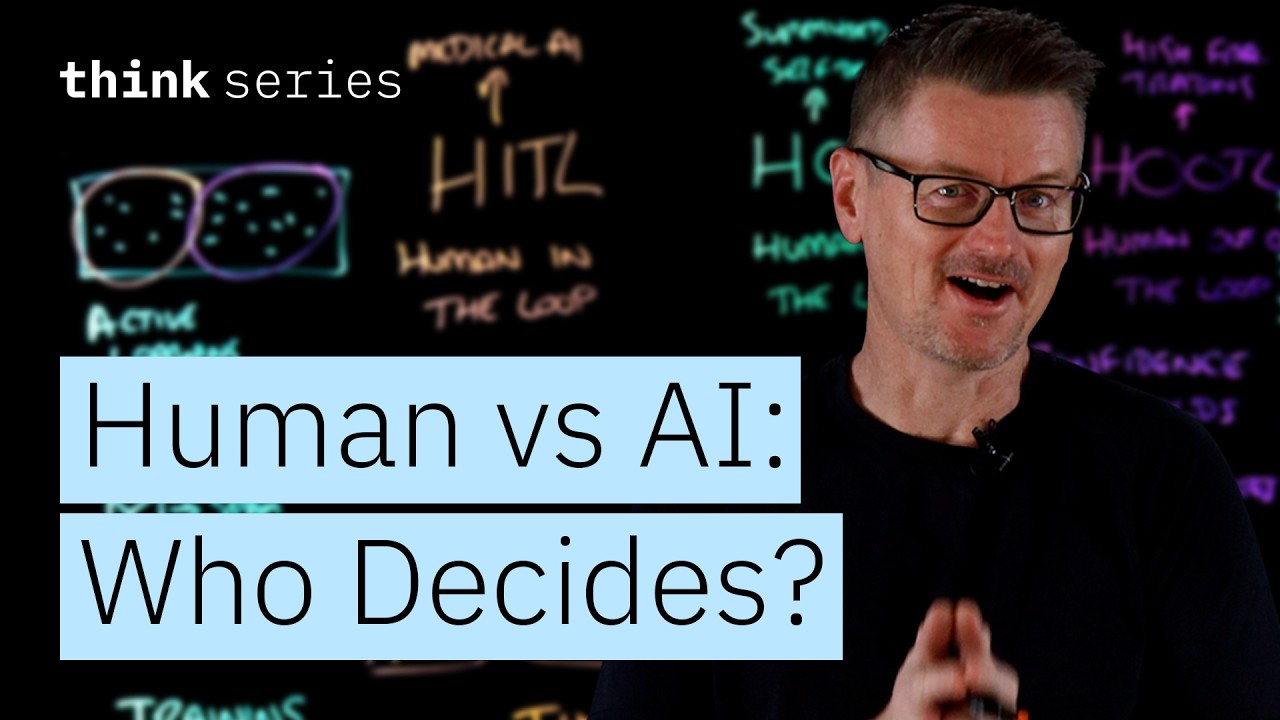
Martin Keen, IBM Master Inventor, stands in front of a black background with 'HUMAN-IN-THE-LOOP' written in neon green.

Martin Keen, a Master Inventor at IBM, breaks down the nuanced concept of the 'human-in-the-loop' (HITL) for artificial intelligence systems. In a clear and concise explanation, Keen illustrates that HITL is not a binary state but rather a spectrum of human involvement, crucial for the development and deployment of reliable AI.

Understanding the Human-in-the-Loop Spectrum

Keen frames the core question of HITL as determining how much human oversight is necessary for an AI to perform a given task. He outlines three key positions on this spectrum: 'human in the loop,' 'human on the loop,' and 'human out of the loop.'

In a 'human in the loop' system, the AI performs a task but pauses to allow human approval or intervention before proceeding. This is exemplified by medical AI that flags potential tumors on an X-ray, requiring a radiologist to make the final diagnosis. The stakes are high, and human judgment is critical to avoid false positives or negatives.

The full discussion can be found on IBM's YouTube channel.
What is Human In The Loop with AI? How HITL Shapes AI Systems - IBM
What is Human In The Loop with AI? How HITL Shapes AI Systems — from IBM

The 'human on the loop' model involves the AI operating autonomously but under human supervision. A prime example is a self-driving car that can handle most driving scenarios but requires the human driver to remain attentive and ready to take over if necessary. The human acts as a safety net, monitoring the AI's performance and intervening when situations become too complex or dangerous.

Finally, 'human out of the loop' represents full AI autonomy, where the system operates entirely independently without human oversight. While this is the ultimate goal for some AI applications, Keen notes that it's often not feasible or desirable due to the complexity and potential risks involved, particularly in high-stakes environments.

Key Stages and Human Intervention

Keen elaborates on how human involvement is critical across different stages of the AI lifecycle:

  • Training: This is where AI models learn from data. For supervised learning, humans are essential for labeling vast datasets, such as identifying images as 'stop signs' or emails as 'spam.' Keen highlights that without this labeled data, the AI has no ground truth to learn from, making the process costly and time-consuming.
  • Tuning: Once a model is trained, it often requires fine-tuning to align with specific objectives or human preferences. Techniques like Reinforcement Learning from Human Feedback (RLHF) are employed here. In RLHF, the AI generates multiple responses to a prompt, and humans rank or select the best one. This feedback is used to train a separate reward model, which then guides the AI's behavior to produce more desirable outputs. This process is vital for making LLMs more helpful, honest, and harmless.
  • Inference: This is the stage where the AI is deployed and actively making predictions or taking actions. Here, human oversight can manifest in several ways:
    • Confidence Thresholds: The AI might be programmed to flag outputs where its confidence level is below a certain threshold, prompting human review.
    • Approval Gates: Similar to the 'human in the loop' model, humans might need to explicitly approve critical actions before they are executed.
    • Escalation Queues: For routine tasks handled by AI, edge cases or uncertain situations can be routed to human operators for resolution.

The Trade-offs: Scalability vs. Consistency

Keen points out the inherent trade-offs in human-AI collaboration. While human intervention can improve accuracy and safety, it introduces bottlenecks. Scalability is a major concern; human review of every AI decision is often impractical, especially for systems processing millions of data points per second, like in high-frequency trading.

Conversely, relying solely on AI without human oversight can lead to consistency issues. Human biases, fatigue, and subjective interpretations can lead to variations in labeling data, impacting the AI's performance. The goal, therefore, is to strike an optimal balance, leveraging human intelligence where it adds the most value without hindering efficiency.

Keen concludes by emphasizing that the ultimate aim is not to remove humans from the loop entirely, but to strategically integrate them at points where their judgment is most critical, ensuring the AI's development and deployment are both effective and responsible.