Artificial Intelligence

Claude's Watermark: No Big Deal for Marketers

Anthropic's new AI watermark is a compliance measure, not a ranking factor. Marketers can rest easy as Google focuses on content quality, not origin.

StartupHub.ai Staff

By StartupHub.ai Staff, reviewed by Daniel Singer, Editor

4 min read

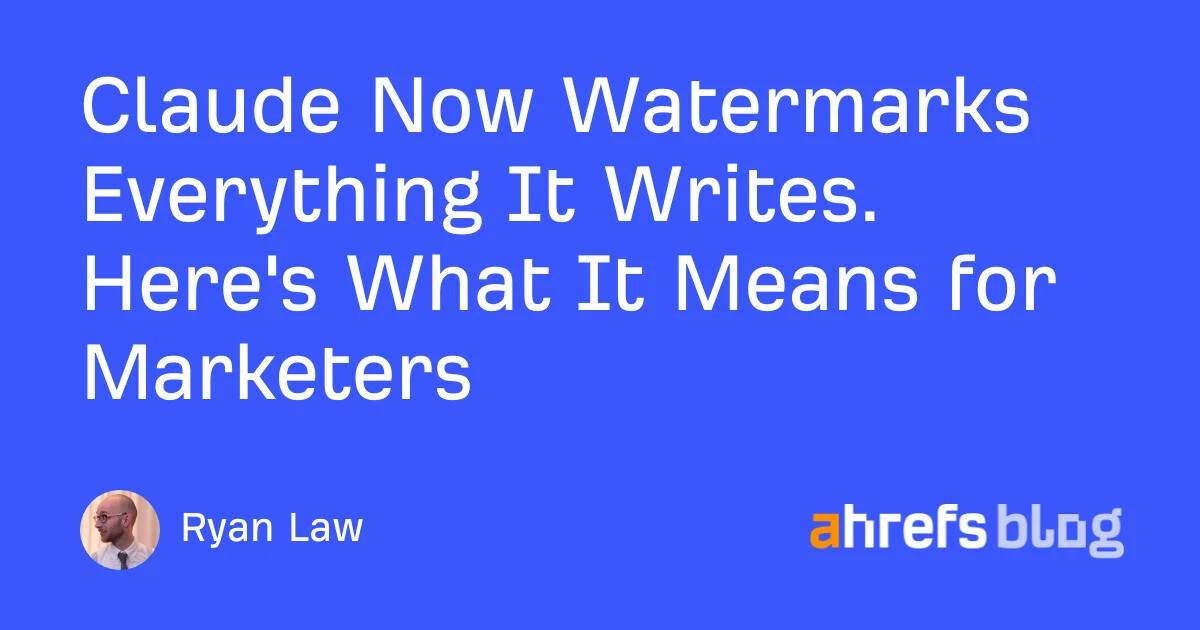
Illustration of AI code with a subtle watermark pattern
Credit: Ahref Blog
Visual TL;DR
EU AI ActDriver
mandates generative AI systems mark their output for transparency and compliance
From the article 2 mentionsThe watermark is designed to be machine-readable, surviving copy-paste and some editing, and is part of Anthropic's compliance with the European Union's AI Act.
Anthropic's AI WatermarkCore
From the article 9+ mentionsAnthropic has begun embedding an invisible watermark into all text generated by its Claude AI models.
Other AI ProvidersContext
Google, Meta, Microsoft, OpenAI expected to follow suit within months
From the article 4 mentionsWhile Anthropic is the first to implement a visible system, other major AI providers are expected to follow suit within months.
Survives Copy-PasteContext
technology subtly nudges AI word choices, surviving editing and copy-paste
From the articleThe watermark is designed to be machine-readable, surviving copy-paste and some editing, and is part of Anthropic's compliance with the European Union's AI Act.
Not Ranking FactorEffect
Ahrefs confirms Google focuses on content quality, not AI origin or watermark
From the article 2 mentionsThis suggests that AI detection, even with watermarks, is unlikely to become a direct ranking signal.
Compliance MeasureContext
primarily a transparency and compliance measure, not a content quality signal
From the articleThe watermark is designed to be machine-readable, surviving copy-paste and some editing, and is part of Anthropic's compliance with the European Union's AI Act.
No Marketer ImpactOutcome
From the article 3 mentionsThis move, while significant from a transparency standpoint, is unlikely to cause major disruption for most marketers, according to Ryan Law, Director of Content Marketing at Ahrefs.
Contents(3)

Anthropic has begun embedding an invisible watermark into all text generated by its Claude AI models. This move, while significant from a transparency standpoint, is unlikely to cause major disruption for most marketers, according to Ryan Law, Director of Content Marketing at Ahrefs. The watermark is designed to be machine-readable, surviving copy-paste and some editing, and is part of Anthropic's compliance with the European Union's AI Act.

The EU AI Act, which became applicable on August 2, 2026, mandates that providers of generative AI systems mark their output. This obligation extends beyond Anthropic; signatories to the EU's Code of Practice on Transparency of AI-generated Content include major players like Google, Meta, Microsoft, and OpenAI. While Anthropic is the first to implement a visible system, other major AI providers are expected to follow suit within months.

How the Watermark Works

The technology involves subtly nudging the AI's word choices towards a predetermined, randomized set of "green" tokens during the generation process. Individually, these choices appear normal. However, across hundreds of words, a pattern emerges that is statistically improbable to occur by chance. This pattern can be detected by those with the necessary "key," which Anthropic currently holds. Importantly, Anthropic notes that a detected mark only indicates content "may have been processed by Claude," not that it was solely written by the AI or that the output is of a certain quality.

The effectiveness of the watermark has limitations. Short passages may not contain enough signal for reliable detection. Heavy rewriting or translation can degrade the mark, and file metadata for image outputs can be stripped through re-saving. Furthermore, detection requires the secret key, meaning external tools or search engines cannot independently verify its presence without cooperation from the AI provider.

No Impact on Google Rankings, Says Ahrefs

Google has consistently maintained that it does not penalize content simply because it is AI-generated. Instead, the search engine giant focuses on content quality and user experience. Ahrefs' own research supports this, showing that 5.3% of top-ranking pages are 100% AI-generated, with another 9% being at least 80% AI. The data indicates a gentle gradient of AI content on SERPs, but no hard line that penalizes AI output outright. This suggests that AI detection, even with watermarks, is unlikely to become a direct ranking signal.

The Ahrefs analysis points out that AI detection is already possible through sophisticated analysis tools, even without watermarking. The company's own Site Explorer can rate the AI content level of any page. The watermark's primary utility, therefore, is likely to be in contractual disputes, such as verifying if an agency fulfilled a promise of human-written content or if a client received what they paid for.

SEO Community Weighs In

The SEO community largely echoes the sentiment that this development will not fundamentally alter search engine optimization strategies. Mark Barrera noted that Google's concern is spam, not AI itself, and a watermark doesn't differentiate between the two. Kevin Briody predicts the emergence of "watermark scrubber" tools, rendering the detection aspect moot for SEO purposes. Bojan Maric added that Google already penalizes thin or spammy content regardless of its origin, making the watermark irrelevant for ranking.

StartupHub.ai data shows that while Google (score 74/100) and OpenAI (score 84/100) are leading AI players, Anthropic (score 76/100) is a significant competitor with its Claude models. The introduction of watermarking by Anthropic, and soon by others, is a regulatory response rather than a technical arms race for content detection. The core challenge for AI developers and marketers remains creating valuable, high-quality content, regardless of the tools used in its creation.

For most marketers, honesty about content creation processes will be key. If AI is used as a tool to assist human writers, summarize research, or refine drafts, as is increasingly common across platforms like Gmail, Notion, and Canva, the watermark is unlikely to pose a problem. The real issue arises only when AI-generated content is deliberately passed off as entirely human-written, particularly when contractual obligations state otherwise.

Mentioned in this story

Markets

Sources

Get the free daily brief every morning

Every morning the day's AI news, new AI startups and new funding rounds. Free and takes a few minutes to read, unsubscribe at any time.

Join 64,000 other subscribers.

TopicsAnthropicClaudeEU AI ActRyan LawAhrefsGoogleOpenAIMeta Platforms

StartupHub.ai StaffDaniel SingerWritten by StartupHub.ai Staff, Editorial teamReviewed by Daniel Singer, EditorAbout

StartupHub.ai Staff, Editorial team

The staff writers of StartupHub.ai, ranging from investment analysts to avid AI tool users, early adopters and critical enthusiasts. Backgrounds span engineering, business and the arts. We hold every piece to rigorous standards of research and review.

Daniel Singer, Editor

Daniel Singer is an AI expert who has been writing about, covering and building AI technology since 2018.

More from Daniel Singer

Test your Agent Readiness now

Paste your website. How well ChatGPT, Claude and the other agents can read and use a site, in about a minute.

Watch

The videos behind the news, one flip at a time

The feed mixes the videos from our articles with startup demos and you flip through them like TV channels for free with no signup.