
Baz's Nimrod Hauser on Bending MCP Servers

Baz's Nimrod Hauser discusses best practices for integrating third-party tools into AI agents, focusing on curation, wrapping, guardrails, and tool composition.

3 min read
Baz's Nimrod Hauser on Bending MCP Servers
AI Engineer

Nimrod Hauser, Founding Engineer at Baz, recently shared insights into the complexities of integrating third-party tools with agentic applications. In a talk titled "Bending a Public MCP Server without Breaking it: A Developer's Guide to Production-Ready Integration," Hauser detailed the challenges and best practices involved in this process.

Baz's Nimrod Hauser on Bending MCP Servers - AI Engineer
Baz's Nimrod Hauser on Bending MCP Servers — from AI Engineer

Meet Nimrod Hauser

Hauser, who identifies as "Employee #1 @ Baz," brings approximately 20 years of experience in backend and data engineering to his role. His background includes work at Salesforce and Bluevoyant, and he has been instrumental in building Baz's code review product for the past few years. His expertise spans cybersecurity, crypto, developer tools, and now, agentic applications.

Agentic Tools and MCP Servers

Hauser began by defining agentic tools and MCP (Multi-Server Communication Protocol) servers. Both have tools in common, essentially functioning as third-party integration code. These are callable functions with descriptions tailored for agentic use. When using MCP servers, agents gain access to these tools.

Related startups

The core challenge lies in ensuring these tools integrate seamlessly and reliably into agent workflows. Many off-the-shelf tools, while powerful, can introduce "context pollution" or lead to unpredictable agent behavior if not properly managed.

Common Tool Integration Challenges

Hauser highlighted three primary challenges in tool integration:

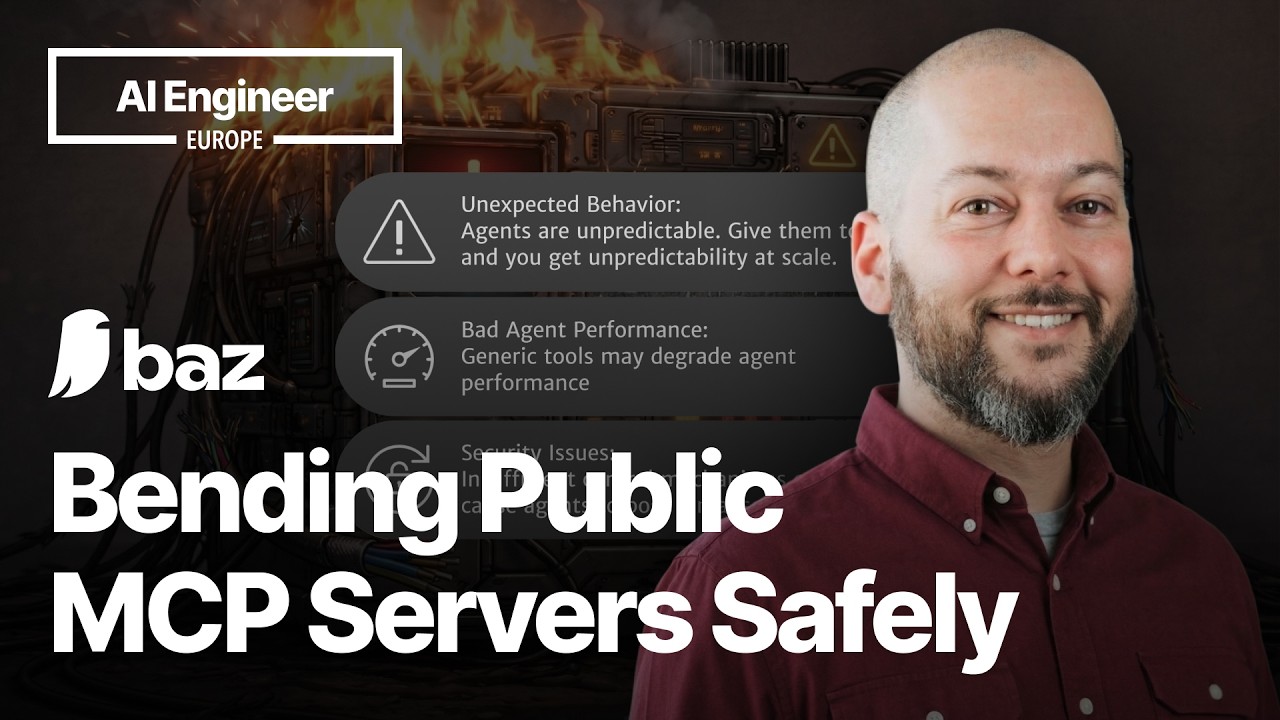
  • Unexpected Behavior: Agents are inherently unpredictable. Providing them with tools amplifies this unpredictability, especially at scale.
  • Bad Agent Performance: Generic tools may not be optimized for specific agent tasks, potentially degrading overall performance.
  • Security Issues: Insufficient control mechanisms for tool usage can pose significant security threats, allowing agents to perform unintended or malicious actions.

To address these, Hauser proposed a framework of five best practices for robust AI agent integration.

The Five Best Practices for Robust AI Agent Integration

The core of Hauser's presentation focused on these five key practices:

  1. Curate 3rd Party Tools: This involves carefully selecting and vetting an agent's toolset to prevent "context pollution." Precise context engineering, Hauser explained, minimizes hallucinations and leads to more predictable, reliable operations.
  2. Wrap 3rd Party Tools: Create a thin wrapper around third-party tools to tailor them to specific use cases. This involves aligning the tool's description with the agent's needs, controlling its "eagerness," providing special instructions, and essentially making the tool your own.
  3. Implement Deterministic Guardrails: Integrate deterministic checks at critical junctures to prevent undesirable agent actions. This acts as a safety net, reducing the likelihood of harmful or incorrect outputs by ensuring agents adhere to specific, predictable behaviors.
  4. Compose New Tools from Existing: Consider using existing tools as building blocks for custom tools. This is particularly useful when a very specific usage pattern is required, or when the context is so specific that it warrants its own description.
  5. Treat Tools as Functions (Occasionally): Sometimes, it's beneficial to treat tools as mere functions, calling them directly and managing their execution flow rather than relying on the agent's interpretation.

Hauser then walked through a practical example using Baz's spec reviewer tool, demonstrating how these principles are applied in a real-world scenario. The demonstration involved using Playwright MCP tools to automate the process of checking requirements against actual implementation, showcasing how the agent navigates web pages, analyzes screenshots, and makes decisions based on visual cues.

The code walkthrough highlighted the importance of clear tool descriptions, proper argument passing, and error handling. Hauser emphasized that while many Playwright tools are generic, wrapping them with specific descriptions and logic can significantly improve agent performance and reliability.

The session concluded with a look at the underlying code, illustrating how these concepts translate into practical Python implementations. Hauser showcased how tools are loaded, filtered, and executed, emphasizing the need for meticulous curation and thoughtful integration to build robust and predictable AI agents.

© 2026 StartupHub.ai. All rights reserved. Do not enter, scrape, copy, reproduce, or republish this article in whole or in part. Use as input to AI training, fine-tuning, retrieval-augmented generation, or any machine-learning system is prohibited without written license. Substantially-similar derivative works will be pursued to the fullest extent of applicable copyright, database, and computer-misuse laws. See our terms.