


Anthropic's Claude Code Creator on AI's Future

Boris Cherny, Head of Claude Code at Anthropic, discusses the evolution of AI models, the future of software engineering, and Anthropic's focus on AI safety.

10 min read
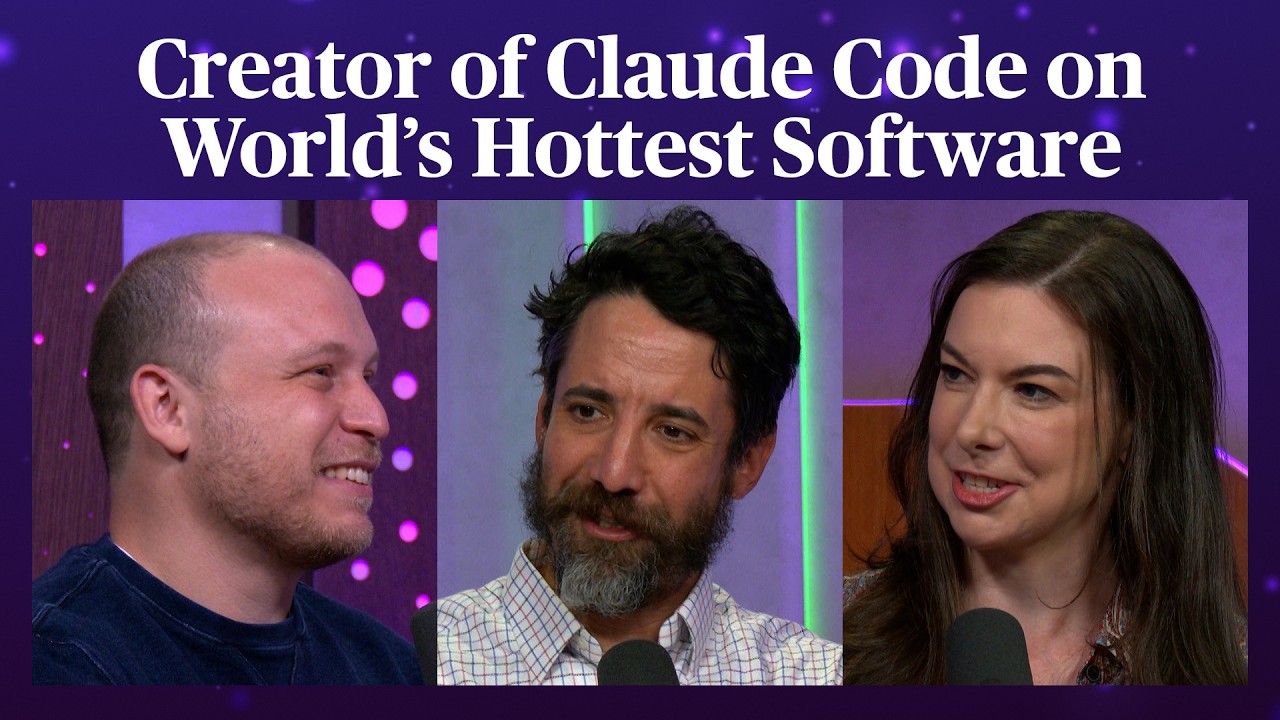
Boris Cherny speaking at a podcast recording, with a microphone in front of him.
Bloomberg Podcast

Visual TL;DR. Early AI Prototypes evolved into Anthropic's Claude Code. Anthropic's Claude Code enables AI as Collaborator. AI as Collaborator driven by Safety & Alignment. Safety & Alignment improves Memory & Intelligence. AI as Collaborator impacts Evolving Software Roles. Evolving Software Roles requires The AI 'Harness'.

  1. Early AI Prototypes: initial experiments with computer use by AI models, like ordering a pizza
  2. Anthropic's Claude Code: Boris Cherny leads building foundational tools like Claude Code and the desktop app
  3. AI as Collaborator: interactions with models like Claude feel more akin to collaborating with a coworker
  4. Safety & Alignment: years of alignment work ensuring models stay on task and maintain coherence
  5. Memory & Intelligence: development of memory and general intelligence allowing sessions to run for weeks
  6. Evolving Software Roles: future of software engineering will involve harnessing AI, not just coding
  7. The AI 'Harness': engineers will focus on guiding and leveraging AI capabilities for complex tasks
Visual TL;DR
Visual TL;DR, startuphub.ai Anthropic's Claude Code enables AI as Collaborator. AI as Collaborator driven by Safety & Alignment. AI as Collaborator impacts Evolving Software Roles enables driven by impacts Anthropic's Claude Code AI as Collaborator Safety & Alignment Evolving Software Roles From startuphub.ai · The publishers behind this format
Visual TL;DR, startuphub.ai Anthropic's Claude Code enables AI as Collaborator. AI as Collaborator driven by Safety & Alignment. AI as Collaborator impacts Evolving Software Roles enables driven by impacts Anthropic'sClaude Code AI asCollaborator Safety &Alignment Evolving SoftwareRoles From startuphub.ai · The publishers behind this format
Visual TL;DR, startuphub.ai Anthropic's Claude Code enables AI as Collaborator. AI as Collaborator driven by Safety & Alignment. AI as Collaborator impacts Evolving Software Roles enables driven by impacts Anthropic's Claude Code Boris Cherny leads building foundationaltools like Claude Code and the desktop app AI as Collaborator interactions with models like Claude feelmore akin to collaborating with a coworker Safety & Alignment years of alignment work ensuring modelsstay on task and maintain coherence Evolving Software Roles future of software engineering willinvolve harnessing AI, not just coding From startuphub.ai · The publishers behind this format
Visual TL;DR, startuphub.ai Anthropic's Claude Code enables AI as Collaborator. AI as Collaborator driven by Safety & Alignment. AI as Collaborator impacts Evolving Software Roles enables driven by impacts Anthropic'sClaude Code Boris Cherny leadsbuildingfoundational tools… AI asCollaborator interactions withmodels like Claudefeel more akin to… Safety &Alignment years of alignmentwork ensuringmodels stay on task… Evolving SoftwareRoles future of softwareengineering willinvolve harnessing… From startuphub.ai · The publishers behind this format
Visual TL;DR, startuphub.ai Early AI Prototypes evolved into Anthropic's Claude Code. Anthropic's Claude Code enables AI as Collaborator. AI as Collaborator driven by Safety & Alignment. Safety & Alignment improves Memory & Intelligence. AI as Collaborator impacts Evolving Software Roles. Evolving Software Roles requires The AI 'Harness' evolved into enables driven by improves impacts requires Early AI Prototypes initial experiments with computer use byAI models, like ordering a pizza Anthropic's Claude Code Boris Cherny leads building foundationaltools like Claude Code and the desktop app AI as Collaborator interactions with models like Claude feelmore akin to collaborating with a coworker Safety & Alignment years of alignment work ensuring modelsstay on task and maintain coherence Memory & Intelligence development of memory and generalintelligence allowing sessions to run forweeks Evolving Software Roles future of software engineering willinvolve harnessing AI, not just coding The AI 'Harness' engineers will focus on guiding andleveraging AI capabilities for complextasks From startuphub.ai · The publishers behind this format
Visual TL;DR, startuphub.ai Early AI Prototypes evolved into Anthropic's Claude Code. Anthropic's Claude Code enables AI as Collaborator. AI as Collaborator driven by Safety & Alignment. Safety & Alignment improves Memory & Intelligence. AI as Collaborator impacts Evolving Software Roles. Evolving Software Roles requires The AI 'Harness' evolved into enables driven by improves impacts requires Early AIPrototypes initial experimentswith computer useby AI models, like… Anthropic'sClaude Code Boris Cherny leadsbuildingfoundational tools… AI asCollaborator interactions withmodels like Claudefeel more akin to… Safety &Alignment years of alignmentwork ensuringmodels stay on task… Memory &Intelligence development ofmemory and generalintelligence… Evolving SoftwareRoles future of softwareengineering willinvolve harnessing… The AI 'Harness' engineers willfocus on guidingand leveraging AI… From startuphub.ai · The publishers behind this format

In a candid conversation on the Odd Lots podcast, Boris Cherny, Head of Claude Code at Anthropic, shared insights into the evolution and impact of AI in software development. Cherny, who joined Anthropic labs in its early days, recounted the journey of building foundational tools like Claude Code and the desktop app, highlighting the initial experiments with computer use by AI models, such as ordering a pizza.

The Evolution of AI as a Collaborator

Cherny contrasted early AI prototypes with the current state, emphasizing the significant leap in intelligence and task adherence. He described current interactions with models like Claude and Claude in Slack as feeling more akin to collaborating with a coworker than using a tool. This shift, he noted, is a result of years of alignment work focused on ensuring models stay on task and maintain coherence over extended periods, with sessions running for weeks.

Central to this progress is the development of memory and general intelligence, allowing models to better recall and utilize information provided. This, combined with robust security systems, leads to AI that "just kind of works," according to Cherny.

The full discussion can be found on Bloomberg Podcast's YouTube channel.

The Creator of Claude Code on The Hottest Piece of Software in the World | Odd Lots - Bloomberg Podcast
The Creator of Claude Code on The Hottest Piece of Software in the World | Odd Lots, from Bloomberg Podcast

From Early Prototypes to Market Impact

Recalling a moment of realization in 2026, Cherny shared an anecdote about outsourcing the task of cleaning up desktop screenshots to Claude Code. This experience underscored the efficiency of outsourcing computational tasks to AI, even when simpler manual methods exist. The success of Claude Code in performing such tasks perfectly, Cherny noted, was a significant step. He also touched upon the broader market reaction, including the "big market scare" where software companies saw stock declines due to the perception that AI like Claude Code could automate all tasks, raising questions about the future of software engineering and jobs.

Anthropic's Focus on Safety and Practical Application

Cherny elaborated on Anthropic's core mission of making AI safe. He explained that safety research involves both mechanistic interpretability, peering into the model's internal workings, and real-world usage to understand how people interact with and utilize AI. This practical application is crucial because theoretical safety in a lab setting doesn't always guarantee safety in real-world use.

The development of Claude Code was driven by the models' proficiency in coding, with Anthropic recognizing early on that models like the then-new Sonnet 3.5 could go beyond simple autocompletion to writing entire files or features. Cherny stated, "We thought coding would kind of be the place to kind of combine these ideas of giving people the models so they can learn about it. Teaching us more about model safety so we can make the model even safer and even more aligned with the interest, and then also do something useful for people."

The Power of Iteration and Feedback Loops

Cherny highlighted that the rapid advancements in AI models, particularly with releases like Opus 4.5, have been key catalysts for the explosion in AI adoption. He explained that Claude Code benefits from being built on the same infrastructure as Anthropic's API offerings, allowing the product team to "dogfood" their own tools. When models improve, the team using them through the API also benefits, driving growth for both.

Discussing the role of AI in creative processes, Cherny drew an analogy between AI code generation and sculpting. He emphasized that while AI can produce impressive initial drafts, the feedback loop, testing, iterating, and refining, is crucial for achieving high-quality outcomes. This iterative process, he noted, is what distinguishes AI's contribution from simple automation.

The Evolving Role of Software Engineers

Cherny addressed the question of what software engineers will do if AI can write better code. He posited that the role is shifting from direct coding to higher-level tasks such as defining problems, overseeing AI outputs, and strategic thinking. He also shared that 100% of his own code has been written by Claude Code since November of the previous year, and that this is becoming the norm across Anthropic, with an average of 90% of code generated by AI.

He outlined a new segmentation of roles in the software industry, including prototypeers, builders, maintainers, growers/scalers, and sweepers (those who polish the product). This shift is driven by the accessibility of AI tools, allowing even designers and product managers to contribute to coding tasks.

The Future of AI and the "Harness"

Cherny also touched upon the user interface evolution for AI tools, noting that while command-line interfaces were an initial stopgap, Anthropic has developed extensions for popular IDEs, desktop apps, and mobile apps. He personally prefers using Claude via Slack, interacting with it as he would a coworker.

Addressing the business aims, Cherny confirmed that Claude Code is a significant contributor to Anthropic's business, but its primary purpose remains learning about AI safety. He explained that features like permission prompts were developed to mitigate risks like prompt injection, where malicious instructions can be embedded in data processed by the AI. The ongoing efforts in alignment and research are crucial for building safer and more reliable AI systems.

The conversation also touched on the potential for AI to circumvent constraints and the importance of training models to understand the appropriate degree of circumvention. Cherny emphasized that while AI can be magical in finding solutions, it must also adhere to intended goals and ethical boundaries. He concluded by discussing the concept of "model collapse" and the scaling laws of AI, highlighting that progress continues to accelerate, albeit with ongoing challenges that are being addressed through continuous research and development.

© 2026 StartupHub.ai. All rights reserved. Do not enter, scrape, copy, reproduce, or republish this article in whole or in part. Use as input to AI training, fine-tuning, retrieval-augmented generation, or any machine-learning system is prohibited without written license. Substantially-similar derivative works will be pursued to the fullest extent of applicable copyright, database, and computer-misuse laws. See our terms.