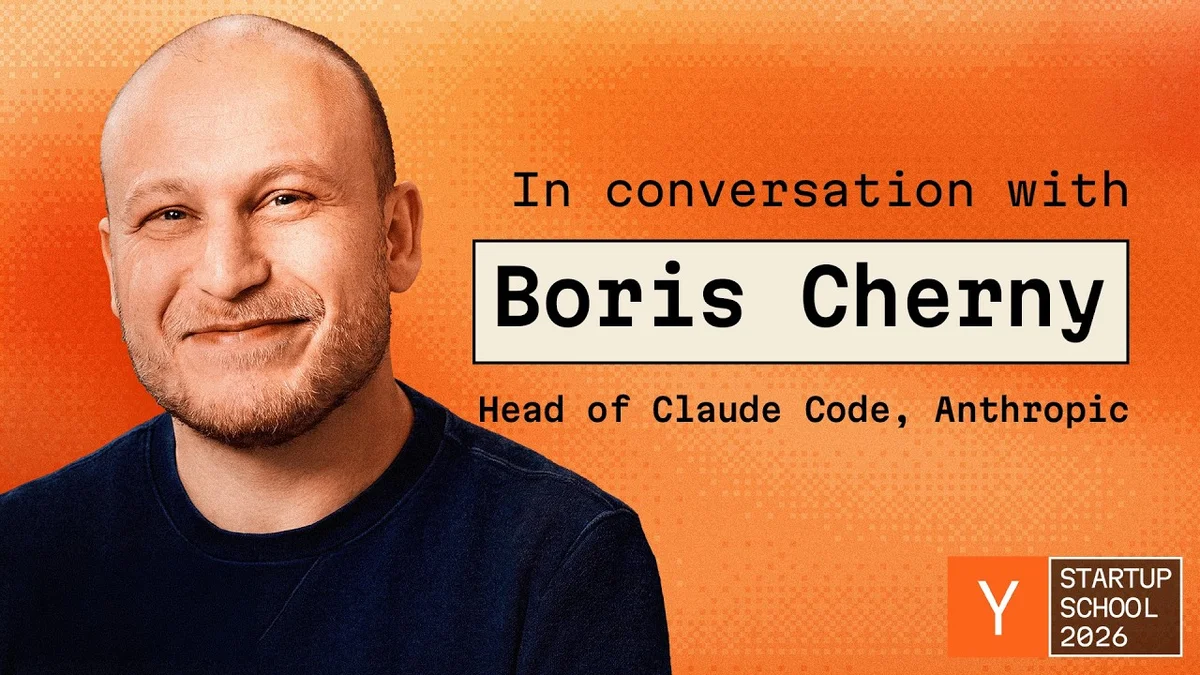
Anthropic's Boris Cherny on Building Claude Code

Boris Cherny of Anthropic discusses Opus 5's advancements, prompt injection resistance, and the 'unhobbling' philosophy behind Claude Code's development.

Boris Cherny and Diana Hu in discussion on stage at Y Combinator Startup School
YC
Visual TL;DR
Anthropic's Boris ChernyCore
From the article 3 mentionsIn a recent discussion at Y Combinator's Startup School, Boris Cherny, Head of Claude Code at Anthropic, shared insights into the development and capabilities of their latest AI model, Opus 5, and the innovative approach behind Claude Code.
Opus 5 ShippedCore
newest AI model shipped, featuring accelerated performance and new capabilities
From the article 6 mentionsCherny announced that Anthropic had just shipped Opus 5 the day prior, highlighting its accelerated model performance.
'Press Delete' PhilosophyContext
rebuilding Claude Code with a focus on simplicity and core functionality
From the articleCherny stressed that this 'press delete' philosophy is crucial for anyone building AI products, emphasizing the need for bravery and a willingness to discard existing structures to accommodate new model capabilities.
30% Arc AGI ScoreOutcome
significant jump from low single digits, major advancement in AI model capabilities
From the articleHe noted the model's achievement of a 30% score on the Arc AGI benchmark, a feat previously in the low single digits or teens.
Extended 'Auto Mode'Effect
From the articleOne of the standout new capabilities of Opus 5 is its ability to run for extended periods, especially when combined with 'auto mode.' Cherny described it as being able to 'go for days, weeks, months at a time,' without stopping and without needing external scaffolding like `slgo`.
'Unhobbling' AI PotentialContext
removing constraints to unlock full AI capabilities and product innovation
From the article 2 mentionsA key concept Cherny introduced is 'unhobbling Claude,' which refers to removing product limitations that prevent models from reaching their full potential.
Future AI EngineeringOutcome
focus on building robust, long-running AI systems with minimal intervention
Contents(7)

Claude Code and Opus 5: Boris Cherny's Developer Insights from YC

Claude Code head Boris Cherny took the stage at Y Combinator's Startup School to explain how Anthropic built Claude Code and Opus 5, the company's most capable agentic model. He covered Opus 5's 30% Arc AGI benchmark score, the 'press delete' rebuilding philosophy behind each new model release, and the concept of 'unhobbling' AI to unlock its full product potential. Anthropic appeared in 138 StartupHub.ai stories in the past 30 days, the most-referenced AI company in our network, reflecting its position at the center of the agentic development wave in 2026.

Last updated: August 24, 2026

StartupHub data

In our directory

Anthropic is an AI safety and research company building reliable, interpretable, and steerable AI systems, best known for the Claude family of models.

Founded
2021
Location
San Francisco, California, USA
Valuation
Private / $100B+ est

A startup accelerator that provides seed funding, mentorship, and resources to early-stage companies.

Founded
2005
Location
San Francisco, United States

Opus 5: Performance and New Capabilities

Cherny announced that Anthropic had just shipped Opus 5 the day prior, highlighting its accelerated model performance. He noted the model's achievement of a 30% score on the Arc AGI benchmark, a feat previously in the low single digits or teens. This significant jump signifies a major advancement in AI model capabilities.

The full discussion can be found on YC's YouTube channel.

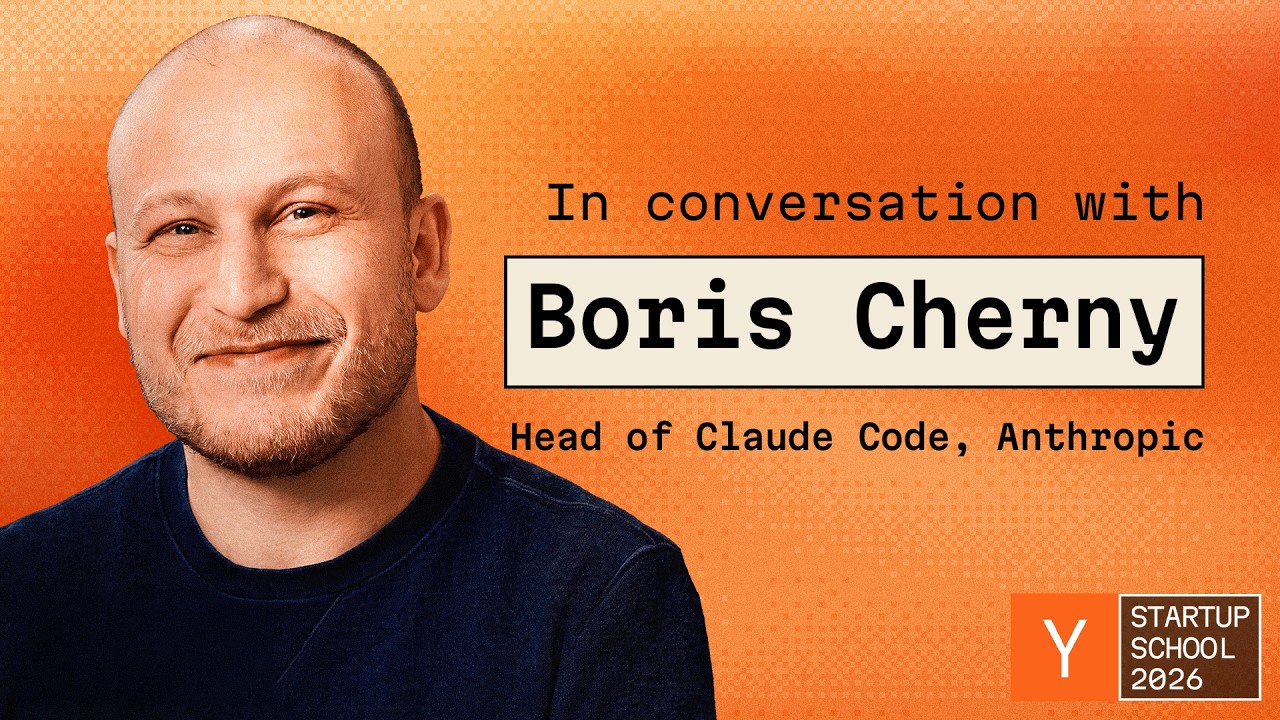
Boris Cherny: Building Claude Code - YC
Boris Cherny: Building Claude Code, from YC

One of the standout new capabilities of Opus 5 is its ability to run for extended periods, especially when combined with 'auto mode.' Cherny described it as being able to 'go for days, weeks, months at a time,' without stopping and without needing external scaffolding like `slgo`. The model inherently understands its task and continues until completion.

Another notable advancement is Opus 5's apparent resistance to prompt injection, a problem that has plagued AI models. Cherny explained that this feature has been present since Opus 4.7, but Opus 5 takes it to a new frontier. This is achieved through a combination of Anthropic's three years of research into alignment, a prompt injection classifier that analyzes neural activity in the model's 'brain,' and an auto-mode classifier. Together, these layers make prompt injection virtually impossible to demonstrate.

Rebuilding Claude Code: The 'Press Delete' Philosophy

Cherny revealed that Anthropic adopts a rigorous approach to updating Claude Code. With each new model release, they essentially 'delete all of the codebase, delete all of the prompt and start from scratch every time.' This practice, termed 'ablation' in research, involves deleting the entire system prompt and then reintroducing it line by line to meticulously determine the impact of each component.

This iterative process allows them to adapt the harness to the unique characteristics of each new model. For instance, the intelligence of Opus 5 meant that 80% of the previous system prompt could be deleted, as the model now inherently understands many behaviors that previously required explicit instructions. Cherny encouraged users to experiment with this by setting their own system prompts or using the undocumented feature `claude code simple=1`, which removes all system prompts, including those for tools. He noted that models can sometimes perform better without these explicit prompts, though some are still necessary for a user-friendly product experience.

Cherny stressed that this 'press delete' philosophy is crucial for anyone building AI products, emphasizing the need for bravery and a willingness to discard existing structures to accommodate new model capabilities. He also advised users of Claude Code to regularly delete their own configurations (`claude.ai`, skills, hooks) to see how the model behaves with fresh parameters.

Unlocking AI Potential: 'Unhobbling' and Product Overhang

A key concept Cherny introduced is 'unhobbling Claude,' which refers to removing product limitations that prevent models from reaching their full potential. He explained the idea of 'product overhang,' where current models possess unrealized capabilities that existing products do not yet elicit. This is often because the product's design 'hobbles' the model, preventing it from expressing its abilities.

He used the original Claude Code, built on Sonnet 3.5, as an example. At the time, it was an incredible coding model, but existing products offered only single-line autocompletes or read-only chat interactions. The vision for Claude Code was to create a harness that removed these limitations, allowing the model to write entire files and features, thereby unlocking its product overhang.

Cherny believes there's immense opportunity for startups to identify and capture this product overhang with current models. He advised founders to challenge models with tasks that seem slightly beyond their perceived capabilities, describe guardrails and exit criteria, and then let the model 'cook.' He also shared an anecdote about a user discovering Opus 5's ability to draw images using OpenCV, enabling it to create portraits and landscapes simply by being prompted correctly, a capability that was not explicitly trained but emerged organically.

August 2026 Update: Auto Mode Now Default

Since Cherny's YC talk, Claude Code has made auto mode the default setting for Pro, Max, and Team accounts as of August 14, 2026. Cherny's team has used auto mode exclusively for months, and the decision to make it the default reflects Anthropic's confidence that most users benefit from letting the model self-select reasoning depth and tool use. The August 2026 release also added Plugins, a bundling mechanism for agents, slash commands, MCP servers, and hooks, making it easier for teams to share and install Claude Code configurations. Additional August improvements include better cost estimates, cloud session management, remote control across devices, and expanded Bedrock and Alpine support.

Frequently Asked Questions

Who is Boris Cherny and what does he do at Anthropic?

Boris Cherny is Head of Claude Code at Anthropic. He leads the team that builds and maintains Claude Code, the agentic coding product that runs Claude on developer terminals and IDE integrations. He previously presented at Y Combinator's Startup School, where he explained Opus 5's capabilities and the product philosophy behind Claude Code's development.

What did Boris Cherny reveal about Opus 5 at YC?

Cherny announced that Opus 5 had just shipped and scored 30% on the Arc AGI benchmark, up from low single digits for earlier models. He explained that Opus 5 can run in auto mode for days, weeks, or months without external scaffolding, resists prompt injection through a combination of alignment research and neural activity classifiers, and allowed Anthropic to delete 80% of Claude Code's previous system prompt because the model now understands those behaviors inherently.

What is the 'press delete' philosophy in Claude Code development?

With every new model release, the Claude Code team deletes the entire system prompt and codebase and rebuilds from scratch through ablation testing, reintroducing each line to measure its impact. This approach, called 'press delete,' ensures the harness is tuned specifically to each model's capabilities rather than carrying forward assumptions from previous versions. Cherny advised other AI developers to apply the same mindset to their own configurations.

What is 'unhobbling' in the context of Claude Code?

Unhobbling refers to removing product constraints that prevent AI models from reaching their full capabilities. Early AI coding tools limited Claude to single-line autocompletes or read-only chat. Unhobbling meant granting Claude Code permission to write entire files and features, execute long autonomous workflows, and operate without external scaffolding. Cherny sees unhobbling as the core product design challenge for any team building on current AI models.

What is Claude Code auto mode?

Auto mode lets Claude Code choose its own reasoning depth and tool selection for each task rather than requiring users to specify a model variant manually. As of August 14, 2026, auto mode is the default for Pro, Max, and Team Claude Code accounts. Cherny's team has used auto mode exclusively for months, citing its ability to run complex agentic tasks for extended periods without manual intervention.

The Future of AI and Engineering

Cherny suggested that coding is becoming 'solved' for many tasks, though challenges remain in highly complex systems code and distributed systems. He posed the question of whether 100% of code can be written by agents, noting that while the desktop app is now quite fast, the journey is ongoing.

He concluded by emphasizing that the most effective users of Claude are those who approach it empirically, forgetting prior knowledge of older models and focusing on understanding the current model's behavior through experimentation. This scientific mindset, he argued, is key to unlocking the full potential of AI.

For those studying computer science before the era of AI agent coding, Cherny advised learning practical application, whether through startups or personal projects, rather than solely focusing on theoretical knowledge. He suggested that combining computer science skills with business acumen, user understanding, and data science knowledge is where true value lies.

Finally, Cherny announced a special offer for attendees: max 20x compute credits for Claude, encouraging them to experiment and build the next generation of AI applications.

© 2026 StartupHub.ai. All rights reserved. You may not republish this article in full without a license. Search engines and AI research tools may crawl and summarize for reference. Bulk reproduction or model training requires a license. See our terms.
Daniel Singer

Written by

Daniel Singer

Editor, StartupHub.ai

Daniel Singer is the editor of StartupHub.ai, a technology expert and thought leader on AI and its applications across sectors, from fintech and healthcare to developer tooling and consumer software. He writes and tests the tools covered here thoroughly and regularly, and built StartupHub.ai to give founders, operators and buyers a clearer read on what they are actually being sold.

More from Daniel Singer

