

• StartupHub.ai
    StartupHub.aiAI Intelligence
Discover
  • Home
  • Search
  • Trending
  • News
Intelligence
  • Market Analysis
  • Comparison
Tools
  • Market Map Maker
    New
  • Email Validator
Company
  • Pricing
  • About
  • Editorial
  • Terms
  • Privacy
  1. Home
  2. AI News
  3. AI Finally Learns To Read A Map
  1. Home
  2. AI News
  3. Artificial Intelligence
  4. AI finally learns to read a map
Artificial intelligence

AI finally learns to read a map

Google's MapTrace system uses synthetic data to teach AI models crucial spatial reasoning for navigating maps, showing significant improvements in path tracing.

StartupHub.ai -
StartupHub.ai -
Feb 18 at 9:17 PM3 min read
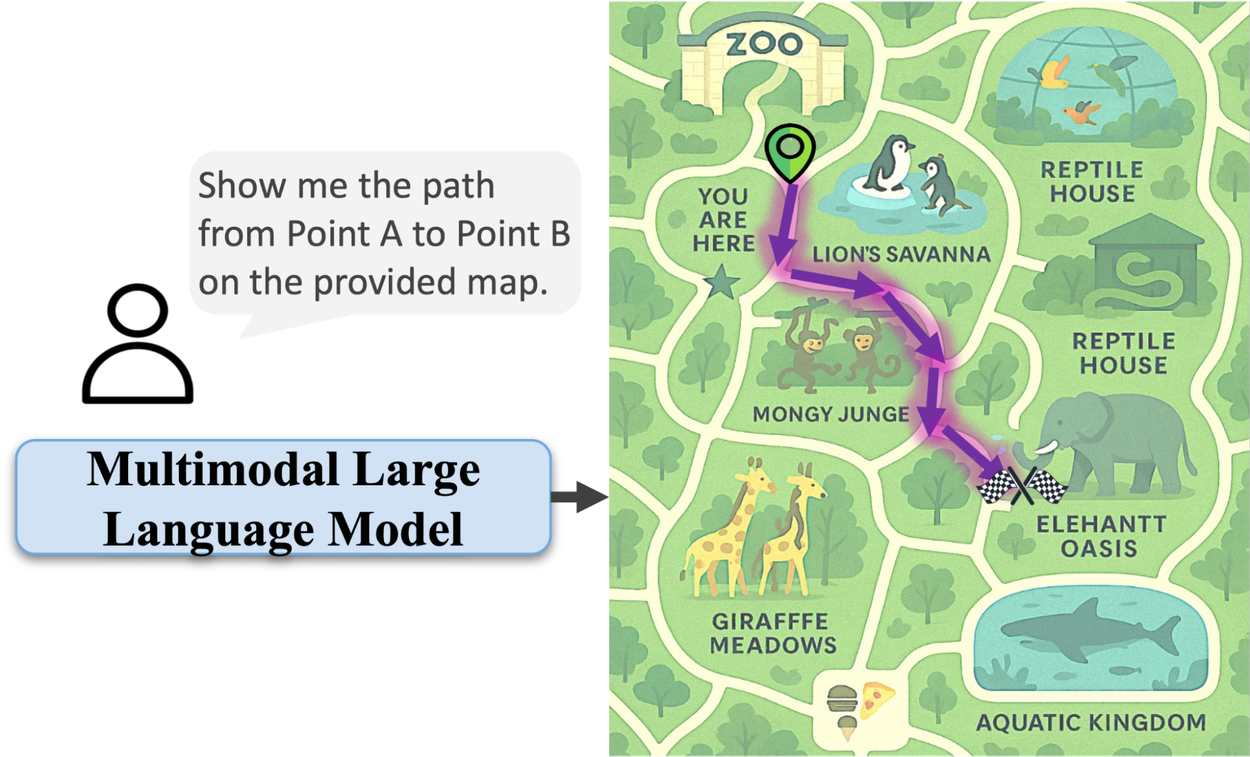
Example of an AI-generated map with a highlighted route showing AI navigation capabilities.
An AI-generated map with a traced route, demonstrating improved AI map navigation.
Key Takeaways
  • 1
    Google researchers developed a synthetic data generation pipeline called MapTrace to teach AI to follow routes on maps.

  • 2
    Current multimodal large language models struggle with spatial reasoning, often failing to navigate maps accurately.

  • 3
    The MapTrace system uses AI models to generate diverse maps and validate paths, significantly improving AI navigation capabilities.

For all their impressive advances, AI models often falter when it comes to a seemingly simple human task: reading a map. While they can identify objects in an image, understanding the geometric and topological relationships needed to navigate from point A to point B remains a significant hurdle. This gap highlights a core limitation: AI excels at recognition but struggles with spatial reasoning.

The Map Navigation Challenge

Multimodal large language models (MLLMs) can identify a zoo, but tracing a path within it often proves difficult. They might draw lines through enclosures or gift shops, failing to grasp environmental constraints. This isn't a failure of vision, but a lack of understanding of how spaces connect and how movement is constrained.

The root cause is a data deficit. MLLMs learn from vast datasets, but these rarely contain explicit examples of navigation rules—that paths must be connected, that walls are impassable, or that routes are ordered sequences. Manually annotating millions of paths with pixel-level accuracy is impractical, and proprietary map data is often inaccessible for research.

MapTrace: A Synthetic Solution

Google researchers propose synthetic data generation as the key. Their MapTrace system automates the creation of maps and annotated routes, circumventing the need for real-world data collection. This pipeline allows for fine-grained control over data diversity and complexity, ensuring generated paths adhere to intended routes and respect environmental boundaries.

The four-stage pipeline uses AI models extensively:

  1. Map Generation: LLMs create detailed prompts for diverse map types (e.g., shopping malls, theme parks), which are then rendered into images by text-to-image models.
  2. Path Identification: An AI "Mask Critic" analyzes candidate paths generated by pixel clustering, verifying they represent realistic, connected walkable areas.
  3. Graph Construction: Traversable areas are converted into a navigable graph, mapping intersections and paths computationally.
  4. Path Validation: An AI "Path Critic" reviews algorithmically generated shortest paths, ensuring they are logical and human-like, before the AI map navigation capability is finalized.

This process yielded a dataset of 2 million annotated map images. While minor text rendering issues persist, the focus remains on path fidelity.

Proven Results

Fine-tuning MLLMs, including Gemma 3 27B and Gemini 2.5 Flash, on a subset of this synthetic data significantly improved their performance on the MapBench benchmark. The NDTW metric, measuring path-tracing error, saw substantial reductions, with Gemini 2.5 Flash dropping from 1.29 to 0.87. Crucially, the success rate—the percentage of valid, parsable paths generated—also increased across models, demonstrating greater reliability.

These gains validate the core hypothesis: spatial reasoning is teachable. Through targeted, synthetically generated data, AI can acquire the skills to interpret and navigate complex spatial layouts, a crucial step for more intuitive navigation tools, advanced robotics, and enhanced accessibility applications.

#AI
#Machine Learning
#Google
#Computer Vision
#LLMs
#Synthetic Data
#Navigation

AI Daily Digest

Get the most important AI news daily.

GoogleSequoiaOpenAIa16z
+40k readers