AI Agents: The Rebuilt CI/CD Pitfalls

Sumaiya Shrabony warns that solo AI agent builders often recreate flawed CI/CD processes, leading to issues like voice drift and missing verification.

8 min read
Sumaiya Shrabony speaking about AI agent CI/CD pitfalls.
AI Engineer

Visual TL;DR. Solo AI Agent Builders create Illusion of Happy Path. Illusion of Happy Path leads to Reinventing Worse CI/CD. Reinventing Worse CI/CD causes Common Agent Failures. Common Agent Failures highlights need for Importance of Boundaries. Solo AI Agent Builders face Overlooked Pitfalls. Overlooked Pitfalls results in Reinventing Worse CI/CD. Importance of Boundaries emphasizes Platform vs. Boundaries.

  1. Solo AI Agent Builders: often recreate flawed CI/CD processes for agents
  2. Illusion of Happy Path: demos show seamless flow, hiding operational complexity
  3. Reinventing Worse CI/CD: lack of robust verification and underlying processes
  4. Common Agent Failures: issues like voice drift and missing verification
  5. Importance of Boundaries: focus on processes, not just agent output
  6. Overlooked Pitfalls: true challenges in agent operations are often hidden
  7. Platform vs. Boundaries: prioritizing robust processes over platform features
Visual TL;DR
Visual TL;DR, startuphub.ai Solo AI Agent Builders create Illusion of Happy Path. Illusion of Happy Path leads to Reinventing Worse CI/CD. Reinventing Worse CI/CD causes Common Agent Failures create leads to causes Solo AI Agent Builders Illusion of Happy Path Reinventing Worse CI/CD Common Agent Failures From startuphub.ai · The publishers behind this format
Visual TL;DR, startuphub.ai Solo AI Agent Builders create Illusion of Happy Path. Illusion of Happy Path leads to Reinventing Worse CI/CD. Reinventing Worse CI/CD causes Common Agent Failures create leads to causes Solo AI AgentBuilders Illusion of HappyPath Reinventing WorseCI/CD Common AgentFailures From startuphub.ai · The publishers behind this format
Visual TL;DR, startuphub.ai Solo AI Agent Builders create Illusion of Happy Path. Illusion of Happy Path leads to Reinventing Worse CI/CD. Reinventing Worse CI/CD causes Common Agent Failures create leads to causes Solo AI Agent Builders often recreate flawed CI/CD processes foragents Illusion of Happy Path demos show seamless flow, hidingoperational complexity Reinventing Worse CI/CD lack of robust verification and underlyingprocesses Common Agent Failures issues like voice drift and missingverification From startuphub.ai · The publishers behind this format
Visual TL;DR, startuphub.ai Solo AI Agent Builders create Illusion of Happy Path. Illusion of Happy Path leads to Reinventing Worse CI/CD. Reinventing Worse CI/CD causes Common Agent Failures create leads to causes Solo AI AgentBuilders often recreateflawed CI/CDprocesses for… Illusion of HappyPath demos show seamlessflow, hidingoperational… Reinventing WorseCI/CD lack of robustverification andunderlying… Common AgentFailures issues like voicedrift and missingverification From startuphub.ai · The publishers behind this format
Visual TL;DR, startuphub.ai Solo AI Agent Builders create Illusion of Happy Path. Illusion of Happy Path leads to Reinventing Worse CI/CD. Reinventing Worse CI/CD causes Common Agent Failures. Common Agent Failures highlights need for Importance of Boundaries. Solo AI Agent Builders face Overlooked Pitfalls. Overlooked Pitfalls results in Reinventing Worse CI/CD. Importance of Boundaries emphasizes Platform vs. Boundaries create leads to causes highlights need for face results in emphasizes Solo AI Agent Builders often recreate flawed CI/CD processes foragents Illusion of Happy Path demos show seamless flow, hidingoperational complexity Reinventing Worse CI/CD lack of robust verification and underlyingprocesses Common Agent Failures issues like voice drift and missingverification Importance of Boundaries focus on processes, not just agent output Overlooked Pitfalls true challenges in agent operations areoften hidden Platform vs. Boundaries prioritizing robust processes overplatform features From startuphub.ai · The publishers behind this format
Visual TL;DR, startuphub.ai Solo AI Agent Builders create Illusion of Happy Path. Illusion of Happy Path leads to Reinventing Worse CI/CD. Reinventing Worse CI/CD causes Common Agent Failures. Common Agent Failures highlights need for Importance of Boundaries. Solo AI Agent Builders face Overlooked Pitfalls. Overlooked Pitfalls results in Reinventing Worse CI/CD. Importance of Boundaries emphasizes Platform vs. Boundaries create leads to causes highlights need for face results in emphasizes Solo AI AgentBuilders often recreateflawed CI/CDprocesses for… Illusion of HappyPath demos show seamlessflow, hidingoperational… Reinventing WorseCI/CD lack of robustverification andunderlying… Common AgentFailures issues like voicedrift and missingverification Importance ofBoundaries focus on processes,not just agentoutput OverlookedPitfalls true challenges inagent operationsare often hidden Platform vs.Boundaries prioritizing robustprocesses overplatform features From startuphub.ai · The publishers behind this format

Sumaiya Shrabony, Technical Program Manager at the University of Colorado Denver, presents a compelling argument in her talk: "Every Solo Agent Builder Eventually Reinvents a Worse Version of CI/CD." Shrabony contends that while agent demos often present a smooth, successful 'happy path,' the reality of agent operations is far more complex, riddled with potential failures that are often overlooked. She highlights that the true challenge lies not in the agent's output itself, but in the underlying processes and the lack of robust verification, drawing parallels to the evolution of Continuous Integration/Continuous Deployment (CI/CD) in software development.

AI Agents: The Rebuilt CI/CD Pitfalls - AI Engineer
AI Agents: The Rebuilt CI/CD Pitfalls — from AI Engineer

The Illusion of the Happy Path

Shrabony begins by illustrating the common perception of agent development, where initial demos showcase a seamless flow from input to output. However, she emphasizes that this 'happy path' is often incomplete and misleading. The real work begins when the agent's initial promise falters, leading developers to build custom solutions for issues that have already been addressed by established software engineering practices.

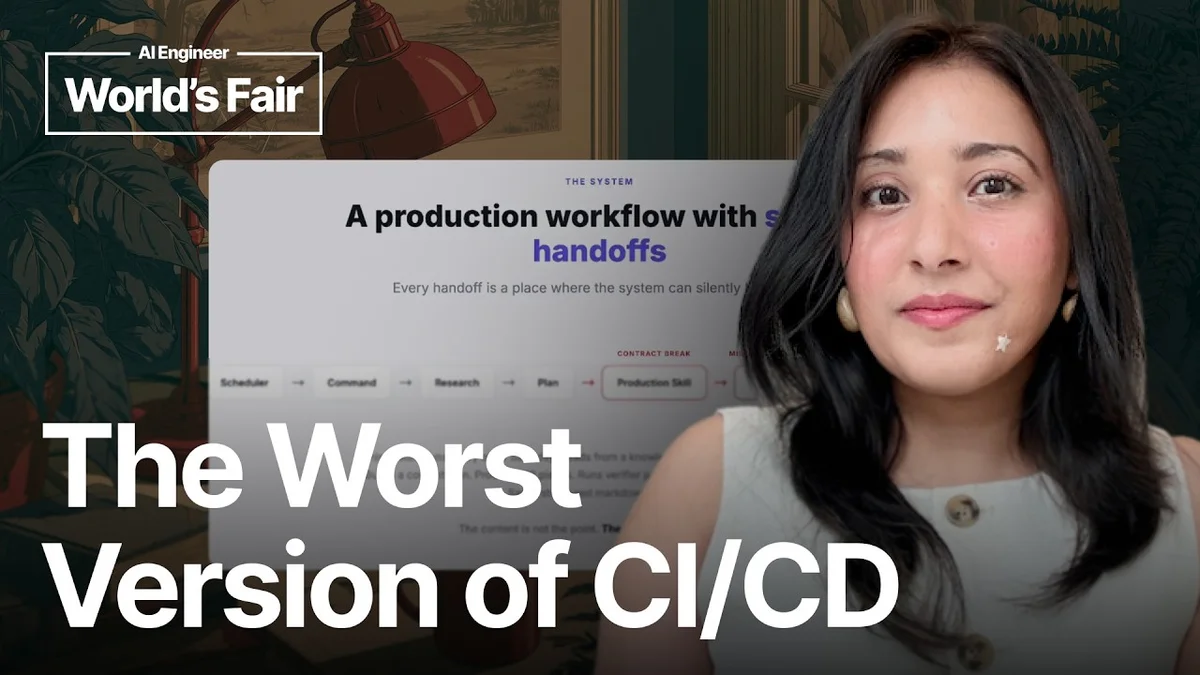
She outlines a typical agent workflow, which includes stages like scheduling, command execution, research, planning, production skill execution, verification, and final output. Each of these 'handoffs' is a potential point of failure, where the system can subtly deviate from expected behavior. Shrabony notes that when building agents solo, developers often find themselves recreating processes that already exist in more mature forms, such as CI/CD pipelines.

Five Common Failures in Agent Systems

Shrabony details five specific failures that commonly emerge as developers build their own agent systems:

  • Voice Drift: The content generated by the agent starts to deviate from the intended voice or tone, often defaulting to generic marketing language. This happens because the system lacks a mechanism to enforce the desired voice patterns.
  • Missing Verification: Claims made by the agent, such as a reduction in rework by a certain percentage, are presented without any underlying verification or source trail. This means the "evidence" for the claim is absent, making it untrustworthy.
  • Duplicate Hook: The agent's opening statement or 'hook' becomes repetitive or recycled, which can erode audience trust and signal a lack of originality.
  • Staging Gates: Artifacts are produced and appear 'ready' but lack essential checks or validation before being shipped. This is akin to shipping code without running tests, leading to potential downstream issues.
  • Rollback & Audit: When something goes wrong, the system lacks the ability to trace the exact steps, skills, or handoffs that led to the failure, making debugging and reconstruction difficult.

Shrabony illustrates these failures with concrete examples from her own experience and showcases how implementing specific 'gates' or checkpoints can prevent them. For instance, in the case of 'Voice Drift,' running the agent in 'Guarded Mode' with a voice contract prevents the output from deviating from the desired patterns.

The Importance of Boundaries Over Platforms

Shrabony argues that the solution is not to rely on complex platforms or frameworks, but rather to implement essential 'boundaries' or gates within the agent system. These boundaries act as crucial checkpoints to ensure the quality, integrity, and reliability of the agent's output.

She identifies five key gates that developers should consider:

  • Output Contract: Ensures the artifact meets the required shape and format before being saved.
  • Voice Contract: Verifies that the output matches the system's intended voice and style.
  • Verification Contract: Checks that all claims made by the agent are traceable to a verifiable source.
  • Dedup Check: Determines if the output is genuinely new or if the system is recycling previous content or angles.
  • Audit Trail: Allows for the reconstruction of events when failures occur, making debugging and troubleshooting possible.

Shrabony concludes with a powerful takeaway: "In software, we learned not to deploy just because code exists. In agent systems, we need to learn not to ship just because the artifact looks complete." She urges developers to map their agent's handoffs and identify the most expensive or critical handoffs to implement these crucial verification gates, thereby building more reliable and trustworthy AI agents.

© 2026 StartupHub.ai. All rights reserved. Do not enter, scrape, copy, reproduce, or republish this article in whole or in part. Use as input to AI training, fine-tuning, retrieval-augmented generation, or any machine-learning system is prohibited without written license. Substantially-similar derivative works will be pursued to the fullest extent of applicable copyright, database, and computer-misuse laws. See our terms.