


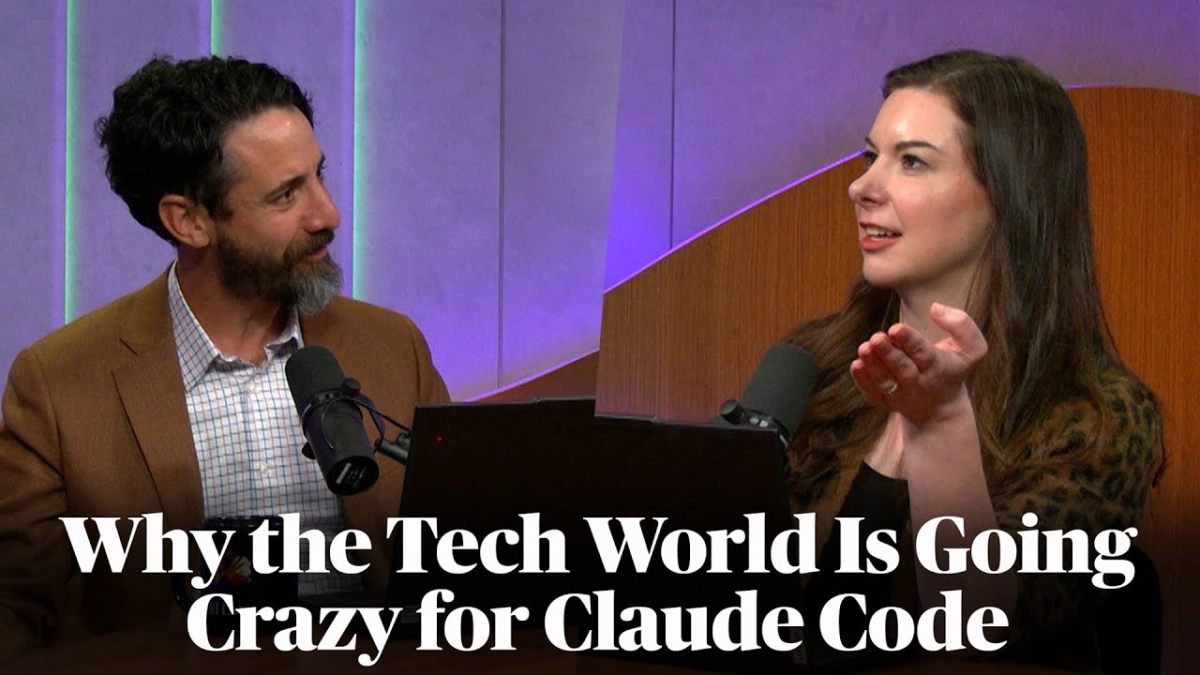
The enthusiasm surrounding Anthropic’s Claude Code has spilled over from the engineering community into the wider tech ecosystem, characterized by Bloomberg’s Odd Lots co-host Joe Weisenthal wryly describing the collective obsession as having a “Claude complex.” This conversational insight, shared with co-host Tracy Alloway and Alephic co-founder Noah Brier, immediately cut to the heart of the matter: Claude Code is not just another iteration in the generative AI space; it represents a fundamental shift in the accessibility and execution of software development, driven by a radical reduction in technical friction.
Weisenthal and Alloway spoke with Brier about the rapid evolution of AI coding assistants, contrasting the current suite of tools, specifically Anthropic’s Claude Code and its emergent application, Co-work, with earlier, clunkier models like GitHub Copilot. Brier, who has been immersed in the API landscape since the early days of GPT-3, provided sharp analysis on why Claude Code has captured the industry’s imagination, focusing less on the core intelligence of the large language model (LLM) itself and more on the elegance of its deployment.
The first major insight driving the current hype cycle is the near-total elimination of installation and operational friction. Early coding models, while impressive, required significant technical knowledge: navigating command line interfaces, installing complex libraries, and managing development environments. This created a high barrier to entry, limiting the tools primarily to professional developers. Claude Code sidesteps this entirely. Weisenthal noted that after playing with it over the holidays, he realized: “I see why half my Twitter feed is just like people posting about this... it’s just getting easier and friendlier. There’s almost no technical frictions at all anymore.” This ease of use is democratizing development, allowing individuals without deep coding backgrounds to execute complex tasks previously reserved for specialized engineers. The barrier has dropped from needing a PhD in computer science to simply understanding the intent of the desired outcome.



