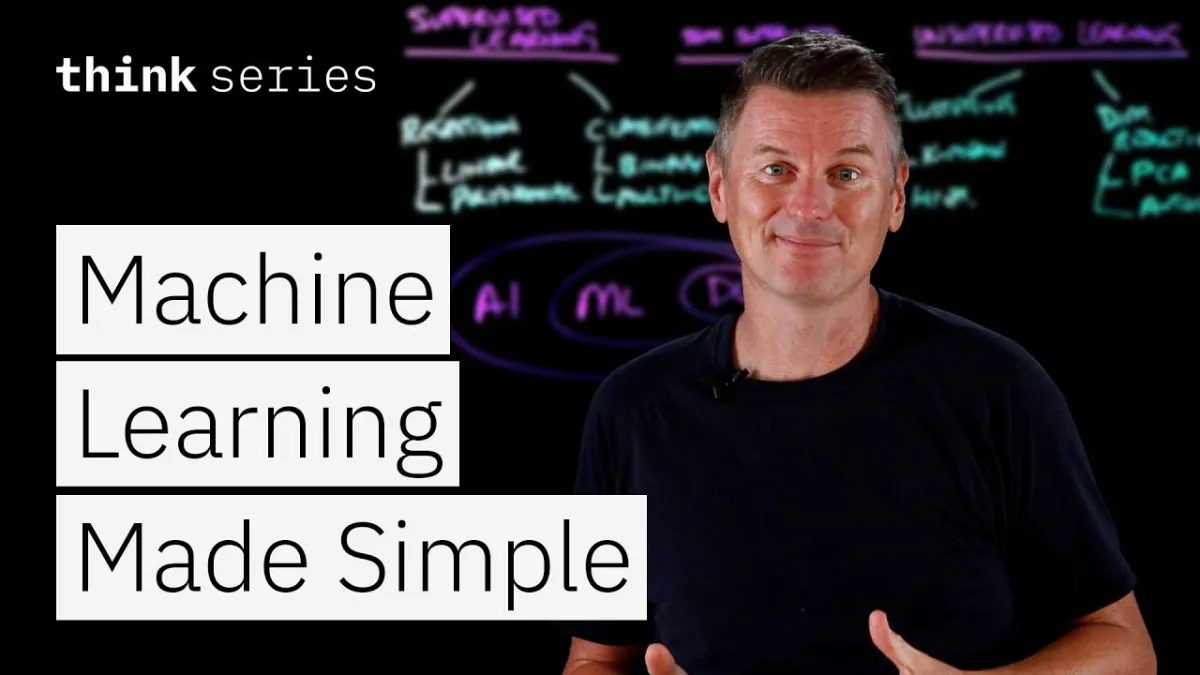
"The foundations are still classic ML concepts, they're just scaled up and combined in new ways," observes Martin Keen, an IBM Master Inventor, in his insightful video demystifying the intricate relationship between Machine Learning, Artificial Intelligence, and Deep Learning. Keen’s presentation serves as a foundational guide for understanding the core tenets of AI, highlighting the hierarchical structure and the various learning paradigms that underpin today’s most advanced systems. His clear explanations offer invaluable context for founders, VCs, and AI professionals navigating this rapidly evolving technological landscape.
At the heart of AI lies a clear, yet often conflated, hierarchy. Artificial Intelligence, as Keen clarifies, is the broadest field, encompassing the ambition to create machines that can simulate human intelligence. Within this expansive domain resides Machine Learning, a subset focused on algorithms capable of discerning patterns from data and making informed predictions without explicit programming. Further nested within Machine Learning is Deep Learning, which leverages neural networks with multiple layers to learn complex, hierarchical representations, mimicking the human brain's structure to process data more abstractly. This layered understanding is critical for discerning the true capabilities and limitations of different AI applications.
The operational essence of machine learning revolves around two pivotal processes: model training and AI inference. Keen articulates this succinctly: "The central premise of machine learning is that if you optimize the machine's performance on a data set of tasks that adequately resemble the real world... that model can make accurate predictions on new data." Training involves exposing a model to vast datasets, allowing it to identify and internalize patterns. Once trained, the model enters the inference phase, where it applies its learned patterns to new, unseen data to generate predictions or decisions, effectively translating learned intelligence into practical action.
Machine learning paradigms are broadly categorized into three distinct approaches. Supervised learning, the most common, trains models using "labeled examples or ground truth" to predict correct outputs. This involves datasets where inputs are paired with desired outputs, such as emails marked as "spam" or "not spam." Conversely, unsupervised learning tackles unlabeled data, aiming to "discover structure on its own" through methods like clustering, which groups similar data points, or dimensionality reduction, which simplifies complex datasets while retaining essential information.
A hybrid approach, semi-supervised learning, bridges these two paradigms. It utilizes a small amount of labeled data in conjunction with a larger pool of unlabeled data to enhance model performance. This method is particularly valuable when extensive labeled datasets are costly or difficult to acquire.
Related Reading
- AI's Relentless March: From Desktop Supercomputers to Agentic Intelligence
- ChatGPT as the Ultimate Personal Productivity Architect
- Nvidia's Moat Under Siege: AI Market Shifts Towards Diversification and Open Source
The third paradigm, reinforcement learning, operates on a system of trial and error, optimizing an agent's "policy through trial and error with rewards and penalties." Here, an agent interacts with an environment, observing its state and choosing actions. The environment, in turn, provides feedback in the form of rewards for correct actions and penalties for incorrect ones. Over time, the agent learns to maximize its long-term rewards, balancing exploration of new actions with the exploitation of known successful strategies. This dynamic learning process is exemplified by self-driving cars, where safe navigation and adherence to traffic rules yield rewards, while hard braking or collisions incur significant penalties.
While the current discourse often centers on Large Language Models (LLMs) and generative AI, Keen emphasizes that these cutting-edge innovations are fundamentally rooted in classic machine learning principles. LLMs, for instance, are built upon "Transformer" architectures, a sophisticated neural network design. These modern systems still rely on the core ML tenets of pattern recognition, model training, and inference. Even the refinement process for LLMs, known as Reinforcement Learning with Human Feedback (RLHF), directly applies reinforcement learning concepts, using human annotators to provide rewards and penalties that fine-tune the model’s behavior to better align with human preferences. This continuity underscores a crucial insight: the rapid advancements in AI are not a departure from foundational ML, but rather an ingenious scaling and novel combination of its enduring concepts.