Tensor Logic: Unifying AI's Divided Paradigms

3 min read
Tensor Logic: Unifying AI's Divided Paradigms

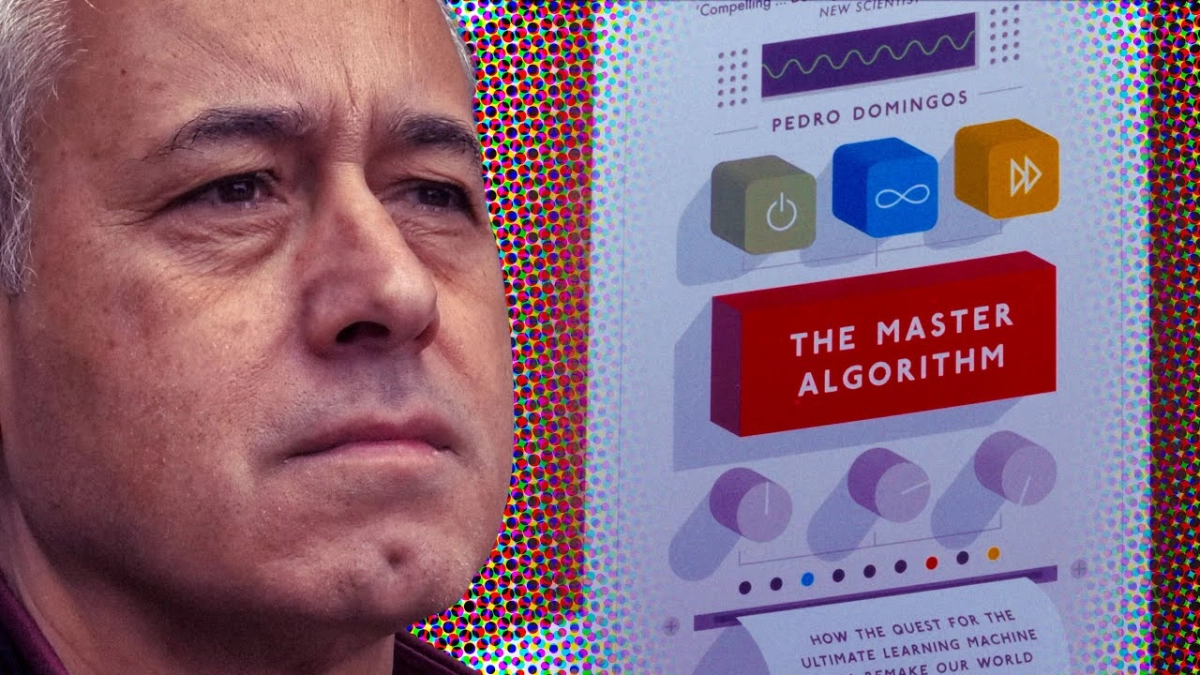
Pedro Domingos, author of "The Master Algorithm," presented his latest work, Tensor Logic, in a conversation on "Machine Learning Street Talk." The interview, hosted by Tim Scarfe, alongside other insightful commentators, delved into Domingos's ambitious quest to forge a singular, foundational language for artificial intelligence, akin to calculus for physics or Boolean logic for circuit design. Domingos argues that the current schism between symbolic AI and deep learning has stifled progress, leading to a "trillion-dollar waste" in compute resources, as companies redundantly "reinvent reasoning" rather than building upon established AI research.

Tensor Logic, Domingos posits, is the culmination of his lifelong dream to unify disparate AI paradigms into a single, coherent framework. At its core, Tensor Logic marries the robust logical reasoning capabilities of symbolic AI with the pattern recognition and data-driven learning strengths of deep learning. This innovative language leverages tensor operations to represent logical rules, allowing the system to not only execute these rules but also learn and dynamically modify them from data, a critical step towards more flexible and adaptive AI.

A pivotal feature highlighted in the discussion is Tensor Logic's inherent ability to tackle the pervasive hallucination problem in large language models. Domingos emphasized that current LLMs, even with their "temperature" settings adjusted to zero, still "hallucinate," generating plausible but factually incorrect outputs. Tensor Logic, however, offers a "deductive mode" where, by setting the temperature to zero, "it does purely deductive reasoning," ensuring transparent and verifiable outputs crucial for high-stakes applications. This granular control, where the "temperature can be different for each rule," offers an unprecedented level of precision and reliability.


Related startups

Beyond simply combining existing methods, Tensor Logic introduces the concept of "predicate invention," allowing the system to discover new concepts and relationships not explicitly present in the initial data. This capability, likened to how humans perceive "objects" rather than raw pixels, is crucial for advancing AI beyond mere pattern matching into true understanding and abstraction. It addresses what Domingos considers "the key problem in AI," the "Holy Grail" of discovering meaningful representations that explain complex phenomena more effectively.

The fundamental construct of Tensor Logic is the tensor equation, which Domingos illustrates as a deep unification of tensor algebra (the bedrock of neural networks) and logic programming (the foundation of symbolic AI). He points out a "gob-smacking observation": an Einstein summation rule in logic programming and an Einstein summation in tensor algebra are "the same thing." This mathematical equivalence allows Tensor Logic to inherit the scalability of deep learning on GPUs while providing the transparent, reliable reasoning previously exclusive to classical AI languages like Prolog.

While acknowledging the interviewer's skepticism about a single universal programming language for AI, Domingos maintains that Tensor Logic represents a significant leap forward. He argues that its elegant, compact syntax for expressing complex operations like Einstein summations makes it "much pithier, more compact, easier to write and understand." This improved notation, he suggests, fosters clearer thinking and faster development. Furthermore, the underlying implementation of Tensor Logic is designed for efficiency, overcoming the performance bottlenecks that often plague existing symbolic AI systems.

Ultimately, Tensor Logic is presented not merely as another programming language but as the scaffolding upon which the true "Master Algorithm" can be built. It provides a robust, interpretable framework that integrates learning and reasoning directly, enabling AI systems to not only learn from data but also discover underlying structures and adhere to logical constraints. This dual capability promises to unlock new avenues for AI development, moving beyond brute-force computation towards more elegant, efficient, and trustworthy intelligent systems.

© 2025 StartupHub.ai. All rights reserved. Do not enter, scrape, copy, reproduce, or republish this article in whole or in part. Use as input to AI training, fine-tuning, retrieval-augmented generation, or any machine-learning system is prohibited without written license. Substantially-similar derivative works will be pursued to the fullest extent of applicable copyright, database, and computer-misuse laws. See our terms.