Rockefeller's Ruchir Sharma Declares AI Market in "Advanced Stages of a Bubble"

5 min read
Rockefeller's Ruchir Sharma Declares AI Market in "Advanced Stages of a Bubble"

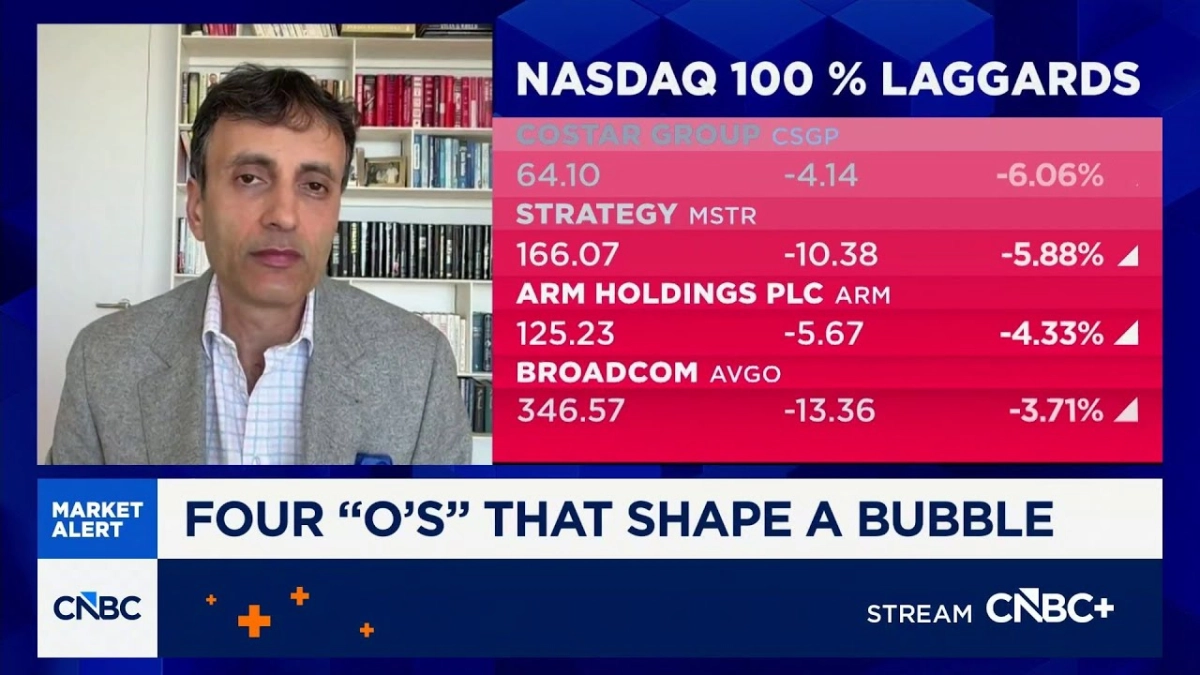
The current euphoria surrounding artificial intelligence has propelled the tech sector to unprecedented valuations, prompting seasoned financial analysts to question the sustainability of this growth. Ruchir Sharma, Chairman of Rockefeller International and Founder & CIO of Breakout Capital, offers a sobering perspective, asserting that the market is already in the "advanced stages of a bubble." His analysis, presented during a recent CNBC "Squawk on the Street" interview, outlines a clear framework of four "O's" to assess market bubbles, providing a potent lens through which to view the current AI landscape.

Sharma spoke with CNBC’s David Faber, discussing the criteria for identifying speculative bubbles and applying them directly to the burgeoning AI sector. He sought to define the elusive concept of a bubble by laying out a clear framework, rather than relying on abstract notions, emphasizing the need for concrete indicators.

The first "O" in Sharma's framework is Overvaluation. Historically, major market bubbles have seen prices, adjusted for inflation, increase tenfold over a 10-to-15-year period. Sharma notes that the U.S. tech sector has exhibited precisely this pattern, with current valuations residing in the 95th percentile on most metrics, a level only surpassed during the dot-com boom of 1999-2000. This stark comparison suggests that, by historical standards, the market's pricing of AI-driven assets is nearing peak speculative territory.


Related startups

Next is Overownership. Sharma points to a striking statistic: "Americans have 52% of their financial wealth in the stock market. That's higher than where we were in 2000." This indicates an unprecedented level of public participation and reliance on equity markets, even surpassing the irrational exuberance of the late 90s. This widespread ownership, particularly among younger generations who see stock trading as a more accessible path to wealth than traditional avenues like homeownership, signals a potentially dangerous concentration of capital in a single asset class.

The third indicator is Overinvestment. Capital expenditure in the U.S. as a share of GDP currently stands at 6%, a figure also higher than that observed in 2000. While investment in transformative technologies like AI is necessary for progress, an excessive allocation of capital, particularly at inflated valuations, can lead to diminishing returns and misallocation of resources across the broader economy. This surge in investment, driven by the promise of AI, risks creating an oversupply of capabilities that may not translate into proportional revenue growth in the near term.

The final "O" is Overleverage. This is where Sharma identifies a slight divergence from past bubbles, offering a "degree of comfort." While there has been a ramp-up in AI debt, households and the private sector generally are not as leveraged as in previous cycles. However, a critical fault line exists: "The government is where the leverage has been built up this time." This shift in where systemic risk resides—from private hands to public balance sheets—introduces a different, but no less significant, set of vulnerabilities.

Putting these factors together, Sharma unequivocally concludes, "we are pretty much in the advanced stages of a bubble." This is not merely a theoretical exercise but a direct assessment of the market's current state based on historical precedents.

The interviewer challenged Sharma's thesis, noting that some of the largest tech companies, like Meta, Amazon, and Microsoft, are currently underperforming the S&P 500 despite being at the forefront of AI development and significant capital expenditure. Sharma countered that these companies were previously "valued a lot because of the amount of free cash flow that they were generating," adding that "that free cash flow growth is now declining sharply." This decline, he argues, is the price they are paying, indicating a re-evaluation of their core business models even amidst AI investment. Furthermore, Sharma observed a quiet questioning of whether all this AI investment will truly pay off, and a realization that the American economy has become "one big bet on AI." He pointed out that "the rest of the world's stock markets have done far better than America this year," representing the widest gap since 2009, suggesting a potential end to "American exceptionalism" in market performance.

For founders, venture capitalists, and AI professionals, Sharma's framework provides a crucial analytical tool. It moves beyond anecdotal evidence to offer a structured method for evaluating the market's health, urging a critical examination of valuation multiples, investor concentration, capital allocation, and debt levels. The insights gleaned from this historical perspective underscore the importance of discerning genuine innovation from speculative fervor.

The historical catalyst that ends every bubble, according to Sharma, is a rise in interest rates. "The one single catalyst... which has ended every single bubble is when you get a rise in interest rates." He clarifies that there is no precise science to predict when a bubble will burst based on valuation alone; rather, it is "any sign of tightening in financial conditions" that typically pricks the bubble. The interplay of high valuations, concentrated ownership, significant investment, and the looming threat of sustained higher interest rates paints a picture of a market poised for a significant correction.

© 2025 StartupHub.ai. All rights reserved. Do not enter, scrape, copy, reproduce, or republish this article in whole or in part. Use as input to AI training, fine-tuning, retrieval-augmented generation, or any machine-learning system is prohibited without written license. Substantially-similar derivative works will be pursued to the fullest extent of applicable copyright, database, and computer-misuse laws. See our terms.