The notion of a deep rift between Washington's political establishment and the burgeoning pro-AI lobby may be more perception than reality, according to recent insights. Far from a contentious divide, a significant alignment appears to be forming between a powerful new pro-AI Super PAC and the White House, both recognizing the urgent need for a cohesive federal approach to artificial intelligence regulation. This strategic convergence, rather than conflict, signals a maturing phase for AI's political footprint in the United States.
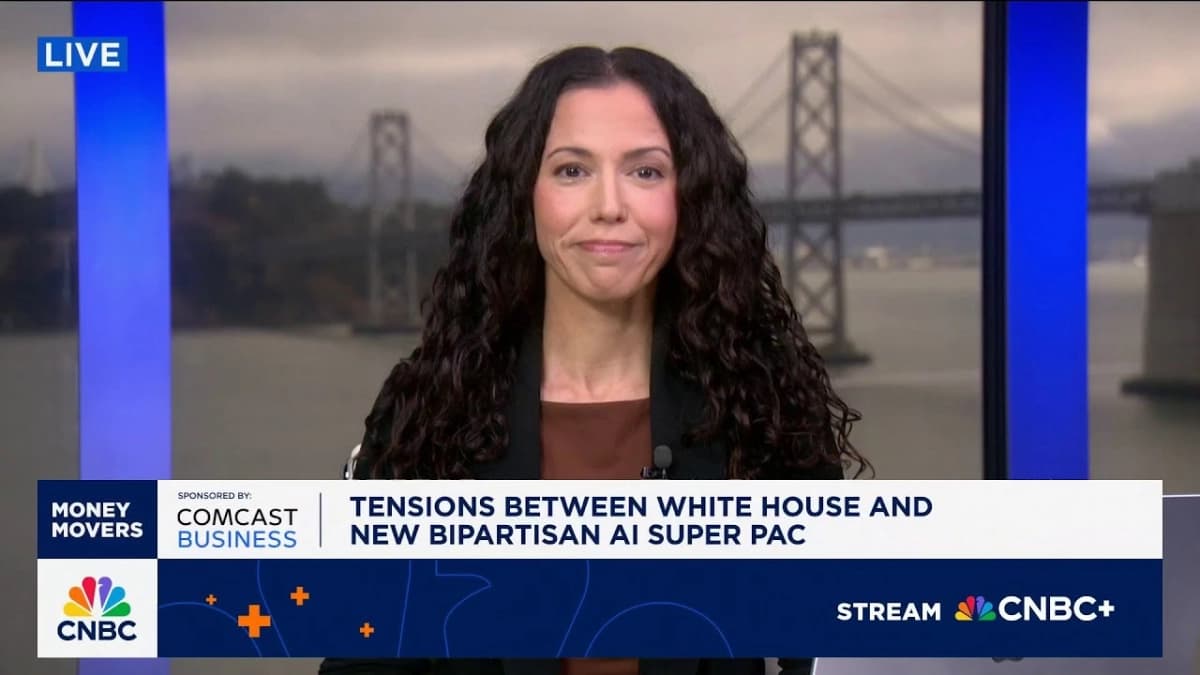
Michal Lev-Ram, a CNBC contributor and Fortune Contributing Editor, spoke with CNBC's "Money Movers" about the dynamics between the newly formed "Leading the Future PAC" and the Biden administration. Her commentary shed light on the sophisticated political maneuvering underway, aiming to shape the legislative landscape for AI, and crucially, to ensure American leadership in this transformative technology. The core of her analysis suggests that despite surface-level narratives, the underlying goals of both entities are remarkably consonant.
Indeed, Lev-Ram explicitly stated, "Everything I'm hearing for those affiliated with the Super PAC is really that this reported rift is not what it seems to be, that they are aligned, the aims of this Super PAC and the White House agenda on AI." This assertion challenges the prevailing media portrayal, indicating a coordinated effort rather than a tug-of-war. The mutual objective is clear: to establish a stable and enduring federal framework for AI legislation, circumventing a fragmented regulatory environment.
A central insight gleaned from Lev-Ram's commentary is the imperative for bipartisanship in crafting AI policy. The Super PAC, with over $100 million in initial funding, is designed to back both Democratic and Republican candidates who support a national AI framework. This bipartisan strategy is not merely aspirational but deemed essential for any meaningful progress. As Lev-Ram highlighted, "There does need to be a bipartisan approach in order to enact a federal framework for AI legislation, which is what this Super PAC is after, ultimately what the White House is after." This mirrors past legislative successes, such as in crypto regulation, where cross-aisle cooperation proved vital.
The Super PAC’s strategy is both defensive and offensive. It aims to prevent overly restrictive or inconsistent state-level regulations from stifling innovation, while simultaneously pushing for forward-looking federal legislation that fosters U.S. leadership. This duality underscores the high stakes involved in AI governance, impacting everything from economic competitiveness to national security.
The geopolitical dimension of AI leadership forms another critical insight. The race between the United States and China for technological supremacy looms large over these domestic policy discussions. The Super PAC's mission to "ensure the U.S. remains a global AI leader" is intrinsically linked to this international competition. A unified federal strategy is seen as paramount to maintaining America’s edge, preventing a patchwork of state laws that could impede rapid development and deployment. Lev-Ram noted, "This does all come back to the race between China and the US, of course."
Related Reading
- The AI boom & politics: Michal Lev-Ram on the launch of the $100M pro-AI super PAC
- Trip.com CEO Jane Sun on AI, Human Connection, and the Future of Travel
A significant strategic divergence between this AI Super PAC and its predecessors in the crypto space is its focus on state elections. While crypto PACs largely targeted federal races, "this Super PAC is very much focused on state elections," Lev-Ram explained. This shift suggests a recognition that state-level policy can either pave the way for federal frameworks or create significant roadblocks. By influencing state legislatures, the PAC can cultivate a more favorable environment for AI development and adoption, building momentum for national standards. This ground-up approach is a calculated move to ensure comprehensive, rather than piecemeal, regulatory evolution.
The current White House administration is perceived as "pro-AI friendly," a distinct advantage for the Super PAC's advocacy efforts. This stands in stark contrast to the often adversarial relationship between crypto proponents and regulators in previous periods. This favorable political climate, coupled with a shared understanding of AI's strategic importance, creates fertile ground for collaboration between the Super PAC and the administration, even as they navigate the complexities of specific laws and implementation details. The overarching goal remains a robust, federal framework that positions the U.S. at the forefront of global AI innovation.