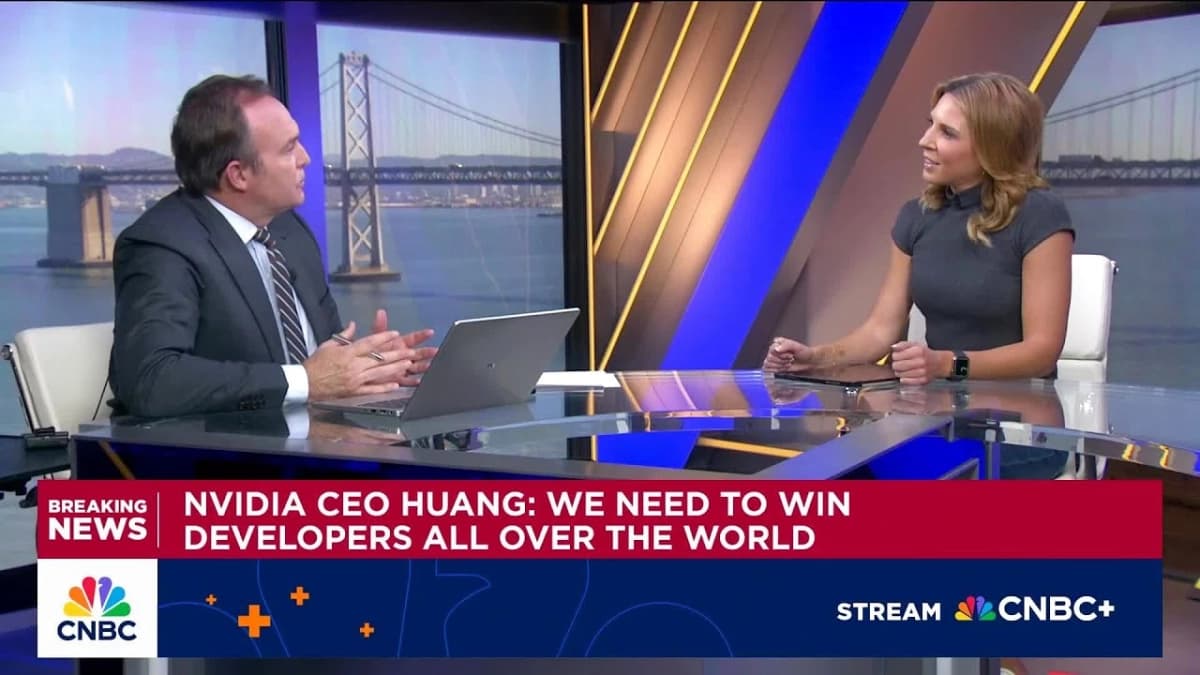
Microsoft's staggering ten-fold return on its OpenAI investment, now valued at $135 billion, signals a new era where strategic AI stakes redefine corporate power and valuation. This monumental gain, highlighted by CNBC’s MacKenzie Sigalos, follows a significant corporate restructure at OpenAI that redefines its partnership terms with Microsoft, granting the tech giant a 27% equity stake and a substantial revenue share. The implications extend far beyond a single financial windfall, illuminating the intense, multi-faceted competition for AI dominance that is reshaping the global tech landscape.
On CNBC, anchor Frank Holland and reporter MacKenzie Sigalos dissected the latest developments surrounding Microsoft's OpenAI investment and the escalating AI infrastructure arms race, highlighting the immense capital and strategic maneuvering defining the sector. Sigalos detailed the specifics of the OpenAI restructure, where the non-profit OpenAI Foundation now holds ultimate control, while Microsoft secures a pivotal commercial agreement. This arrangement solidifies Microsoft's position as the largest single shareholder in the commercial entity, with a reported 20% revenue share on OpenAI's general-purpose AI models until it recoups its initial $13 billion investment, plus an additional 20% on further investments up to $100 billion.
The financial success for Microsoft is undeniable, transforming a $13 billion investment into a $135 billion valuation. As MacKenzie Sigalos succinctly put it, "Microsoft's stake is worth $135 billion. They invested $13 billion into OpenAI. That's a pretty impressive return over that space of time." This demonstrates the profound strategic foresight and financial upside of backing foundational AI research and development early. Beyond the direct equity value, the partnership grants Microsoft a significant competitive edge in integrating advanced AI capabilities into its product ecosystem, from Azure cloud services to Copilot and beyond, creating a powerful flywheel effect.
However, the conversation quickly pivoted to the colossal infrastructure ambitions driving the next phase of AI. OpenAI CEO Sam Altman, a figure Frank Holland described as "probably the most powerful man in technology in America if it's not Jensen Huang," has outlined an audacious plan for future compute. MacKenzie Sigalos reported Altman’s vision to commit to "33 gigawatts of compute. And the best way to think about that is each gigawatt is what the equivalent of one nuclear reactor that it would take to power it or 750,000 homes." This staggering demand for processing power underscores a fundamental challenge: the sheer energy and physical infrastructure required to scale advanced AI.
Altman's ambition also extends to drastically reducing the cost of this infrastructure. The industry standard, according to Sigalos, is "50 billion dollars roughly to build out a gigawatt of compute. He wants to get it down to $20 billion." This pursuit of efficiency highlights a critical bottleneck in AI development: the escalating costs of specialized hardware and energy. Achieving such a reduction would democratize access to advanced AI compute, but it presents significant engineering and economic hurdles.
Related Reading
- OpenAI Recapitalization Reshapes AI Landscape with Microsoft at the Helm
- The AI boom & politics: Michal Lev-Ram on the launch of the $100M pro-AI super PAC
- AI Valuations Spark Bubble Fears Amidst Broader Market Optimism
This drive for infrastructure is not confined to OpenAI. The entire tech ecosystem is locked in what Frank Holland termed "not just an AI arms race, it's a PR arms race, it's a money race." Tech giants are diversifying their chip exposure and investing heavily in their own silicon. Google has its TPUs, Amazon is developing in-house chips, and Nvidia, traditionally a GPU powerhouse, is strategically investing in companies like Nokia and a self-driving car startup, broadening its influence beyond core hardware. The competition is fierce, with companies vying for both technological leadership and investor capital.
The unfolding scenario reveals a complex interplay of innovation, investment, and strategic positioning. The race is not merely about developing the most advanced AI models, but also about controlling the underlying compute infrastructure and the energy sources that power it. This necessitates massive capital allocation, global supply chain mastery, and a keen eye on both technological breakthroughs and geopolitical dynamics. The stakes are immense, shaping not just the future of technology, but also global economic power and national security.