


A stark warning echoes from the latest CNBC Fed Survey: nearly 80% of respondents believe AI stocks are currently overvalued, with a quarter deeming them "extremely overvalued." This sentiment, highlighted by CNBC Senior Economics Reporter Steve Liesman on "Squawk on the Street," paints a picture of growing apprehension within the investment community regarding the sustainability of the current AI boom. It's a critical signal for founders, venture capitalists, and AI professionals navigating a landscape where innovation meets market exuberance.
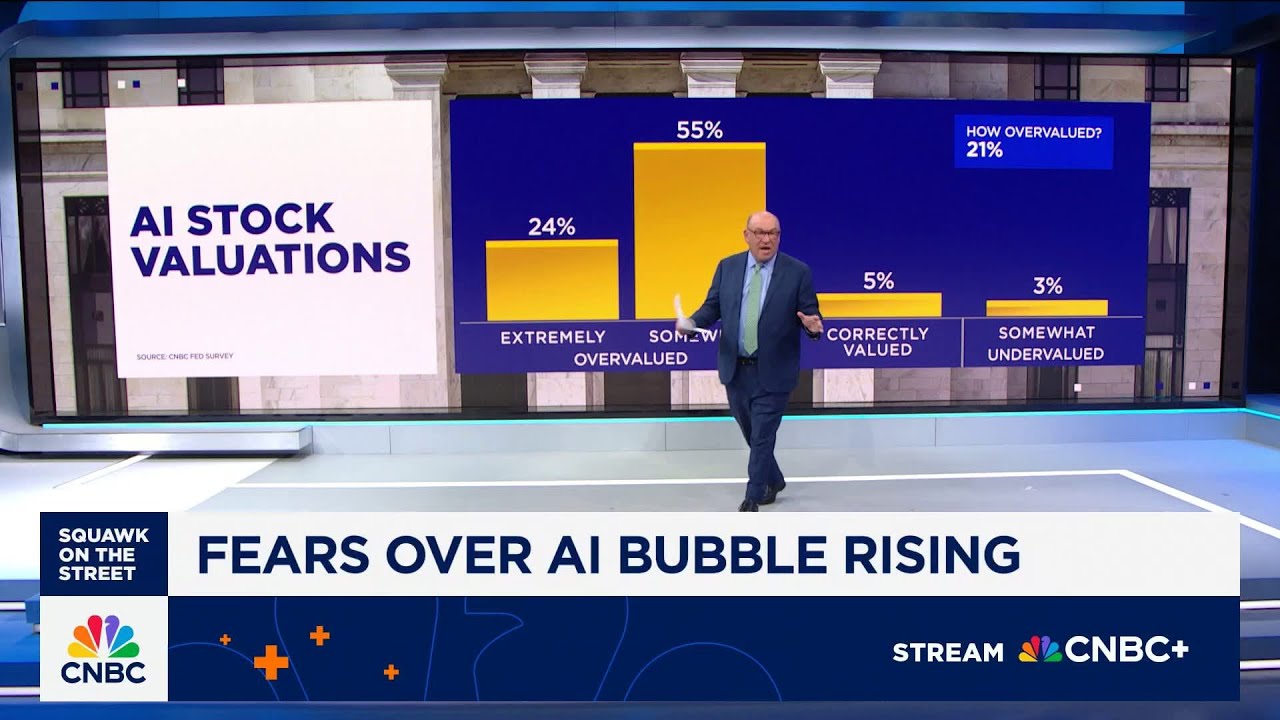
Steve Liesman, presenting the October CNBC Fed Survey results, underscored the profound concern among economists and financial strategists regarding the valuation of artificial intelligence companies. The survey revealed that a striking 79% of participants view AI stocks as either "extremely overvalued" (24%) or "somewhat overvalued" (55%). This widespread conviction suggests that the rapid ascent of AI-related equities may be outpacing fundamental justifications, leading to a precarious market environment. On average, respondents estimated AI stocks to be overvalued by more than 20%, a significant premium that could herald a future correction.
The underlying insight here is the classic tension between groundbreaking technological advancement and speculative market behavior. While AI's transformative potential is undeniable, the survey data reflects a collective unease that current valuations might be fueled more by hype than by realized revenue and profit. John G. Lonski, President of The Lonski Group, articulated this stark reality, stating, "Once the AI bubble bursts, only the financially strong participants in the AI space will survive." This powerful assertion serves as a potent reminder for startups and investors alike: financial resilience and a clear path to profitability will be paramount in weathering any market downturn.
Despite these pronounced concerns over AI valuations, the broader economic outlook presented by the survey offers a contrasting, somewhat more optimistic, perspective. The probability of a recession in the next 12 months has notably declined from 40% in prior surveys to 33% in the current one. This shift indicates a growing confidence among economists that the U.S. economy might achieve a "soft landing" rather than succumbing to a significant downturn.
This dichotomy is fascinating. On one hand, a specific sector is seen as inflated, while on the other, the overall economic environment appears to be improving. The S&P 500 outlook, however, remains relatively muted. The average forecast for the S&P 500 suggests "pretty lackluster returns," with a projected 1% decline by the end of 2025 from yesterday's close, followed by modest gains of around 5% by the end of 2026 and 12% by the end of 2027. This suggests that while a broad market crash might be avoided, significant upside from current levels is not widely anticipated, potentially due to already high valuations across certain segments.