Google DeepMind Unveils Gemini 3 and Nano Banana Pro, Redefining AI Development

4 min read
Google DeepMind Unveils Gemini 3 and Nano Banana Pro, Redefining AI Development

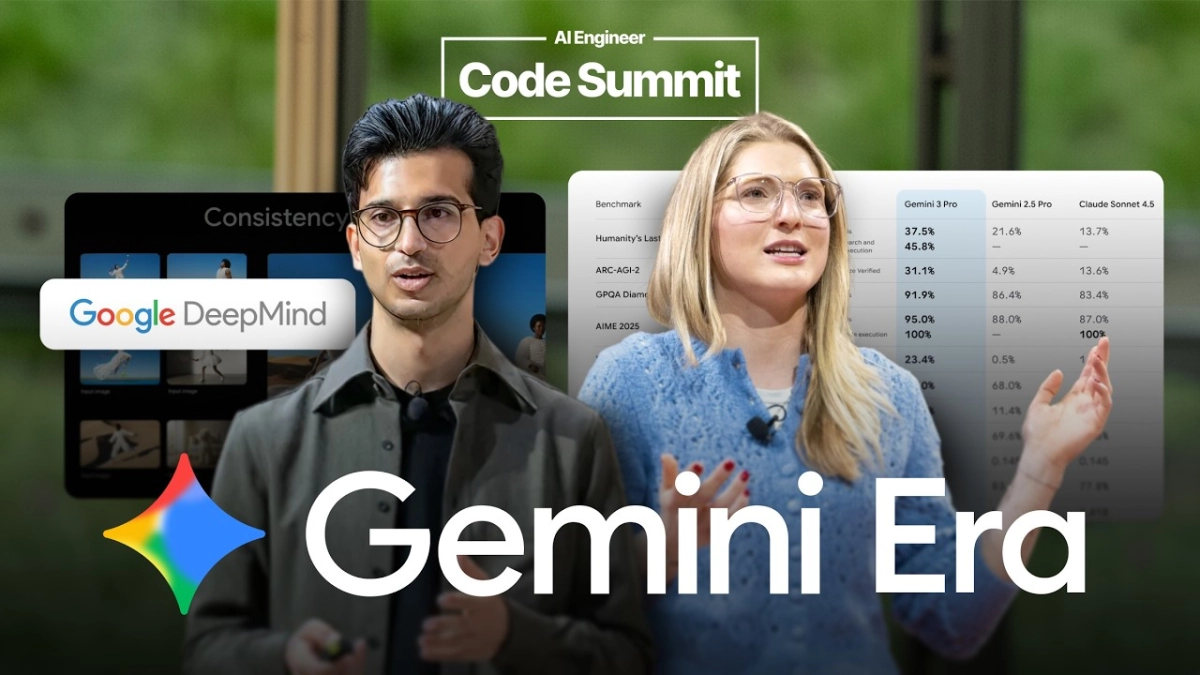
Google DeepMind recently showcased its latest advancements in artificial intelligence at the AI Engineer Code Summit, where Product Manager Kat Kampf and Product & Design Lead Ammaar Reshi introduced Gemini 3 Pro and Nano Banana Pro. Their presentation, "Building in the Gemini Era," highlighted how these new models, combined with the Google AI Studio, are democratizing AI application development and pushing the boundaries of creative and agentic capabilities. The overarching message was clear: Google aims to empower a new generation of engineers to build sophisticated software with unprecedented ease.

Kat Kampf kicked off the session by emphasizing Google DeepMind's long-standing commitment to AI innovation, citing milestones like the Transformer and AlphaGo. The highlight of the week, she noted, was the introduction of Gemini 3 Pro, Google's "most intelligent model that helps you bring any idea to life." This latest iteration boasts two significant capabilities. First, its strong UI and aesthetic sensibilities allow for "design understanding and generating websites and good UIs in one shot," streamlining the front-end development process. Second, Gemini 3 Pro excels in agentic tool-calling, enabling it to tackle complex tasks within massive codebases, moving beyond simple one-shot outputs to orchestrate multi-step processes. Performance metrics presented showed Gemini 3 Pro outperforming competitors like Opus 4 and GPT 4.5 in agentic scenarios, signaling a new era for AI-driven problem-solving.

Following this, Ammaar Reshi unveiled Nano Banana Pro, describing it as a "huge leap on our already state-of-the-art image model." This image generation model integrates seamlessly with Google Search, providing "world knowledge" that allows it to create detailed infographics, such as a step-by-step guide for making cardamom tea, directly from a query. One of its most impressive features is its "detailed text rendering," capable of perfectly wrapping text around objects in an image and even translating it into multiple languages, like Korean, while maintaining visual integrity. Nano Banana Pro also demonstrates remarkable consistency, allowing users to include up to 14 distinct individuals in a single generated image, all while maintaining a cohesive aesthetic. This level of creative control extends to features like changing the focus within an image with a simple prompt and generating images across a wide range of aspect ratios for various applications, from wallpapers to advertising boards.


Related startups

The true enabler for these powerful models, as both Kampf and Reshi underscored, is Google AI Studio. This platform is designed to be the central hub for developers to interact with Gemini models, obtain API keys, and build applications with remarkable ease. A key differentiator is the inclusion of "AI chips" that showcase the API's unique features, such as Google Search grounding and Google Maps grounding, or even integrating live APIs for webcam input. Developers can simply "prompt to app," rapidly iterating on ideas.

Crucially, Google AI Studio democratizes access to these advanced tools by offering a free quota for most models, eliminating the need for developers to manage their own API keys or worry about unexpected billing. When an application built on the platform goes viral, the users' individual free quotas are utilized, preventing a "crazy surprise API bill" for the creator. This fosters a collaborative environment where developers can freely share their creations and inspire others.

During a live demonstration, Kampf showcased how Google AI Studio could generate laptop stickers based on user interests by leveraging Google Search grounding. Reshi then demonstrated the platform's ability to create an interactive comic book, complete with rich text rendering and creative storytelling, where users could even influence the narrative's direction. He highlighted the model's unexpected humor, noting, "Honestly, some of these stories have genuinely made me laugh, which is the first time that's happened with one of these models." Further examples included generating a sleek, sci-fi-themed design portfolio website and a 3D multiplayer racing game, all initiated with simple prompts. The vision extends to full-stack runtime support, abstracting away complex backend details like database integration or payment solutions, empowering developers to focus purely on innovation. Google DeepMind is not just building advanced AI; it is engineering a future where anyone can build software, transforming the landscape of creation.

© 2025 StartupHub.ai. All rights reserved. Do not enter, scrape, copy, reproduce, or republish this article in whole or in part. Use as input to AI training, fine-tuning, retrieval-augmented generation, or any machine-learning system is prohibited without written license. Substantially-similar derivative works will be pursued to the fullest extent of applicable copyright, database, and computer-misuse laws. See our terms.