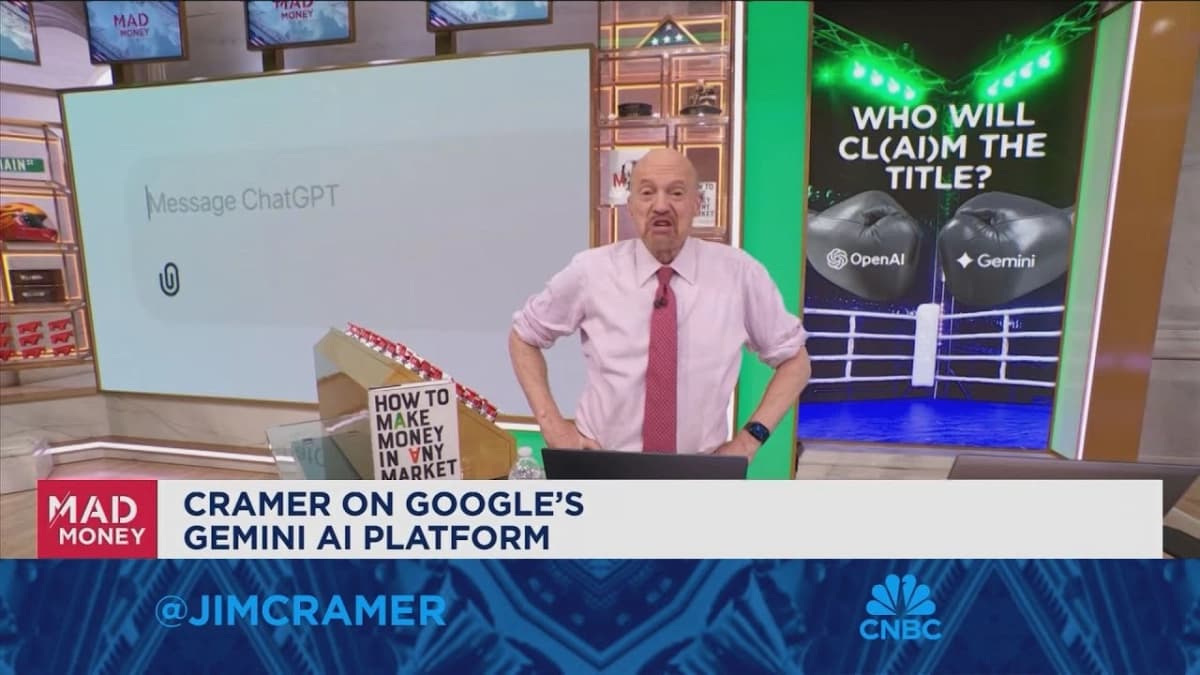
"Sometimes, out of nowhere, you just get hit by a tech lightning bolt." This sentiment, expressed by Jim Cramer on CNBC's *Mad Money*, perfectly encapsulates the initial awe inspired by OpenAI's ChatGPT. Yet, as Cramer elaborated, the artificial intelligence landscape is witnessing another, perhaps even more potent, lightning strike, this time from Google's formidable Gemini platform, posing an existential threat to the reigning chatbot.
Jim Cramer, the outspoken host of *Mad Money*, spoke with a CNBC interviewer about the intensifying AI race, focusing specifically on the latest developments from Google's Gemini and their profound implications for OpenAI's ChatGPT and the broader tech ecosystem. His analysis delved into the strategic advantages and potential pitfalls for the industry's titans.
Cramer vividly recalled his first encounter with ChatGPT a little over three years ago, describing it as a "tech lightning bolt." The generative AI's ability to craft a haiku or simulate an interview with historical figures like Gandhi was, to him, nothing short of revolutionary. OpenAI, the brainchild behind this innovation, launched ChatGPT on November 30, 2022, and remarkably, within five days, it amassed one million users, a growth trajectory previously unheard of in the business world. This meteoric rise propelled the broader tech averages higher, despite OpenAI itself not being publicly traded.
However, the narrative shifted dramatically with Google's recent unveiling of Gemini 3. The new version of Google's generative AI platform immediately garnered fervent praise, notably from Salesforce CEO Marc Benioff, who took to X (formerly Twitter) to declare, "I've used ChatGPT every day for 3 years. Just spent 2 hours on Gemini 3. I'm not going back. The leap is insane – reasoning, speed, images, video… everything is sharper and faster. It feels like the world just changed, again." This powerful endorsement underscores the perception that Gemini represents a significant leap forward, potentially dethroning ChatGPT from its dominant position. The sheer scale of ChatGPT's 800 million users makes such a rapid shift seem inconceivable, yet the industry is witnessing just that.
Google's strategic brilliance lies in its seamless integration of Gemini with its ubiquitous search capabilities. Cramer highlighted this as a critical differentiator, stating, "They figured out how to link Google, the search company, to Gemini, the AI company, in a seamless way." This integration avoids the cannibalization many initially feared, instead creating a powerful, unified AI experience that leverages Google's existing user base and data infrastructure. This is a feat that OpenAI, despite its groundbreaking innovation, has yet to replicate with similar efficacy, lacking a comparable proprietary search engine or equivalent distribution channel.
The market's reaction has been swift and decisive. Alphabet, Google's parent company, has seen its stock rally furiously, climbing 68% year-to-date, with much of that gain concentrated in the weeks following Gemini's release. This surge is not merely speculative; it reflects a growing recognition that Google was undervalued compared to other "Magnificent Seven" tech giants, and Gemini provided the catalyst for its re-evaluation. Beyond Alphabet, Broadcom, which designed the proprietary chips underpinning Gemini, also experienced a significant boost, with its stock vaulting 11% in a single day, a testament to the foundational technology enabling Google's AI ambitions.
The implications for OpenAI and its partners are stark. While OpenAI itself is not publicly traded, the potential for even a slight slowdown in its user growth due to Gemini's prowess could pose a significant challenge. OpenAI has committed to spending hundreds of billions to maintain its leading position, and sustained growth is crucial to justify these investments and attract further funding. Oracle, a major business partner providing data center infrastructure for OpenAI, could also face headwinds if OpenAI's trajectory falters, though Oracle's diversified business mitigates some of this risk. Even Nvidia, a seemingly unassailable leader in AI chips, saw its stock dip by 10% month-to-date, partially due to concerns about Google's reliance on Broadcom's proprietary chips for Gemini, signaling a potential shift in the AI hardware supply chain.
Related Reading
- Alphabet's Vertical AI Dominance Threatens Nvidia-OpenAI Ecosystem
- Google's AI Ascent Rattles OpenAI's Financial Foundation
- No AI Bubble, Just an Altitude Adjustment: Doug Clinton on Market Realities and Google's Gemini Leap
For other tech giants, the landscape is also shifting. Amazon, with its robust retail and cloud services (AWS), continues to perform well, though its retail business has often been overshadowed by AWS's growth. Tesla, under Elon Musk's vision, transcends a mere car business, with its stock now valued based on its AI-driven self-driving cars and robotics aspirations. Microsoft, a significant investor in OpenAI, has remained relatively quiet, yet its business continues to hum along, likely benefiting from its broader enterprise software offerings. Apple, surprisingly, could emerge as a major beneficiary. Google reportedly pays Apple over $20 billion annually to be the default search option on iPhones. If Gemini proves superior, Apple could command a similar fee for Gemini's integration, or even develop its own competitive AI.
The bottom line is undeniable: "We have to recognize that Gemini is the biggest threat to ChatGPT we’ve seen so far. There’s simply no two ways about it. Gemini is existential for OpenAI." The competitive pressure is immense, and OpenAI must respond with a compelling counter-strategy to avoid being eclipsed.