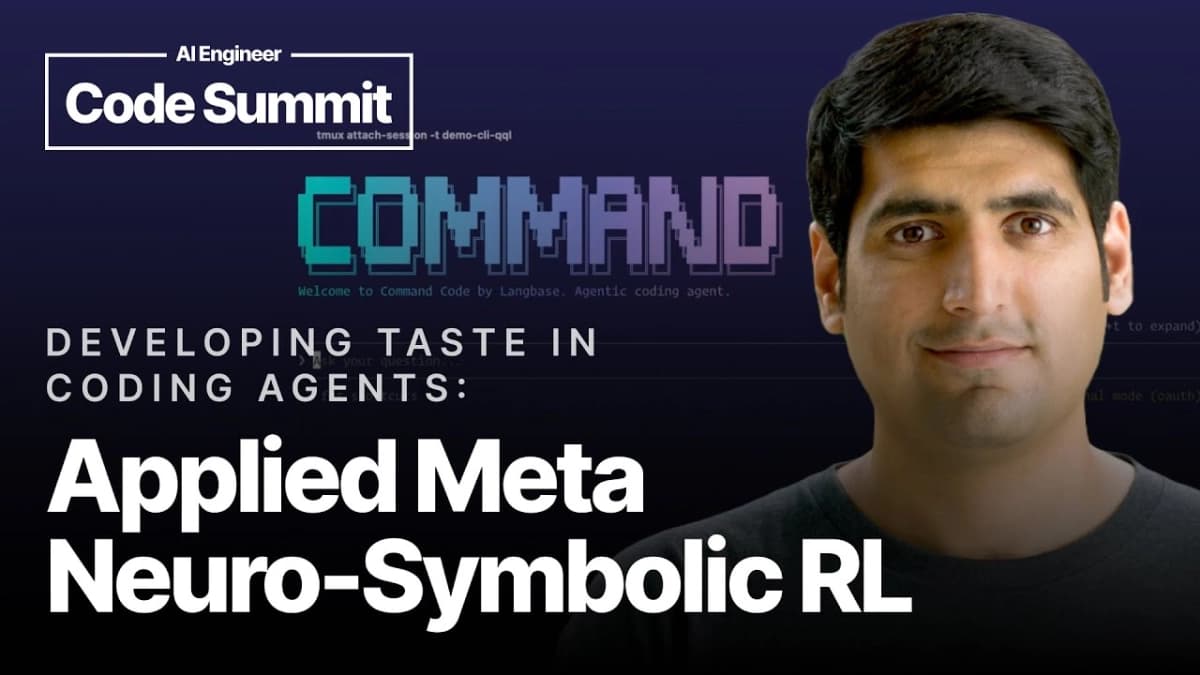
Ahmad Awais, founder and CEO of Langbase and creator of CommandCode.ai, recently presented a compelling vision for the future of AI-powered coding, moving beyond the current limitations of large language models. His core premise is simple yet profound: what if your coding agent didn't just generate code, but understood and replicated your unique "taste" in development? This insight, gleaned from five years of building AI agents, promises to transform how developers interact with artificial intelligence, making it a truly personalized and intuitive partner.
Awais's journey into AI coding agents began in 2020 with an early GPT-3 invitation from OpenAI co-founder Greg Brockman. His initial thought was to build a tool that could "suggest next step in the code we write — sort of like experts suggestions for code." This early ambition evolved into Langbase, an AI cloud powering over 350,000 agents, and eventually CommandCode.ai. He argues that while current LLMs are powerful, their code generation often amounts to "AI slop" – generic, functional, but lacking the nuanced stylistic and architectural preferences that define a seasoned developer's output.
"AI is lazy by default. It's very sloppy," Awais states, highlighting the common experience of needing to heavily prompt or manually refine AI-generated code. This constant tweaking to align with personal or team standards drains efficiency. Developers spend valuable time not just building, but repeatedly correcting the AI to fit their "invisible architecture of choices" – the unwritten rules, naming conventions, utility extractions, and early return preferences that constitute their unique coding fingerprint. This is where CommandCode steps in, aiming to learn and embody these preferences.
The demonstration of CommandCode against a generic LLM (Claude Code) vividly illustrates this distinction. Tasked with creating a simple CLI to display the date in ISO format, Claude delivers a basic JavaScript console log. CommandCode, however, leverages its learned "taste." It automatically incorporates TypeScript, utilizes `tsup` for bundling, integrates `commander.js` for CLI handling, adds an ASCII art banner, and even sets the version to `0.0.1`—all reflecting Awais’s established coding patterns. Furthermore, CommandCode intelligently organizes commands into dedicated directories, a structural preference Claude overlooked. The contrast is stark: one provides functional code, the other delivers code that feels genuinely *yours*.
"I want it to learn from me. I want it to learn that how I am editing its code. I want it to understand my preferences and continuously adopt to that... invisible architecture of choices that I have," Awais passionately explains. This learning isn't about explicit rules, which are often insufficient and cumbersome to maintain. Instead, CommandCode operates on a "meta neuro-symbolic reasoning space with continuous reinforcement learning (RL)." This advanced architecture combines neural intuition with symbolic reasoning, creating a dynamic model of a developer's taste. The continuous learning side absorbs the "texture of your code" through both explicit and implicit feedback, while the meta neuro-symbolic space enforces the invisible logic of your choices. A "reflective context engineering" feedback loop helps the agent build skills, allowing it to develop a true "skill of intuition."
Related Reading
- Claude Code Redefines Developer Workflows on Desktop
- The Unseen Architect: How AI Can Engineer a Future of Zero Bugs
- Agents are Robots Too: The Infrastructure Imperative for Next-Gen AI
This innovative approach moves beyond the limitations of "rules" and "vibe." Rules-based systems are rigid and prone to gaps, requiring constant human intervention. "Vibe coding," or context engineering, relies on elaborate prompts but still lacks the deep, adaptive understanding of personal preferences. Taste, in CommandCode's paradigm, is a living, evolving model. It understands not just *what* to do, but *how* a developer prefers it done. This translates into significant gains in productivity and code quality, as the agent anticipates and aligns with developer expectations, drastically reducing review times.
The long-term vision for CommandCode is an open ecosystem of "Taste Repos." Imagine developers being able to explore and adopt the "React taste" of a leading expert, or an entire engineering team sharing a unified "Design Engineer taste" that automatically influences every line of code generated. This isn't about static documentation or `.md` files; it's about live, adaptive models of coding preferences. Awais posits that while "large language models captured the world’s text, taste models will capture the world’s intentions." This shift represents the next frontier of AI coding intelligence, promising to unlock unprecedented levels of developer efficiency and creative freedom by making AI truly empathetic to human coding style.