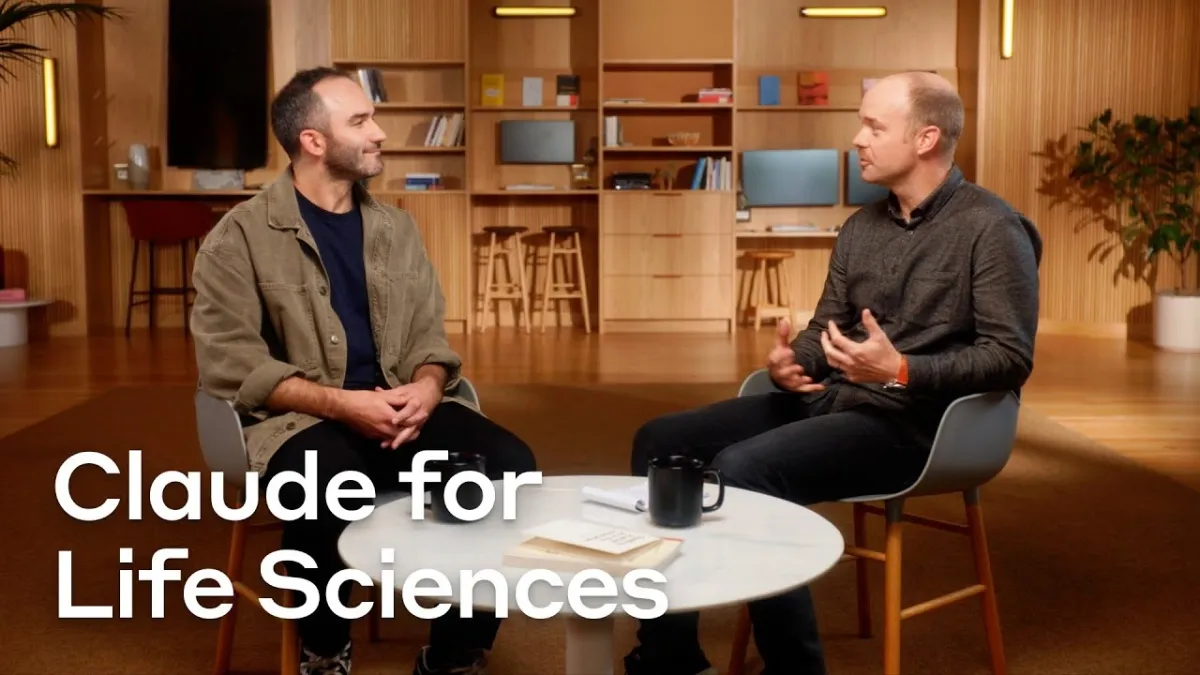
"I posed this problem to Claude. I said, 'Hey, what should we do to get unstuck?' And just in one minute, you know, one response, Claude actually just one-shotted the answer." This compelling anecdote from Eric Kauderer-Abrams, Anthropic’s Head of Biology and Life Sciences Research, encapsulates the transformative potential Anthropic sees in its Claude for Life Sciences initiative. In a recent discussion, Kauderer-Abrams, alongside Jonah Cool, Head of Life Sciences Partnerships and Deployment, laid out Anthropic’s ambitious vision to integrate AI deeply into the scientific workflow, moving beyond mere problem-solving to fundamentally altering the practice of science itself.
Anthropic’s commitment to the life sciences is not incidental; it is central to their mission. Kauderer-Abrams emphasized this point, stating, "Actually, the number one place that we at Anthropic are excited about applying it is within biology and the life sciences." This focus stems from a belief that AI's beneficial impact can be profoundly realized in accelerating research, driving innovation, and ultimately improving human well-being. Their strategy aims to empower individual scientists, enhancing their daily experience by automating tedious tasks and allowing more focus on creative, high-leverage work.
The core insight driving Anthropic’s approach is the ambition to transform Claude into a versatile AI research assistant. This involves building tools that empower individual scientists, making them more productive and enriching the scientific process. The goal is to "take away some of the grunt work that, you know, everyone would rather get out of and allow you to focus more on the creative high-leverage side." This vision parallels the evolution of software engineering, where AI partners now assist with brainstorming and task delegation, an experience Anthropic aims to bring to biologists.
Anthropic is taking a holistic approach, addressing the entire spectrum of tasks within the life sciences. This spans from the nascent stages of early-stage discovery, such as molecule design and protein folding, all the way through development and translational research. This comprehensive strategy covers everything from drafting and reviewing experimental protocols and debugging lab procedures, to performing complex bioinformatics analyses and generating publication-ready figures and reports. No task is too small or too large for Claude’s intended capabilities.
A pivotal shift in thinking, highlighted by Jonah Cool, is moving past the question of "what problem will AI solve for me?" to a more profound inquiry: "how do we change how we do science?" This reorientation emphasizes leveraging AI not just as a tool for specific tasks, but as a catalyst for new methodologies and accelerating the pace of discovery. It’s about creating a fluidity in research that breaks down traditional barriers.
Central to this integrated approach are strategic partnerships with key players in the life sciences ecosystem. Collaborations with Benchling, 10x Genomics, and PubMed are critical. These integrations ensure Claude can seamlessly interact with the tools and data sources scientists already use, from managing experimental data and lab notebooks with Benchling, to analyzing single-cell genomics data with 10x Genomics’ Cell Ranger, and efficiently querying vast scientific literature on PubMed. This network of partnerships is designed to embed Claude naturally into existing workflows, making it an indispensable part of the scientific process.
The recent release of Sonnet 4.5 marks a significant milestone in Anthropic’s journey. This model is their first to undergo extensive scientific training, demonstrating a major leap in its ability to handle long-horizon tasks, such as complex bioinformatics pipelines. This advancement, coupled with the inherent power of Claude Code as a general-purpose agent, allows scientists to tackle multi-step challenges that were previously time-consuming or technically demanding. Claude Code, despite its name, is proving remarkably useful in diverse biological applications, from drafting scientific papers to organizing complex research projects and performing intricate literature reviews.
Related Reading
- Claude’s Agentic Leap: Beyond Workflows to Autonomous Collaboration
- Claude's Microsoft 365 Connector Transforms Enterprise Productivity
Beyond individual research, Claude is poised to accelerate broader industry processes. Regulatory submission processes, notoriously slow and resource-intensive, present a significant opportunity. Claude's ability to facilitate consistent standards and expedite documentation could dramatically speed up the journey from discovery to approved therapies. This beneficial deployment of AI holds immense promise for both pharmaceutical companies and regulatory bodies like the FDA.
Anthropic's "AI for Science" program embodies its commitment to fostering innovation and responsible deployment. This initiative places Claude directly into the hands of scientists working on ambitious projects, allowing Anthropic to gather critical feedback and continuously refine its models. This iterative process, driven by real-world scientific challenges, ensures that Claude's development remains aligned with the practical needs and ethical considerations of the scientific community. Anthropic’s foundational identity as a research organization, deeply committed to safety and beneficial AI, provides a unique framework where the drive for advanced capabilities is balanced with a profound sense of responsibility.