
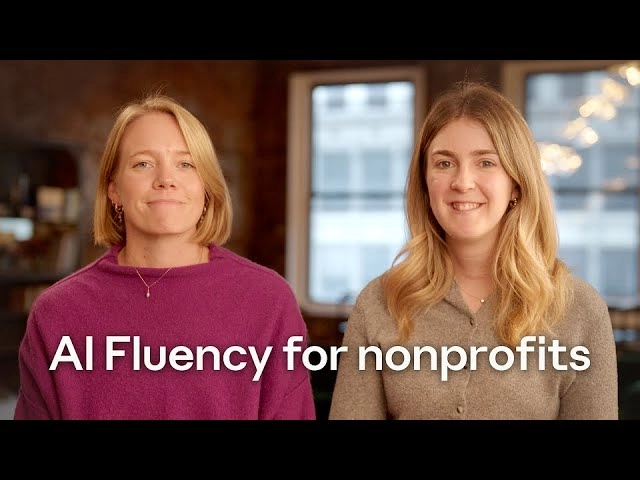
Anthropic, a leading AI safety and research company, has partnered with Giving Tuesday to introduce "AI Fluency for nonprofits," a free course designed to equip mission-driven organizations with the skills to effectively integrate artificial intelligence into their operations. This initiative, highlighted in a recent trailer featuring Zoe Ludwig, Claude Apps Education Lead at Anthropic, and Kelsey Kramer, Director of Partnerships at Giving Tuesday, underscores a strategic push to democratize access to advanced AI tools and foster responsible adoption within the social impact sector. The collaboration reflects a shared conviction that AI holds transformative potential for addressing complex societal challenges, and that nonprofits, often operating with limited resources, are uniquely positioned to benefit from enhanced technological capabilities.
Zoe Ludwig and Kelsey Kramer presented this new course, detailing its framework and practical applications for mission-driven teams. Their discussion centered on empowering nonprofits to leverage AI responsibly and intentionally, moving beyond superficial engagement with technology to a deeper, more strategic integration. This foundational approach aims to ensure that AI serves as a true accelerant for impact, rather than merely another tech expense.
The core philosophy driving this course is Anthropic’s belief that "AI can help solve humanity's most important problems. And nonprofits are on the front lines of those challenges. That's why they deserve AI that's built for their reality." This statement from Zoe Ludwig encapsulates the underlying ethos: to tailor sophisticated AI capabilities, specifically Anthropic's Claude, to the unique operational and ethical landscape of the nonprofit world. It recognizes that generic AI solutions may not adequately address the nuanced requirements of organizations dedicated to public good.

Kelsey Kramer emphasized that "Claude for nonprofits is designed as an ecosystem, not just a product." This distinction is crucial, signaling a holistic approach that combines AI tools with a comprehensive educational framework. It acknowledges that simply providing access to an AI model isn't enough; users need the strategic understanding and practical guidance to apply it effectively and ethically within their specific contexts. This ecosystem includes the "4D Framework" for fluent AI use: Delegation, Description, Discernment, and Diligence, which are explored through the course.
The "4D Framework" acts as a structured guide for integrating AI. Delegation involves understanding which tasks are suitable for AI and how to distribute work between human and machine intelligently. Description focuses on clearly defining desired outputs, formats, audiences, and styles when prompting AI. Discernment teaches users to critically evaluate AI-generated content for accuracy, bias, and relevance. Finally, Diligence covers the ongoing monitoring, refinement, and ethical considerations necessary for sustained, responsible AI use. This framework provides a robust mental model for navigating the complexities of AI adoption.
Practical applications are a significant focus, demonstrating how AI can streamline common nonprofit tasks. Examples include drafting grant proposals, personalizing donor communications, generating program reports, and performing data analysis. These are areas where efficiency gains can directly translate into greater mission impact, freeing up valuable human capital for higher-level strategic work and direct service. The course provides concrete scenarios, such as a data analysis example where AI assists in tracking program attendance and employment outcomes, significantly reducing the manual effort involved.
A central tenet highlighted is the concept of "the human in the loop." This principle ensures that human judgment, oversight, and values remain paramount. Key human roles—Decisions, Direction, Mission, and Values—are explicitly identified as non-delegable to AI. AI is positioned as an augmentative tool, not a replacement for human ethical reasoning or strategic leadership. This emphasis is particularly pertinent for nonprofits, where trust, empathy, and mission fidelity are critical.
The partnership between Anthropic and Giving Tuesday represents a significant strategic move in the broader tech landscape. For Anthropic, it’s not merely about expanding market share for Claude, but about demonstrating the tangible social utility of its models and building a user base that is inherently aligned with responsible AI principles. For Giving Tuesday, a global movement focused on generosity, it’s an opportunity to empower its vast network with cutting-edge tools, amplifying their collective impact. This initiative sets a precedent for how AI companies can engage with the social sector, shifting from traditional philanthropic donations to direct capability building and shared knowledge transfer.
Related Reading
- The $700 Billion AI Productivity Problem
- Nvidia CEO Jensen Huang Declares AI a Foundational Platform Shift Beyond Chatbots
- ASEAN's Digital Crucible: AI and Blockchain Driving a New Economic Narrative
This course also serves as a crucial step in democratizing access to AI expertise. By offering the "AI Fluency for nonprofits" course for free, Anthropic and Giving Tuesday are actively working to bridge the technological divide that often leaves smaller, under-resourced organizations behind. It’s an investment in collective intelligence, recognizing that the benefits of AI should not be confined to well-funded corporations but should extend to those working on the front lines of societal progress. This free access is a powerful statement about equitable technology dissemination.
Ultimately, the course aims to instill a critical mindset, not just technical proficiency. Kelsey Kramer articulates this perfectly: "You'll have tools to consider not just when AI can help with your work, but whether it should." This deliberate focus on discernment and ethical judgment is paramount, particularly as AI capabilities advance. It encourages users to weigh the potential benefits against risks, ensuring that AI deployment aligns with organizational values and avoids unintended consequences. This intentionality is a hallmark of responsible innovation.