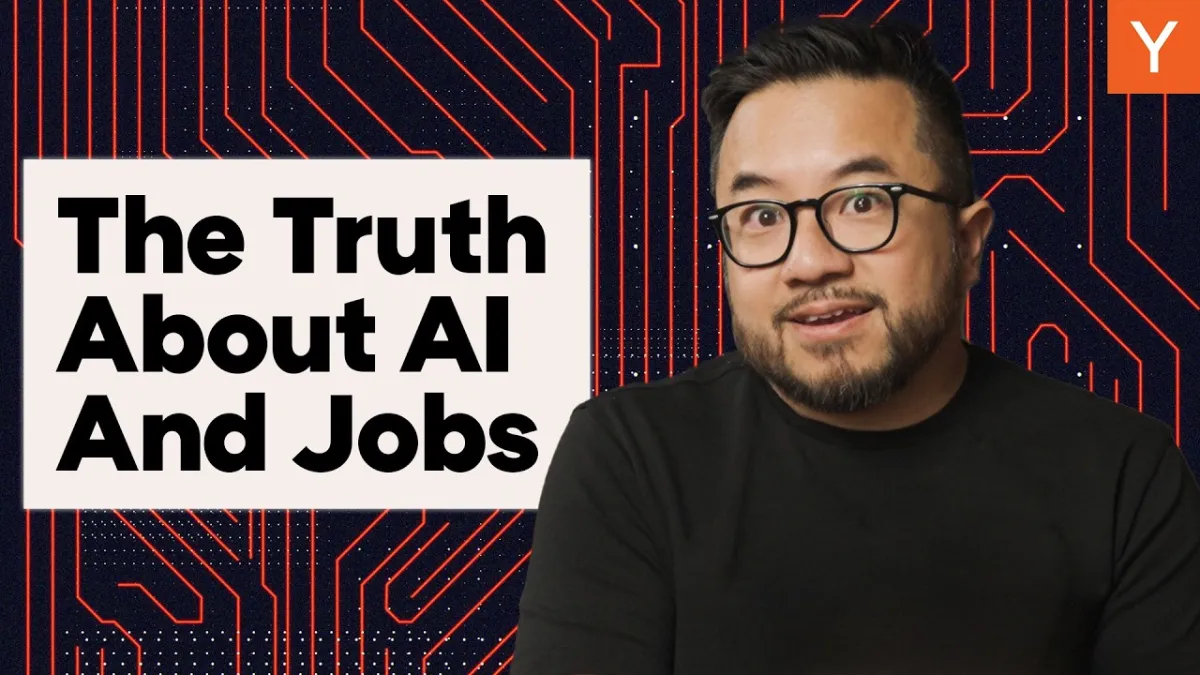
The future of work, often painted in stark contrasts of AI-driven utopia or dystopian unemployment, is far more nuanced than prevailing narratives suggest. Garry Tan, President & CEO of Y Combinator, recently presented a compelling argument refuting both extremes, positing that artificial intelligence, rather than eradicating human labor, is poised to redefine its very nature through a powerful economic principle: Jevons' Paradox.
Tan’s commentary addresses the prevailing hysteria surrounding AI and jobs, where "doomers" predict universal unemployment within years, while "deniers" dismiss AI as mere hype that won't fundamentally transform the economy. Both perspectives, he argues, are flawed. The truth, supported by historical and industrial evidence, points to a transformative, yet not destructive, impact.
A prime illustration of this dynamic comes from the field of radiology. In 2016, Geoffrey Hinton, a Turing Award winner and one of the "godfathers of AI," famously declared that people should "stop training radiologists now," confidently predicting that deep learning would surpass human capabilities in image analysis within five years. Yet, nearly a decade later, the demand for radiologists has not plummeted; it has reached an all-time high. This surge occurred despite the proliferation of sophisticated AI products capable of detecting and classifying hundreds of diseases faster and more accurately than humans.
What explains this counterintuitive outcome? Beyond industry-specific factors like malpractice concerns and regulatory requirements for human oversight, a more fundamental economic principle is at play. When AI makes a resource cheaper and faster to utilize, the demand for that resource, and the services associated with it, often explodes. This phenomenon is known as Jevons' Paradox.
Jevons' Paradox was first identified in mid-19th century England by economist William Stanley Jevons. He observed that technological improvements increasing the efficiency of coal usage paradoxically led to an *increase* in coal consumption across industries, rather than a decrease. This defied the contemporary assumption that efficiency would lower consumption, revealing instead a latent demand that surged once the cost barrier was reduced.
This pattern has recurred throughout technological history. When containerization drastically cut shipping costs by 90% in the 1960s, it initially displaced some dockworkers. However, this newfound efficiency fueled an explosion in global trade, giving rise to multi-billion-dollar empires in freight forwarding, logistics, and warehouse distribution. Similarly, the advent of cloud computing in the 2010s made IT infrastructure ten times cheaper. Far from eliminating IT roles, it transformed them; server administrators evolved into DevOps engineers and cloud architects, managing infrastructure at scales previously unimaginable.
Applying this historical lens to the current AI landscape, the implications are clear. As algorithmic advancements drive down the cost of inference, the demand for GPUs has skyrocketed, not cratered, with Nvidia's stock hitting all-time highs. This mirrors the pattern: making a core component of AI cheaper unlocks vast new applications and drives overall demand for the technology.
Aaron Levy, CEO and co-founder of Box, succinctly captures this insight: "The reason that AI isn't going to wipe out jobs in the way that some predict is that we consistently make the mistake of thinking that when we make something more efficient, you need commensurately less supply. It turns out that in a significant number of fields, better productivity levels actually means more demand for that service. This is the whole point of Jevons paradox. When the cost of doing work goes down, the demand for it goes up. And usually there's far more pent up demand than we realize."
This suggests that as AI makes tasks like analyzing medical images, drafting legal documents, or writing code cheaper, faster, and easier, the demand for the expertise of radiologists, lawyers, and engineers will broadly increase. The nature of their work will shift, but their overall value and necessity will expand. Andrej Karpathy, a co-founder of OpenAI, echoes this sentiment, suggesting that AI will first transform "jobs that look like repetition of one rote task, each task being relatively independent, closed (not requiring too much context), short [in time], forgiving (the cost of mistake is low), and of course automatable giving current [and digital] capability." He predicts that many such roles, instead of disappearing, will be refactored into supervisory or managerial positions, where humans oversee teams of AI agents.
Related Reading
- Automation's AI Infusion Reshapes Enterprise Efficiency
- AI Coding Tools Empower Small Teams to Punch Above Their Weight
- AI and error rate: Can machines replace human experts?
This transformation is already evident in companies emerging from Y Combinator. Avoca (W23), an AI-powered sales agent for service businesses like plumbing and HVAC, is freeing up customer service agents to engage in higher-value interactions that require human nuance. Tennr (W23), which automates the flow of paperwork between healthcare providers, is transforming administrative roles from tedious data entry to more complex patient care coordination and case management. These shifts elevate human involvement from rote, unenjoyable tasks to more engaging and impactful work.
For founders and tech leaders, the message is unequivocal. The AI transformation is real and rapidly accelerating. Don't underestimate its profound impact, nor should one indulge in fantasies of a fully automated luxury communism or an imminent economic collapse. The future of work is being built right now by those who perceive opportunities others miss. Every great company begins with a founder who embraces this conviction, taking the leap to shape the evolving landscape.