
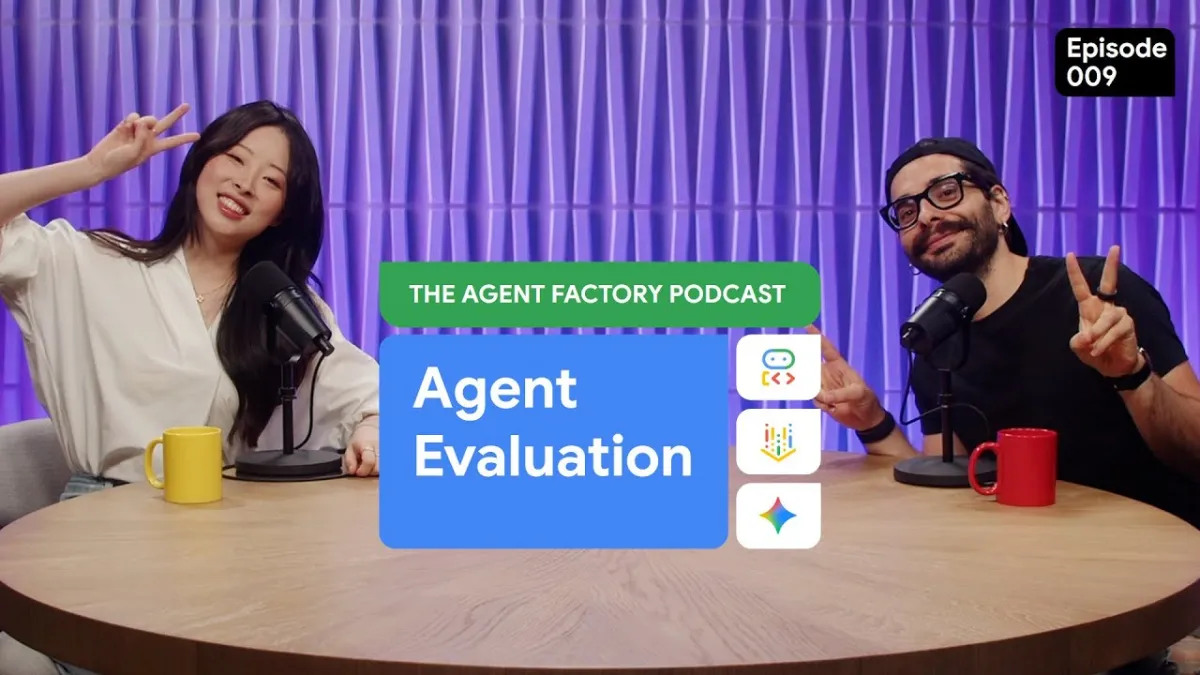
“LLM evaluation is like a school exam. You’re testing knowledge with static Q&A. But agent evaluation is more like a job performance review,” succinctly articulated Annie Wang, a Google Cloud AI Developer Advocate, during her discussion with Ivan Nardini, an AI/ML Developer Advocate for Vertex AI, on "The Agent Factory" podcast. This episode, focused on agent evaluation, peeled back the layers of what it truly means to assess the reliability and effectiveness of AI agents in production, highlighting the profound differences from traditional software testing and even standard Large Language Model (LLM) benchmarks.
Wang and Nardini, both experts from Google Cloud, convened to demystify the complex process of evaluating AI agents. Their conversation provided critical insights for founders, venture capitalists, and AI professionals, emphasizing that trusting an AI agent requires a nuanced approach that goes far beyond merely checking its final output. They delved into the intricacies of measuring system-level behavior, distinguishing agent evaluation from conventional testing paradigms, and presenting a comprehensive strategy utilizing Google’s Agent Development Kit (ADK) and Vertex AI.
A core insight emerging from their discussion is that agent evaluation must encompass the *entire system*, not just isolated components or outputs. Unlike deterministic software where the same input reliably yields the same output, AI agents are probabilistic and emergent. As Wang explained, "You can give the same prompt twice, but it might end up with two completely different outcomes." This inherent variability necessitates a shift from pass/fail unit tests to a holistic assessment of the agent’s dynamic behavior over time. Ivan underscored this, stating, "It's not just, you know, did it finish the job? It's, did it finish it well?" This focus on the quality of execution, including reasoning, tool use, and memory, is paramount.
The distinction between evaluating a foundational LLM and an LLM-powered agent is critical. While LLM benchmarks like MMLU assess a model's general knowledge, agent evaluation scrutinizes its ability to function autonomously within a system. Annie highlighted that "even if you have a really great model, your agent can still perform badly because the agent might not call API properly." This emphasizes that an agent’s real-world efficacy hinges on its orchestration, its capacity to use tools correctly, recover from errors, and maintain consistency across multi-turn interactions.
To effectively evaluate agents, Wang and Nardini advocate for a "full-stack approach" that measures every aspect of the agent’s operation. This includes assessing the final outcome for task completion, analyzing the agent's chain of thought for logical reasoning and planning, scrutinizing tool utilization for efficiency and correctness (avoiding redundant API calls), and verifying memory and context retention. They emphasized the importance of understanding if the agent recalls relevant information or resolves conflicting data appropriately.
The daily brief
Get the free daily brief with the day's AI news, new AI startups and funding rounds every morning.
Join 64,000 other subscribers.
The practical strategy for evaluation involves a combination of offline and online methods. Offline evaluation, conducted before production, leverages static "golden datasets" to catch regressions during development. Online evaluation, conversely, monitors live user data post-deployment, looking for drift or running A/B tests. The optimal approach, they argued, is a "calibration loop" that marries the accuracy of human judgment with the scalability of LLM-as-a-judge systems. This process starts with human experts creating small, high-quality golden datasets, then fine-tuning an LLM-as-a-judge to align its scoring with human expectations, thereby achieving both precision and scale.
Google's Agent Development Kit (ADK) Web UI provides a powerful tool for this "offline inner loop" development. Its interactive interface allows developers to quickly debug, create golden datasets, run evaluations, and trace an agent's step-by-step reasoning process. This visibility is invaluable for identifying root causes of failure, such as an ambiguous instruction leading to incorrect tool selection. For production-scale, "outer loop" evaluation, Vertex AI's GenAI Evaluation Service steps in, offering a robust platform for qualitative assessment, richer metrics, and dashboards to monitor agent performance in live environments.
Beyond single-agent evaluation, the discussion ventured into the complexities of multi-agent systems. Here, individual agent metrics can be misleading, as the collective performance hinges on seamless handoffs, shared context, and efficient communication between agents. As Annie pointed out, "single agent metrics can be totally misleading." The challenges extend to the "cold start problem", the scarcity of real-world evaluation data, which can be mitigated by synthetic data generation using LLMs. This multi-phase process involves LLMs generating realistic tasks, "expert agents" providing ideal solutions, and optionally, "weaker agents" offering imperfect attempts, all scored by an LLM-as-a-judge. The journey towards robust AI agents is not merely about building smarter models, but about building smarter, comprehensive evaluation frameworks that can truly vouch for their reliability in dynamic, real-world applications.





