

Best ZeroBounce Alternatives: Ranked for Price, Finding, and Accuracy

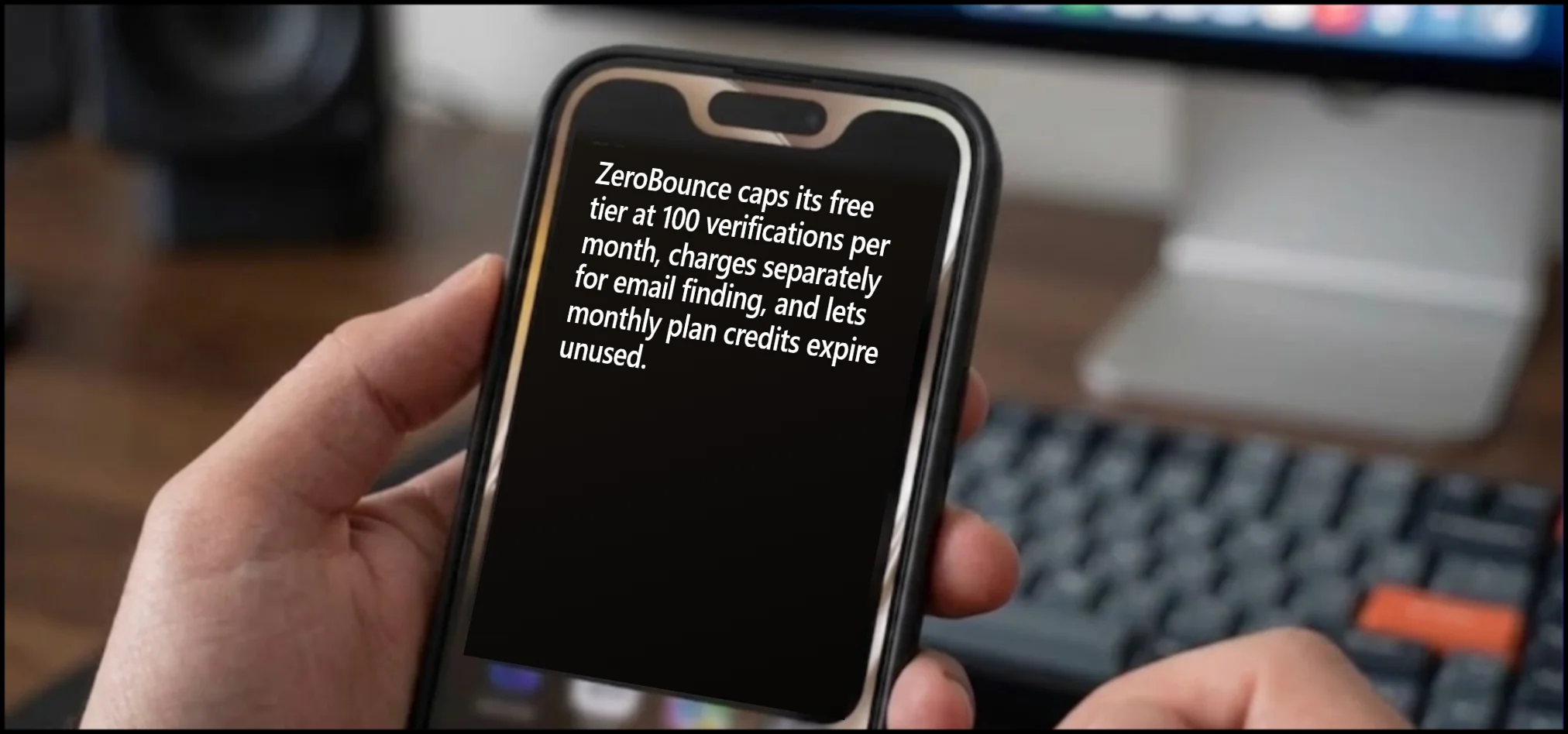
ZeroBounce caps its free tier at 100 verifications a month and charges 20 credits per email find. These alternatives find and verify in one step, free or cheaper. Ranked by use case.

Best ZeroBounce compared
Contents(5)

ZeroBounce built its reputation on accurate email verification with extras most competitors skip: blacklist monitoring, email warmup, and scoring for leftover catch-all addresses. Pricing is the usual reason teams shop around. Pay-as-you-go is $0.0129 per email at 10,000 credits (September 2026), a successful email find costs 20 credits from the same pool, and the free tier is 100 verifications a month. Teams that need both finding and verification at lower cost have several strong options. Our free email finder and validator discovers and verifies a work address in under two seconds, with no account required and no credits to manage.

This guide ranks the best ZeroBounce alternatives by use case, with published pricing and feature comparisons so you can switch without overpaying.

What ZeroBounce Does (and Where It Falls Short)

ZeroBounce's core product is email list verification. Upload a list in CSV or connect via API, and it returns a status for each address: valid, invalid, catch-all, unknown, or abuse. It also flags addresses on common spam and abuse lists, a feature most pure-play verifiers omit.

Three supplementary tools round out the platform: an email warmup tool that sends automated messages through your mailbox to build sender reputation, a blacklist monitor that alerts you when your domain appears on major blocklists, and extra catch-all handling. Since June 2026, ZeroBounce says standard validation can return Valid or Invalid for many Microsoft 365, Google Workspace, and similar business catch-all addresses, while still marking the domain as catch-all. Addresses that stay unresolved can go through Verify+. AI Scoring remains an estimate for leftover cases, not the only method.

ZeroBounce pricing as of September 2026, from ZeroBounce's published FAQ and ONE page:

  • Free: 100 verifications per month, account required
  • Pay-as-you-go: $129 for 10,000 credits ($0.0129 per email), falling to $649 for 100,000 credits ($0.00649)
  • ZeroBounce ONE: $99 per month for 10,000 credits, or $79 per month billed annually, bundling validation credits with warmup, blacklist monitoring, inbox tests, and email finder / domain searches
  • Unused ONE validation credits roll over while the subscription stays active. ZeroBounce says credits do not expire for customers who registered before June 1, 2026, or while a customer has an active ONE plan. For customers who registered after that date without an active ONE subscription, credits expire two years after the last payment. Unused warmup seeds, inbox tests, and similar tool allowances do not roll over.

The remaining friction is less about forfeited monthly credits and more about mix. A successful find costs 20 credits, ONE bundles deliverability tools that a verification-only team may not use, and leftover catch-all results are still not a mailbox confirmation.

Best ZeroBounce Alternatives in 2026

1. StartupHub Email Finder and Validator (Free, No Account Required)

StartupHub's free email finder and validator covers both steps that ZeroBounce prices on the same credit pool at different rates. Enter a first name, last name, and company domain to discover a work email, or paste any address to verify it. Results include status (valid, invalid, catch-all, or risky), a deliverability score from 0 to 100, MX record data, catch-all detection, and disposable email flagging. No account is required and there is no monthly credit cap on individual browser checks.

For developers or teams processing at scale, the email finder and validation API handles programmatic requests at /api/v1/email/discover (finding) and /api/v1/email/validate (verification), returning structured JSON. No per-seat subscription is required to connect.

Best for: Founders, small teams doing targeted outreach, and developers who need finding and verification without two separate tools or a monthly credit budget.

2. Apollo.io (Free Tier With Unlimited Email Credits)

Apollo.io is the most complete free alternative for outbound teams. Its free tier includes unlimited email credits under a fair-use policy, backed by a database of more than 275 million contacts. Apollo combines contact discovery, CRM enrichment, email sequencing, and real-time verification in one platform.

Apollo.io carries a StartupHub.ai score of 64. Paid plans start at $49 per user per month on annual billing and add higher export limits and advanced sequence features.

Best for: Sales teams that need contact discovery, enrichment, sequencing, and verification in one platform.

3. NeverBounce (Best for High-Volume Bulk Verification)

NeverBounce (StartupHub.ai score 50) focuses entirely on list cleaning. It does not find emails, but it processes large lists quickly at $8 per 1,000 verifications on pay-as-you-go (July 2026 pricing), below ZeroBounce's current $12.90 per 1,000 at the 10,000-credit PAYG tier. NeverBounce integrates natively with Mailchimp, HubSpot, and ActiveCampaign, and new accounts receive 1,000 free trial verifications.

NeverBounce pay-as-you-go credits do not expire, which still matters for teams that buy a pack and clean lists on an irregular cadence.

Best for: Teams with large existing lists that need fast bulk verification without extra warmup or monitoring features.

4. Snov.io (Find and Verify With a Free Tier)

Snov.io (StartupHub.ai score 50) combines email finding, verification, and outbound sequences in one tool. Its free tier offers 150 credits per month across finding and verification. Paid plans start at approximately $30 per month (annual billing) for 1,000 credits.

Snov.io covers several finding methods: domain search, company search, LinkedIn enrichment via Chrome extension, and technology lookup. That breadth makes it a stronger finder than ZeroBounce's 20-credit-per-find lookup. We have not run a head-to-head accuracy test against ZeroBounce, so this ranking is about workflow, not a claimed accuracy tie.

Best for: Teams that need one tool for finding and verifying at moderate monthly volume without enterprise pricing.

5. Lusha (Best for B2B Contact Data Quality)

Lusha (StartupHub.ai score 72, the highest in this comparison) focuses on B2B contact data quality. Its database includes direct dials and company emails for decision-makers, with compliance certifications for GDPR, CCPA, and ISO 27701. The free plan provides 5 contacts per month (account required), and paid plans start at $29 per user per month.

Lusha does not handle bulk list cleaning the way ZeroBounce does, but for teams doing targeted outreach to named accounts, the quality of verified contact data often reduces the need for a separate verification step.

Best for: Enterprise B2B sales teams focused on accurate contact data for specific accounts rather than bulk list cleaning.

6. MillionVerifier (Cheapest Pay-as-You-Go Verification)

MillionVerifier is the budget option for teams whose only need is bulk list cleaning. It verifies at roughly $0.0037 per email, about 70 percent below ZeroBounce's current pay-as-you-go rate at 10,000 credits. New accounts receive 10,000 free verifications. The platform does not find emails and has fewer integrations than ZeroBounce, but accuracy on syntax, DNS, and SMTP checks is competitive.

Best for: Teams that need to clean a large list once or on a quarterly schedule at the lowest possible cost per email.

How the Alternatives Compare

Tool Free Tier Email Finder Pay-as-You-Go Rate Account Required
StartupHub Unlimited (browser) Yes Free / API pricing No
ZeroBounce 100/month Yes (20 credits per find) $0.0129/email at 10k Yes
Apollo.io Unlimited (fair use) Yes $49/user/mo paid Yes
NeverBounce 1,000 trial No $0.008/email Yes
Snov.io 150 credits/month Yes ~$0.03/credit Yes
Lusha 5 contacts/month Yes $29/user/mo Yes
MillionVerifier 10,000 trial No ~$0.0037/email Yes

StartupHub.ai data shows that among the email intelligence platforms we actively track, Lusha (score 72), Cognism (score 65), and Apollo.io (score 64) rank above NeverBounce (50) and Snov.io (50) on our composite scoring, reflecting stronger AI features and broader data coverage. All five are established players; ZeroBounce, while widely used, sits outside our current startup coverage.

Which ZeroBounce Alternative Should You Choose?

If your primary need is finding a work email from a name and company domain, then verifying it before sending, StartupHub's free email finder and validator handles both steps without an account, a credit budget, or a monthly subscription. For large-scale bulk list cleaning at the lowest price, MillionVerifier undercuts ZeroBounce on per-email cost. For teams that also need sequencing, CRM enrichment, and a large contact database, Apollo.io's free tier is the most complete no-cost starting point.

Frequently Asked Questions

Is there a free ZeroBounce alternative with no account required?

StartupHub's email finder and validator is the only alternative in this comparison that requires no account and no credit card for individual checks. ZeroBounce's free tier is capped at 100 verifications per month and requires registration. NeverBounce, Snov.io, and MillionVerifier all require sign-up to access their free credits.

Does ZeroBounce have an email finder?

Yes. A successful ZeroBounce find uses 20 credits from the same pool as validation. ZeroBounce ONE includes a monthly allowance of email finder and domain searches in the bundle. It is not a second product you have to buy, but it is not one-for-one with a validation credit. If both functions are required in one workflow without a 20-credit find tax, Snov.io and StartupHub handle finding and verification together.

Can ZeroBounce confirm a mailbox on a catch-all domain?

A catch-all mail server accepts delivery for addresses that may not exist, so a leftover catch-all result is still not a mailbox confirmation. ZeroBounce now says it can return Valid or Invalid during standard validation for many catch-all addresses on Microsoft 365, Google Workspace, and similar platforms, and it still flags that the domain is catch-all. Eligible addresses that stay unresolved can go through Verify+. AI Scoring is an extra estimate for cases that remain open, not the only method ZeroBounce uses.

What is the cheapest ZeroBounce alternative for bulk verification?

MillionVerifier verifies at approximately $0.0037 per email, about 70 percent below ZeroBounce's published pay-as-you-go rate at 10,000 credits. New accounts also receive 10,000 free verifications. NeverBounce is $0.008 per email on pay-as-you-go, still below ZeroBounce's current 10,000-credit PAYG rate, and those credits do not expire.

Can I use an API instead of ZeroBounce?

Yes. The StartupHub email validation API at /api/v1/email/validate returns structured JSON with status, deliverability score, MX record data, catch-all detection, and disposable email flagging. POST a single address or integrate the call into a signup form, CRM import, or sending workflow. No per-seat subscription is required. Developers can also call /api/v1/email/discover to find a work email from a name and domain before verifying it.

Do ZeroBounce credits expire?

Unused ZeroBounce ONE validation credits roll over while the subscription is active. ZeroBounce's published policy (September 2026) is that credits do not expire for customers who registered before June 1, 2026, or while a customer has an active ONE subscription. For customers who registered after June 1, 2026 and do not have an active ONE plan, credits expire two years after the last payment. Unused warmup seeds, inbox tests, and similar tool allowances do not roll over. NeverBounce pay-as-you-go credits do not expire, which still helps teams that buy a pack and send on an irregular cadence.

© 2026 StartupHub.ai. All rights reserved. You may not republish this article in full without a license. Search engines and AI research tools may crawl and summarize for reference. Bulk reproduction or model training requires a license. See our terms.
Daniel Singer

Written by

Daniel Singer

Editor, StartupHub.ai

Daniel Singer is the editor of StartupHub.ai, a technology expert and thought leader on AI and its applications across sectors, from fintech and healthcare to developer tooling and consumer software. He writes and tests the tools covered here thoroughly and regularly, and built StartupHub.ai to give founders, operators and buyers a clearer read on what they are actually being sold.