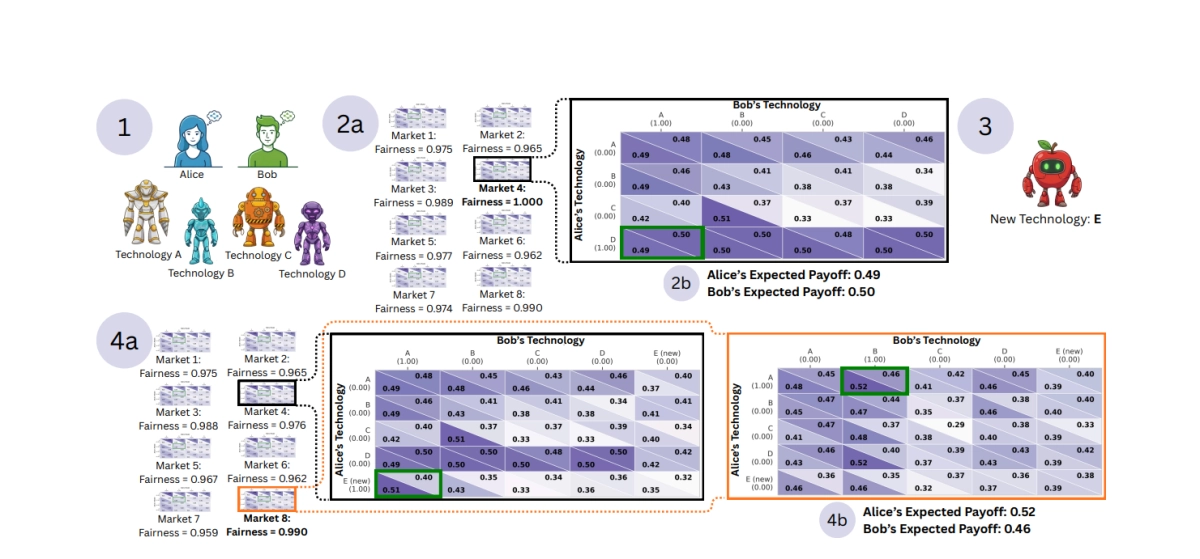
The future of economic regulation is facing a critical vulnerability: the strategic release of artificial intelligence. New research from Technion researchers Eilam Shapira, Moshe Tennenholtz, and Roi Reichart reveals a phenomenon they term the "Poisoned Apple Effect," demonstrating that the mere availability of a new AI technology, even if it is never used, can be deployed as a weapon to coerce market regulators into shifting the rules in favor of the releasing party.
This finding fundamentally challenges the assumption that expanding technological choice is inherently neutral or beneficial, suggesting that open-weight model releases and API availability could become instruments of regulatory arbitrage in the emerging era of Agentic Commerce.
The Vulnerability in Autonomous Negotiation
The integration of AI agents into global commerce, from complex corporate partnerships to routine real estate transactions, is rapidly accelerating. We are entering an age of Agentic Commerce, where software delegates autonomously execute negotiations, search for counterparties, and finalize contracts without human intervention.
While current regulatory focus centers on issues like model safety, bias, and catastrophic risk, this new economic analysis identifies a critical, overlooked vulnerability arising from the strategic expansion of the technology choice set itself.
The researchers modeled this interaction as a meta-game involving two economic agents, "Alice" and "Bob," and a regulator. The regulator’s primary function is to maximize social objectives, typically fairness or efficiency, by setting the rules of the market (e.g., the protocols of a digital marketplace or B2B platform). Alice and Bob, meanwhile, strategically select from a pool of available AI negotiation delegates (drawn from a set of 13 state-of-the-art LLMs like GPT-4o, Gemini, and LLaMA) to maximize their own utility in bargaining, bilateral trade, and persuasion scenarios.