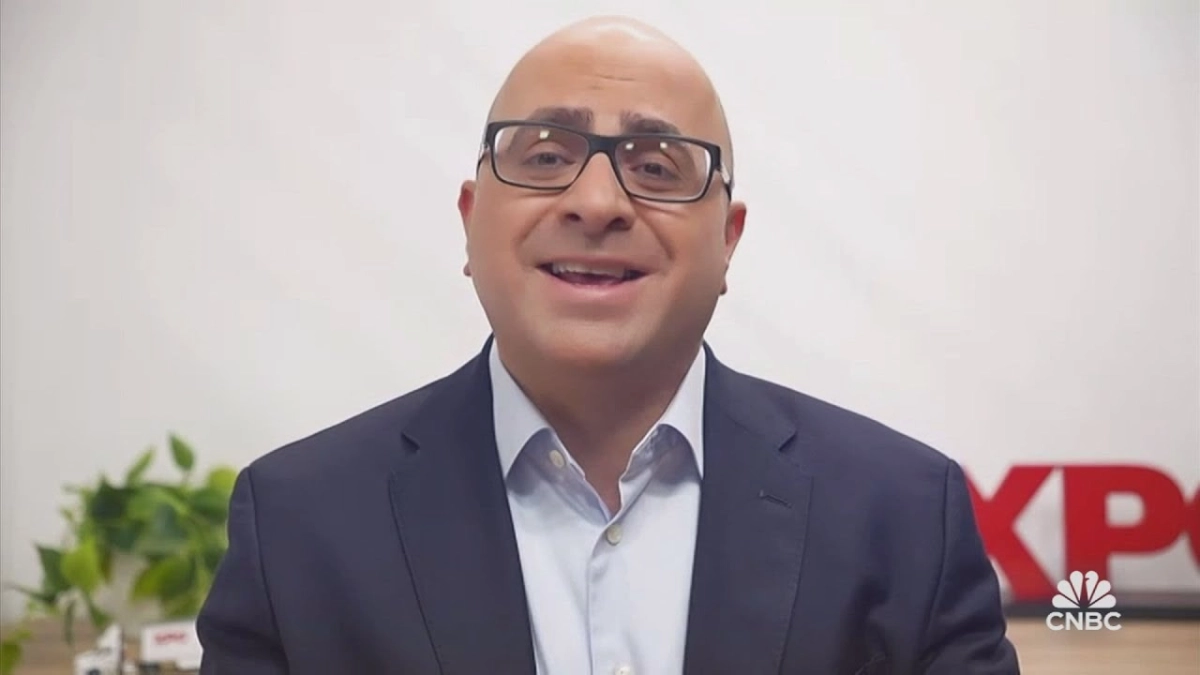
In an era where artificial intelligence often conjures images of job displacement, XPO CEO Mario Harik offers a refreshingly pragmatic perspective: AI, for his logistics giant, is fundamentally about efficiency and optimization, not headcount reduction. This insight anchored a recent interview on CNBC's Worldwide Exchange with anchor Frank Hollan, where Harik detailed XPO's latest earnings and the profound, yet nuanced, impact of AI on its operations amidst a challenging freight market. Harik, an MIT alumnus with degrees in computer science and engineering, speaks with the authority of someone deeply embedded in both the technological and operational realities of modern logistics, providing a compelling commentary for founders, VCs, and AI professionals.
XPO, a prominent less-than-truckload (LTL) carrier, reported a strong quarter, beating both top and bottom-line estimates. Harik attributed this success to a robust strategy that thrives even in a downturn. "Our strategy is working," he stated, emphasizing the company's achievement of "improving margin in the trough of the freight market, in a freight recession." This strategic resilience, he explained, stems from delivering best-in-class service, which in turn encourages customers to entrust XPO with more freight. A significant driver of this growth has been the expansion into the small-to-medium customer segment, with over 7,500 new clients added year-to-date, a testament to XPO's enhanced service product.
A critical component underpinning this performance is XPO's strategic deployment of artificial intelligence. Harik was explicit in clarifying the nature of this AI integration: "It's not the AI you hear about in terms of replacing people doing a certain amount of work. It's about efficiency, it's about optimization." This distinction is crucial for understanding how legacy industries are leveraging advanced technologies. For XPO, AI acts as an efficiency multiplier, allowing the company to extract more value from its existing network and workforce rather than diminishing it.
Consider the operational scale: XPO's line-haul network alone involves driving 2.6 million miles of freight every night across the U.S. and Canada. The application of AI here is not about autonomous trucks (a "very long runway," as Harik noted, especially given the multi-stop, customer-facing nature of LTL deliveries), but about optimizing the movement of that freight. Harik highlighted a tangible result: "We reduced our empty miles by 12%." This directly translates to lower costs, reduced fuel consumption, and improved environmental impact, demonstrating AI's immediate value in operational streamlining. Furthermore, AI assists XPO's sales force with "lead scoring," identifying and prioritizing potential customers who are the best fit for their LTL service capabilities, thereby enhancing sales productivity and network utilization.
The industrial economy, a significant segment for XPO with clients like Ford, Caterpillar, and 3M, remains in a contraction phase, with the ISM Manufacturing Index still below 50. Despite this, Harik expressed optimism for 2026, citing several macro levers. He noted that tariffs, while creating short-term uncertainty that led to deferred capital deployment in 2025, are ultimately "good medium to long term for the less than truckload industry." This is because tariffs incentivize domestic manufacturing, leading to increased movement of raw materials, parts, and finished goods within the country, all freight that moves on domestic trucks, a direct boon for LTL carriers.