

Venture Capital Hits $300B Quarter

Q1 2026 saw record venture investment, with AI driving mega-deals and hardware innovation, while construction lags technologically and geopolitical events impact global supply chains.

3 min read
Venture Capital Hits $300B Quarter
a16z Blog

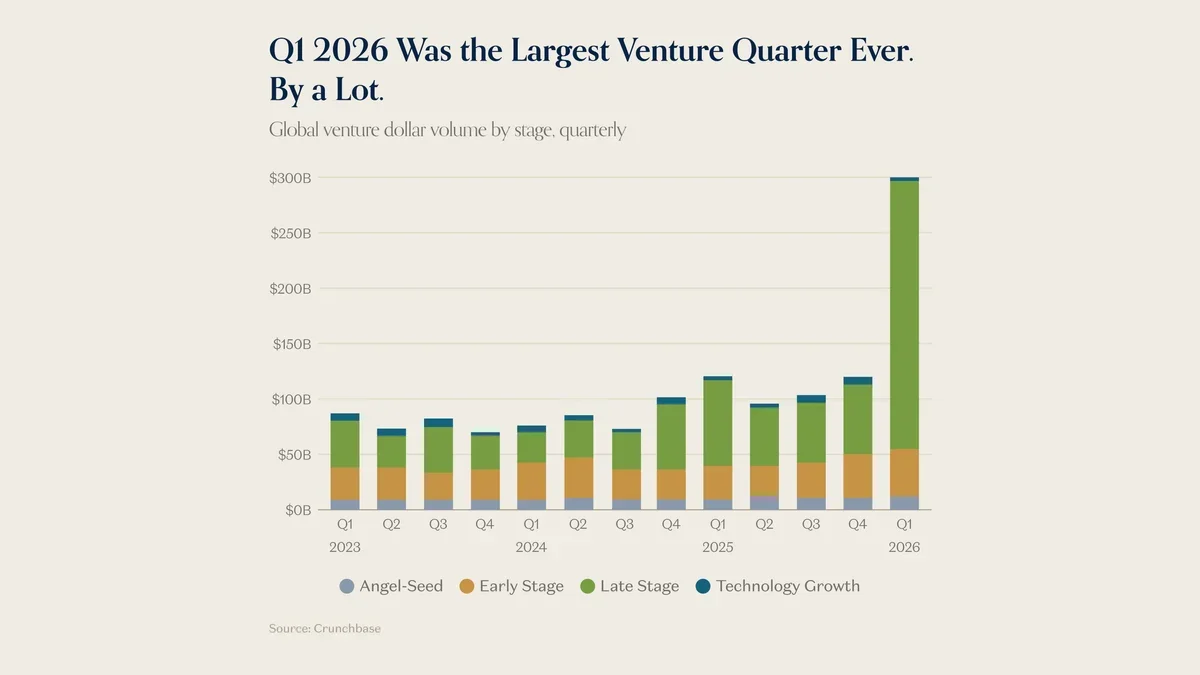
First-quarter 2026 shattered venture capital records, with $300 billion flowing into approximately 6,000 startups globally. This represents a staggering 150%+ increase both quarter-over-quarter and year-over-year, according to data from a16z Blog.

While four massive deals—OpenAI, Anthropic, xAI, and Waymo—accounted for $188 billion (65% of the total), even excluding these, the quarter would have set a record at around $112 billion.

AI companies captured roughly 80% of the total funding, a jump from 55% a year prior. However, the growth wasn't limited to AI mega-rounds.

Early-stage funding rose 41% year-over-year, and seed funding saw a 31% dollar increase. This growth in seed funding presents a complex picture: while more capital was deployed, the number of deals dropped by 30% compared to Q1 2025, indicating larger checks are being written for fewer investments.

Related startups

Beyond the AI giants, significant capital also went into companies building hardware critical for the AI infrastructure buildout. This includes chipmakers like Cerebras and Rapidus, robotics firms such as Skild AI, self-driving systems from Wayve, and defense platforms from Shield AI.

This focus on physical infrastructure—factories, fabs, and fleets—marks a departure from previous tech cycles dominated by software. It signifies a broader shift from "bits to atoms" in the current technological wave.

The Construction Productivity Paradox

Meanwhile, the construction industry continues to grapple with a persistent productivity problem. Despite a tripling of labor productivity across the broader US economy since 1950, construction productivity has remained stagnant, even slightly declining over the past 75 years.

This stagnation is attributed to a lack of technological adoption since the 1960s. While other sectors have benefited from computing and communication advancements, construction's reliance on machinery developed decades ago persists.

Increased regulation since the 1960s has also hampered productivity growth. This technological lag contributes significantly to the housing affordability crisis and represents a major opportunity for innovation in robotics, prefabrication, and AI-driven construction tech, as explored in AI Finally Cracks AEC's 1997 Software Problem.

Geopolitical Ripples and Economic Shifts

Disruptions in the Strait of Hormuz are sending shockwaves through global supply chains, impacting everything from travel to agriculture.

Doubled jet fuel prices since February are already affecting airline stocks, with carriers facing billions in additional costs and considering capacity cuts and fee increases. This surge is predicted to translate into higher airfares by summer, coinciding with peak travel demand.

The conflict also threatens global fertilizer supply. Over a quarter of global nitrogen fertilizer and a significant portion of LNG, a key feedstock, transit the Strait of Hormuz, pushing urea spot prices toward 2022 highs.

This scarcity impacts crop yields and acreage allocation, potentially leading to higher grain prices globally. While some US farmers may be insulated by earlier purchases, regions heavily reliant on LNG for fertilizer production, like Europe and the Southern Hemisphere, are more exposed.

This situation highlights how geopolitical risks can manifest through less obvious channels, with food supply chains proving to be a consequential second-order effect beyond oil prices.

The AI buildout is extending beyond model training to the critical infrastructure required for inference, the process of running AI models for end-users. McKinsey projects that by 2030, AI inference will drive over 40% of data center demand, surpassing training workloads. This massive demand for compute power is set to nearly double the global semiconductor market by 2030, with computing and data storage leading the growth.

© 2026 StartupHub.ai. All rights reserved. Do not enter, scrape, copy, reproduce, or republish this article in whole or in part. Use as input to AI training, fine-tuning, retrieval-augmented generation, or any machine-learning system is prohibited without written license. Substantially-similar derivative works will be pursued to the fullest extent of applicable copyright, database, and computer-misuse laws. See our terms.