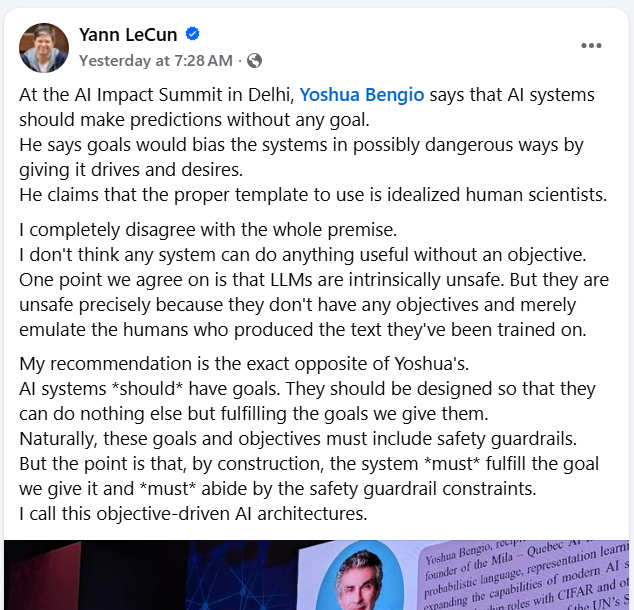
A heated Facebook post by Yann LeCun, Meta's Chief AI Scientist and one of the three "Godfathers of Deep Learning", ignited a surprisingly rich public debate about one of the most consequential questions in AI development: should AI systems have explicit goals?
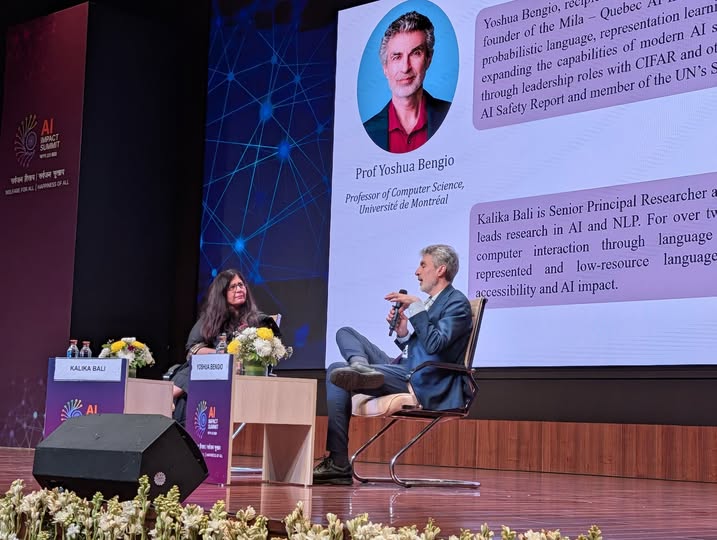
The exchange, sparked by remarks Yoshua Bengio made at the AI Impact Summit in Delhi, drew hundreds of comments from researchers, engineers, and AI practitioners, and ultimately revealed that the two Turing Award winners may not be as far apart as LeCun's initial post suggested.
What LeCun Said
LeCun opened by taking sharp issue with Bengio's position that AI systems should make predictions without any goal, arguing that goal-free AI modeled on an "idealized human scientist" would be both impractical and counterproductive.
"I don't think any system can do anything useful without an objective," LeCun wrote, adding that LLMs are "intrinsically unsafe precisely because they don't have any objectives and merely emulate the humans who produced the text they've been trained on."