

Together AI Pushes LLM Context Limits to 5 Million Tokens

Max Ryabinin from Together AI discusses breaking barriers in LLM training, detailing techniques to achieve 5 million token context lengths and their impact on memory and performance.

8 min read
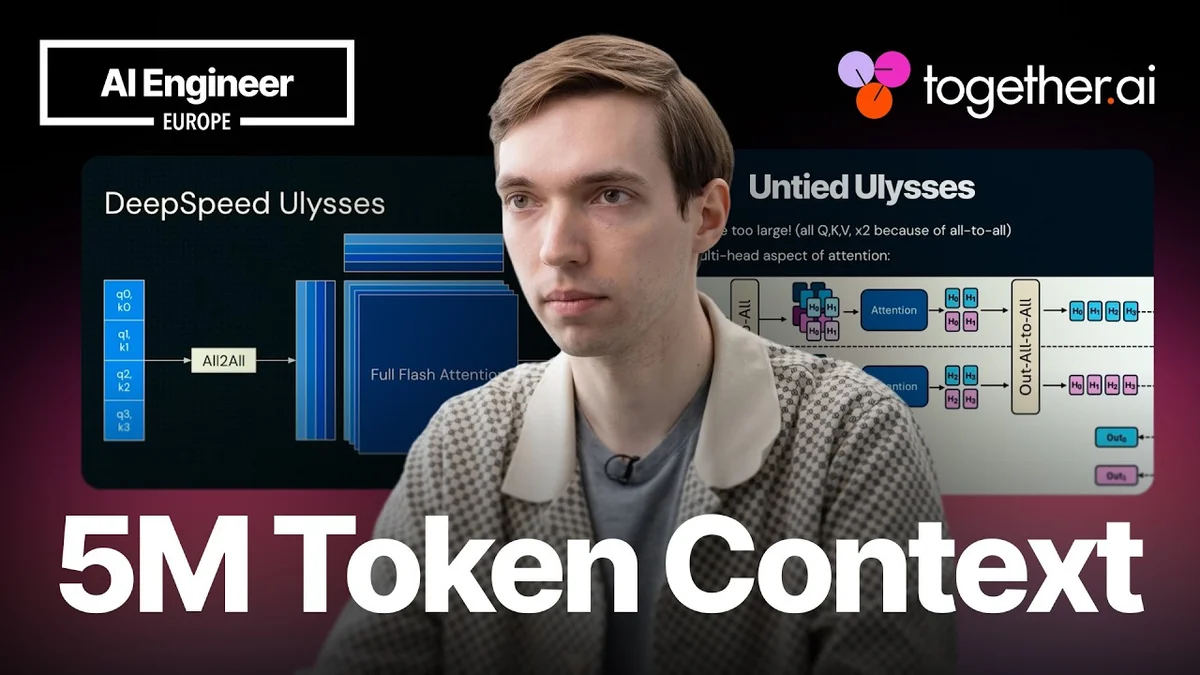
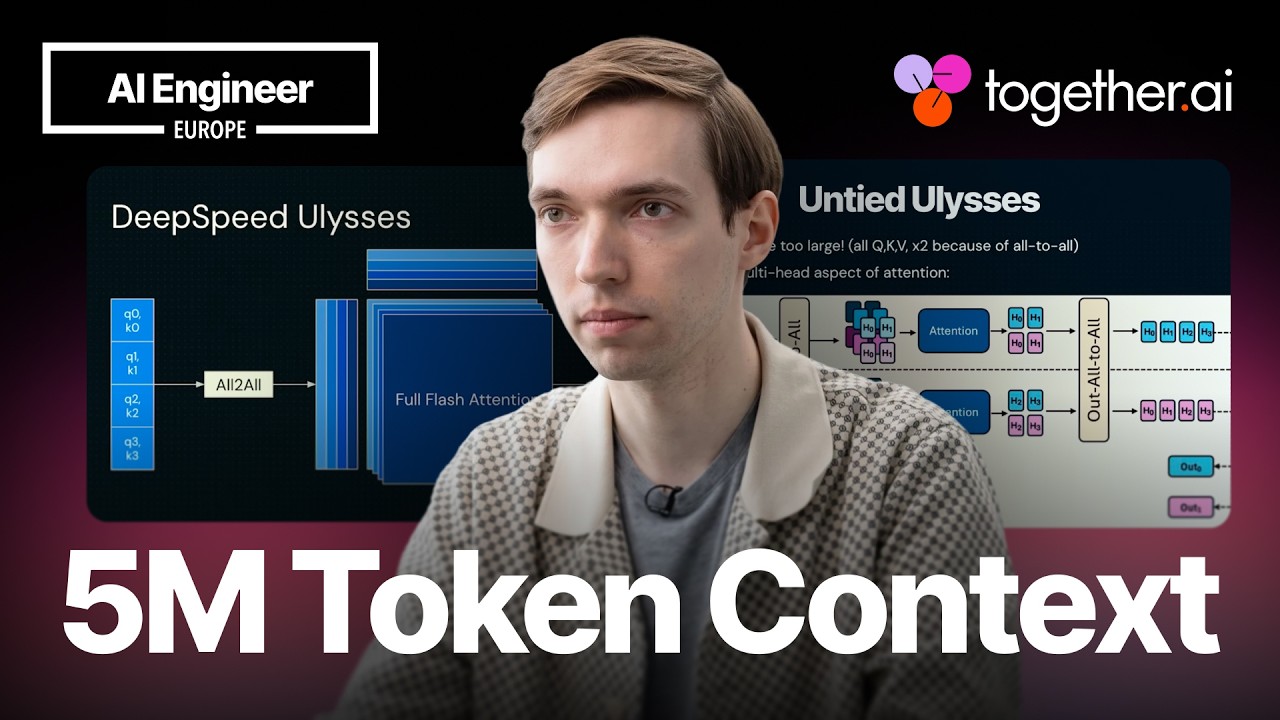
Max Ryabinin presenting on a stage about LLM context length
Max Ryabinin, VP R&D, Model Shaping at Together AI, discusses breaking barriers in long context LLM training.· AI Engineer

Max Ryabinin, VP of R&D and Model Shaping at Together AI, presented "Road to 5 Million Tokens: Breaking Barriers in Long Context Training" at AI Engineer Europe. The talk detailed the challenges and solutions involved in training large language models (LLMs) with extremely long context windows, aiming to push the boundaries beyond current capabilities.

Together AI Pushes LLM Context Limits to 5 Million Tokens - AI Engineer
Together AI Pushes LLM Context Limits to 5 Million Tokens — from AI Engineer

Visual TL;DR. Demand for Long Context leads to Transformer Bottlenecks. Transformer Bottlenecks addressed by Together AI's Role. Together AI's Role develops New Training Techniques. New Training Techniques enables Pushing Context Limits. Pushing Context Limits leads to Impact on Performance. Pushing Context Limits informs Future Directions.

  1. Demand for Long Context: growing need for LLMs to process vast amounts of text
  2. Transformer Bottlenecks: quadratic computation, linear memory complexity with sequence length
  3. Together AI's Role: AI Native Cloud provider for GPU, model shaping, inference
  4. New Training Techniques: methods to overcome memory and computational limitations
  5. Pushing Context Limits: achieving 5 million token context lengths
  6. Impact on Performance: improved memory and computational efficiency
  7. Future Directions: further advancements in LLM context capabilities
Visual TL;DR
Visual TL;DR — startuphub.ai Demand for Long Context leads to Transformer Bottlenecks. Transformer Bottlenecks addressed by Together AI's Role. Together AI's Role develops New Training Techniques. New Training Techniques enables Pushing Context Limits addressed by develops enables Demand for Long Context Transformer Bottlenecks Together AI's Role New Training Techniques Pushing Context Limits From startuphub.ai · The publishers behind this format
Visual TL;DR — startuphub.ai Demand for Long Context leads to Transformer Bottlenecks. Transformer Bottlenecks addressed by Together AI's Role. Together AI's Role develops New Training Techniques. New Training Techniques enables Pushing Context Limits addressed by develops enables Demand for LongContext TransformerBottlenecks Together AI'sRole New TrainingTechniques Pushing ContextLimits From startuphub.ai · The publishers behind this format
Visual TL;DR — startuphub.ai Demand for Long Context leads to Transformer Bottlenecks. Transformer Bottlenecks addressed by Together AI's Role. Together AI's Role develops New Training Techniques. New Training Techniques enables Pushing Context Limits addressed by develops enables Demand for Long Context growing need for LLMs to process vastamounts of text Transformer Bottlenecks quadratic computation, linear memorycomplexity with sequence length Together AI's Role AI Native Cloud provider for GPU, modelshaping, inference New Training Techniques methods to overcome memory andcomputational limitations Pushing Context Limits achieving 5 million token context lengths From startuphub.ai · The publishers behind this format
Visual TL;DR — startuphub.ai Demand for Long Context leads to Transformer Bottlenecks. Transformer Bottlenecks addressed by Together AI's Role. Together AI's Role develops New Training Techniques. New Training Techniques enables Pushing Context Limits addressed by develops enables Demand for LongContext growing need forLLMs to processvast amounts of… TransformerBottlenecks quadraticcomputation, linearmemory complexity… Together AI'sRole AI Native Cloudprovider for GPU,model shaping,… New TrainingTechniques methods to overcomememory andcomputational… Pushing ContextLimits achieving 5 milliontoken contextlengths From startuphub.ai · The publishers behind this format
Visual TL;DR — startuphub.ai Demand for Long Context leads to Transformer Bottlenecks. Transformer Bottlenecks addressed by Together AI's Role. Together AI's Role develops New Training Techniques. New Training Techniques enables Pushing Context Limits. Pushing Context Limits leads to Impact on Performance. Pushing Context Limits informs Future Directions addressed by develops enables leads to informs Demand for Long Context growing need for LLMs to process vastamounts of text Transformer Bottlenecks quadratic computation, linear memorycomplexity with sequence length Together AI's Role AI Native Cloud provider for GPU, modelshaping, inference New Training Techniques methods to overcome memory andcomputational limitations Pushing Context Limits achieving 5 million token context lengths Impact on Performance improved memory and computationalefficiency Future Directions further advancements in LLM contextcapabilities From startuphub.ai · The publishers behind this format
Visual TL;DR — startuphub.ai Demand for Long Context leads to Transformer Bottlenecks. Transformer Bottlenecks addressed by Together AI's Role. Together AI's Role develops New Training Techniques. New Training Techniques enables Pushing Context Limits. Pushing Context Limits leads to Impact on Performance. Pushing Context Limits informs Future Directions addressed by develops enables leads to informs Demand for LongContext growing need forLLMs to processvast amounts of… TransformerBottlenecks quadraticcomputation, linearmemory complexity… Together AI'sRole AI Native Cloudprovider for GPU,model shaping,… New TrainingTechniques methods to overcomememory andcomputational… Pushing ContextLimits achieving 5 milliontoken contextlengths Impact onPerformance improved memory andcomputationalefficiency Future Directions furtheradvancements in LLMcontext… From startuphub.ai · The publishers behind this format

Together AI's Approach to Long Context Training

Ryabinin began by outlining Together AI's role as an AI Native Cloud provider, offering services from GPU clusters to model shaping and inference. He emphasized the growing demand for LLMs that can process and understand vast amounts of text, driving the need for longer context lengths.

Related startups

The primary challenges in training models with long context lengths stem from the inherent computational and memory complexities of transformer architectures. Standard transformers exhibit quadratic complexity in computation and linear complexity in memory with respect to the sequence length. This means that as the context window grows, the resources required for training increase dramatically, often leading to out-of-memory (OOM) errors.

Addressing Memory and Computational Bottlenecks

Ryabinin highlighted several key techniques employed to overcome these limitations. Fully Sharded Data Parallelism (FSDP) is a crucial method for distributing model parameters, gradients, and optimizer states across multiple GPUs, thereby reducing the memory footprint on each individual GPU. This allows for the training of larger models or the use of longer sequences.

The presentation then introduced DeepSpeed Ulysses, a system designed for efficient training of extreme-length transformer models. Ulysses employs a technique where attention computations are untied, allowing for the parallel processing of different attention heads across multiple GPUs. This strategy helps to manage the memory burden associated with processing long sequences.

Activation checkpointing was also discussed as a vital optimization. This technique reduces memory usage by recomputing activations during the backward pass rather than storing them all in memory. While this increases computation time, it significantly alleviates memory constraints, enabling the training of models with much larger context windows.

Pushing Towards 5 Million Tokens

The talk showcased empirical results demonstrating the effectiveness of these methods. Initial experiments with a Llama 3-8B model showed that standard training runs out of memory with 3 million tokens. Applying FSDP alone reduced memory usage but still resulted in OOM errors. The combination of FSDP with Ulysses and activation checkpointing (AC) brought the memory usage down to 15.0 GB, allowing for successful training.

Further experiments with a larger Qwen 32B model and 5 million tokens illustrated the cumulative benefits of these techniques. By stacking FSDP, Ulysses, activation checkpointing, and a custom approach called "UPIPE" (which involves tiling large matrix multiplications along the sequence axis), Together AI achieved significant memory savings. The UPIPE approach, in particular, allowed for the reuse of intermediate buffers across different stages of computation, further optimizing memory usage.

The results presented clearly indicated that training with larger chunk sizes in these memory-efficient methods leads to both reduced memory consumption and increased throughput, demonstrating the scalability of these approaches.

Key Takeaways and Future Directions

Ryabinin summarized the key takeaways: training models with large context lengths is challenging, bottlenecks can appear unexpectedly, and tools like the PyTorch Memory Profiler are invaluable for debugging. He also pointed to their research paper for further details on their methods, including "untied Ulysses" and "UPIPE," which allow for more efficient parallelization of attention computations across multiple heads and GPUs.

The presentation concluded by highlighting the potential for these advancements to unlock new possibilities in LLM applications, enabling models to process and understand much larger documents, codebases, and datasets.

© 2026 StartupHub.ai. All rights reserved. Do not enter, scrape, copy, reproduce, or republish this article in whole or in part. Use as input to AI training, fine-tuning, retrieval-augmented generation, or any machine-learning system is prohibited without written license. Substantially-similar derivative works will be pursued to the fullest extent of applicable copyright, database, and computer-misuse laws. See our terms.