Figma's Coding Agents Playbook Without Garbage

Figma engineer Alon Blum shares how verification, planning and attention-aware docs let coding agents ship 5x faster without trashing quality.

6 min read
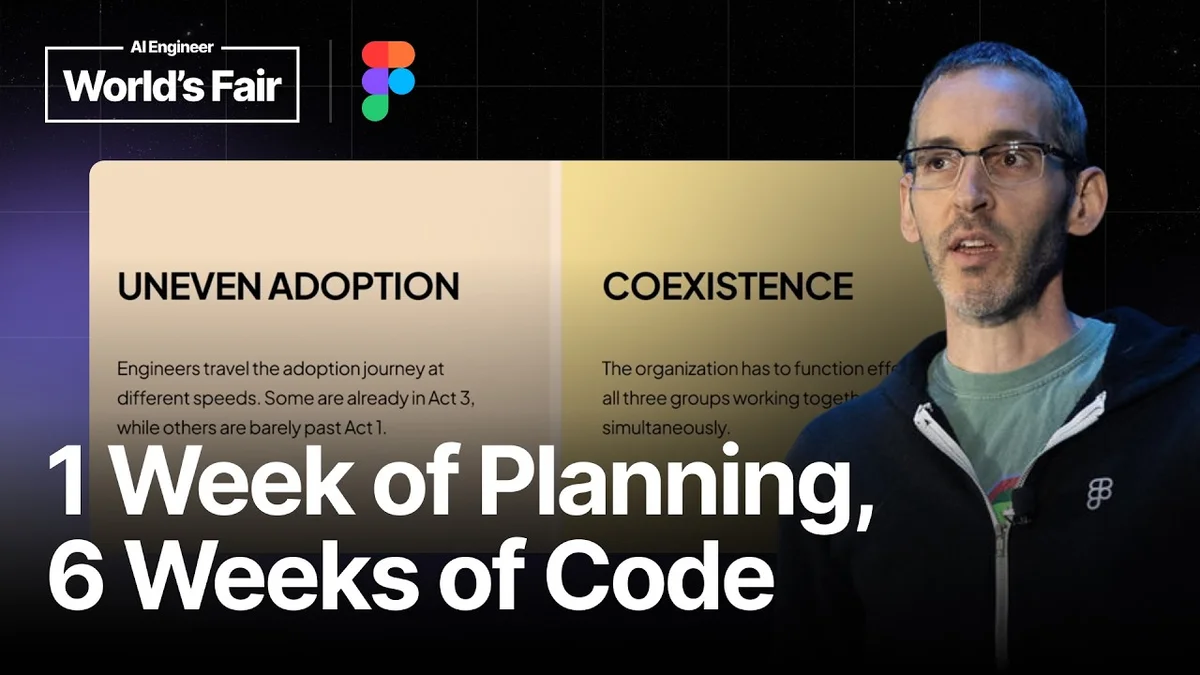
Figma engineer presenting coding agents adoption playbook on stage
Alon Blum details how Figma ships with agents without sacrificing code quality.· AI Engineer
Visual TL;DR
Prompt‑wait burnoutDriver
engineers stuck in prompt and wait loop lose flow and satisfaction
Verification first agentsCore
figma agents treat verification as their primary task rather than relying on prompts alone
From the article 3 mentionsAlon Blum says Figma cracked coding agents by making verification, not prompting, the core job, according to AI Engineer.
Planning restores craftContext
engineers write attention aware docs that guide agents before coding begins
From the articlePlanning versus prompting became Figma's fix for agency loss, replacing live coding joy with the craft of writing a plan.
5x faster shippingOutcome
teams ship code five times quicker while maintaining quality standards
Prompt‑wait burnoutDriver
engineers stuck in prompt and wait loop lose flow and satisfaction
Verification first agentsCore
figma agents treat verification as their primary task rather than relying on prompts alone
From the article 3 mentionsAlon Blum says Figma cracked coding agents by making verification, not prompting, the core job, according to AI Engineer.
Planning restores craftContext
engineers write attention aware docs that guide agents before coding begins
From the articlePlanning versus prompting became Figma's fix for agency loss, replacing live coding joy with the craft of writing a plan.
Uneven adoptionContext
some teams fully transformed while others remain skeptical or experimental
From the article 2 mentionsInside Figma that adoption is uneven, with some teams fully transformed and others stuck in experiment or skepticism.
5x faster shippingOutcome
teams ship code five times quicker while maintaining quality standards
Coexistence requiredEffect
product must ship despite mixed agent and human workflows across teams
From the articleThose groups must still ship one product, so coexistence matters more than a single mandated workflow.
Contents(9)

Alon Blum says Figma cracked coding agents by making verification, not prompting, the core job, according to AI Engineer.

Figma's Coding Agents Playbook Without Garbage - AI Engineer
Figma's Coding Agents Playbook Without Garbage, from AI Engineer

Figma (NYSE:FIG) is now the browser editor where design, engineering and AI ship together, and Blum spoke as a software engineer on its internal rollout.

Three acts and uneven reality

Blum describes adoption in three acts: quick wins at 10x, then failure on bigger problems as trust breaks, then real skill with guardrails and context.

Inside Figma that adoption is uneven, with some teams fully transformed and others stuck in experiment or skepticism.

Those groups must still ship one product, so coexistence matters more than a single mandated workflow.

Where the friction actually shows

Reduced agency pushes engineers from flow state into a prompt-and-wait loop that hurts satisfaction and accelerates burnout.

The best engineers get hit hardest because they carry unwritten institutional context and become bottlenecks holding back bad agent output.

Communication bloat follows, with design docs growing three to four times longer and email volume doubling or tripling without adding substance.

Why verification beats prompting

Blum calls left-shifting verification the highest value move, letting agents check what humans used to.

When Playwright and MCP arrived, agents could explore the codebase themselves instead of humans clicking through it.

Anything an agent proves useful at should be encoded into a deterministic check to save tokens, time and reasoning.

Writing code test-first in red to green style also works better, because the agent aims at a goal instead of fitting tests to already-written code.

The pyramid that saves human review

Blum maps this to the classic testing pyramid, pushing as much as possible down to deterministic analysis like linting, compiler and unit tests.

Architectural standards that can be codified move to agent review, leaving humans to judge only what humans must: whether this is the right thing to build.

Planning restores craft

Planning versus prompting became Figma's fix for agency loss, replacing live coding joy with the craft of writing a plan.

Teams now spend a week drafting, debating and reviewing a detailed plan, then hand it to agents for implementation.

A good plan starts with a why to prevent drift, breaks into small independently verifiable phases sized to a single reviewable PR, and gates each phase so errors do not compound.

Blum showed a result of about 20 PRs, each 10 to 100 lines and nothing larger, where work that once took a week of coding plus a week of alignment with three teams shipped overnight from the plan.

Their complaints map exactly where validation is missing and tools fail, and fixing that list restores their trust.

Attention is the scarce resource

In an AI-saturated org, human attention does not scale, so Blum pushes attention-aware communication.

His team marks what was written by hand versus generated, putting a short human summary at the top of every PR description so readers know where to focus and where to be suspicious.

Blum learned this after sending AI-assisted analysis of PR comments without clear labeling and hearing senior skeptics call it sloppy, a mistake he now fixes with explicit provenance.

Low-friction entry points help too, like tagging an agent in Slack to close the loop in thread, which normalizes use without mandating fancy workflows.

Why this matters beyond Figma

Every engineering org faces the same pressure seen with GitHub Copilot, Cursor, Windsurf and Devin: agents can write fast but quality collapses without verification.

Figma's answer reframes productivity from prompt tricks to system design, deterministic gates and reviewable slice size.

That shift decides who wins: teams that codify standards and plans outrun teams that chase agent autonomy without guardrails.

How Figma compares

StartupHub.ai data shows Figma scores 66/100, behind Canva at 77/100 but ahead of Cord at 56/100, Vizcom at 55/100, Dessn at 51/100 and Paper at 38/100.

StartupHub.ai data also notes Figma's verified early financing as $3.8M Seed in 2013, a useful anchor for a company now navigating an AI-first rebuild while public.

Against those peers the lesson travels: design-heavy platforms compete on workflow reliability, not just generation speed.

Blum is explicit that Figma has not finished this journey, with automation and long-horizon cloud agents still constrained by dependencies.

© 2026 StartupHub.ai. All rights reserved. Do not enter, scrape, copy, reproduce, or republish this article in whole or in part. Use as input to AI training, fine-tuning, retrieval-augmented generation, or any machine-learning system is prohibited without written license. Substantially-similar derivative works will be pursued to the fullest extent of applicable copyright, database, and computer-misuse laws. See our terms.