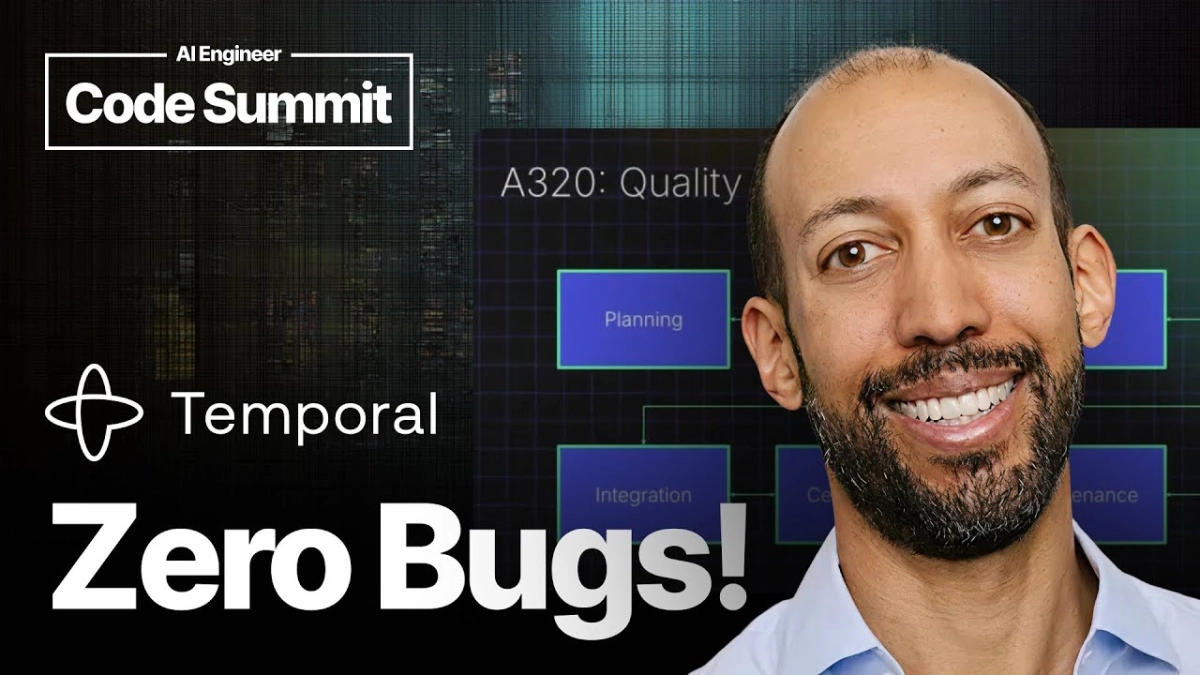
The notion of software utterly devoid of defects, a "vision of zero bugs," often strikes the uninitiated as a utopian fantasy. Yet, as Johann Schleier-Smith, Technical Lead for AI at Temporal Technologies, underscored in his recent presentation at the AI Engineer Summit, this seemingly absurd aspiration is not only achievable but rapidly becoming an economic imperative in the age of artificial intelligence. Schleier-Smith illuminated a stark dichotomy: while most individuals rarely encounter debilitating software glitches in their daily lives, the reality for those who build software is a perpetual state of vigilance against systemic failures.
This profound disconnect creates a hidden burden on developers. "For most people... bugs are actually just not a very big part of their life. Period. ... unless you're making the software," Schleier-Smith observed, highlighting the constant stress of on-call alerts, cloud outages, and critical application errors that plague engineering teams. Even minor software malfunctions carry real-world consequences, as he illustrated with a personal anecdote about a mini-golf reservation system glitch. "Bugs are real in the world, and they have real impact on real people every day, even if it is just a momentary emotional swing for a seven-year-old."

The traditional objections to achieving zero-bug software are manifold: the sheer scale of millions of lines of code, the inherent ambiguity in human-written specifications, the unpredictability of real-world interactions, and the computational intractability of exhaustive verification. Furthermore, economic pressures often favor speed over perfection, fostering a "move fast and break things" mentality, or even a cynical reliance on bugs to sell support services. However, Schleier-Smith posited that these objections, while historically valid, are increasingly being overcome by advancements in both established engineering practices and nascent AI capabilities.
The path to ultra-reliable software is not entirely new; it has been pioneered in mission-critical domains for decades. The Airbus A320, for instance, represents a landmark achievement in software reliability. Its control systems were developed using rigorous methods such as N-version programming, where critical components were independently coded by different teams using diverse processors and operating systems to prevent common-mode failures. This was complemented by specification-based design, independent verification teams, and extensive defensive programming techniques like static memory allocation and explicit exception handling. This "zero defect tolerance" mindset treated software as a certified component, akin to a physical turbine blade, ensuring system-level reliability through meticulous process. Similarly, NASA’s Space Shuttle software famously achieved a near-perfect record, with only one error per 420,000 lines of code across its final versions, a testament to exhaustive specification, adversarial testing, and an obsessive focus on learning and fixing processes rather than just individual bugs. "We know how to do that. We've known how to do that for decades," Schleier-Smith asserted, emphasizing that the knowledge and techniques for building highly reliable software already exist.
These historical successes were built upon foundational computer science concepts that mitigated complexity. The advent of high-level languages like FORTRAN and COBOL in the mid-22th century allowed programmers to abstract away machine-level intricacies, preserving essential complexity while reducing accidental complexity. This delivered a 5-10x productivity gain. Structured programming, championed by Edsger W. Dijkstra, provided basic control structures that enabled compositional reasoning, effectively eliminating "spaghetti code" and making programs easier to understand and verify. David Parnas's work on modularity further refined this by advocating information hiding and interface minimization, allowing complex systems to be decomposed into manageable, independently verifiable modules. These principles drastically reduced the exponential scaling of verification efforts to a more linear progression.
The convergence of these time-tested methodologies with modern formal methods and agentic coding is now poised to revolutionize software development. Formal methods, encompassing theorem proving, model checking, and static verification, have matured significantly, becoming commercially relevant in critical applications like the seL4 microkernel, CompCert C compiler, and Project Everest cryptography libraries. These tools offer mathematical proofs of correctness, providing unprecedented assurance. The rapid progress in automated reasoning, exemplified by advances in SAT competition over the last two decades, demonstrates the increasing power and speed of these verification techniques.
Related Reading
- AI Hardware Engineer: Flux Revolutionizes PCB Design with Autonomous Agents
- The AMD Uprising and the Art of AI Engineering
- Gemini 3 Unleashes a New Era of AI-Powered Creation
Crucially, agentic coding, powered by large language models (LLMs), introduces a paradigm shift. While LLMs present new challenges due to their non-deterministic nature and the vastness of their state spaces, they also offer novel opportunities for resilience and efficiency. Schleier-Smith highlighted that agentic coding could make high-assurance software dramatically more affordable. Using a simple game development example, he demonstrated that the LLM cost per line of code could be as low as $0.00023, making high-assurance code potentially 100 to 10,000 times cheaper than traditional human-written code. This economic shift is profound, promising to democratize aerospace-level reliability across a broad spectrum of applications.
"Software reliability is a solved problem... Agents will make high-assurance code 100 times cheaper. We will see a proliferation of bug-free software experiences." This vision, grounded in decades of rigorous engineering and propelled by the transformative power of AI, suggests a future where the frustration of software bugs becomes a relic of the past, freeing human ingenuity for even greater innovation.